Exercise 1: BSTree operations For this exercise you'll implement three additional methods in the binary search...
Exercise 1: BSTree operations
For this exercise you'll implement three additional methods in the binary search tree data structure completed in class, so that you have an opportunity to practice both using the recursive pattern covered in class and navigating the binary tree structure.
The methods you'll implement are:
- count_less_than: takes an argument x, and returns the number of elements in the tree with values less than x
- successor: takes an argument x, and returns the smallest value from the tree that is larger than x (note that x itself does not need to be in the tree); if there are no values larger than x, returns None
- descendants: takes an argument x, and returns all descendants of x in the tree (i.e., all values in the subtree rooted at x), ordered by value; if x has no descendants or does not exist in the tree, returns an empty list
The cell below contains the (read-only) BSTree implementation from lecture. Beneath that is the cell containing the methods you will be implementing, followed by unit test cells.
In [ ]:
class BSTree:
class Node:
def __init__(self, val, left=None, right=None):
self.val = val
self.left = left
self.right = right
def __init__(self):
self.size = 0
self.root = None
def __contains__(self, val):
def contains_rec(node):
if not node:
return False
elif val < node.val:
return contains_rec(node.left)
elif val > node.val:
return contains_rec(node.right)
else:
return True
return contains_rec(self.root)
def add(self, val):
assert(val not in self)
def add_rec(node):
if not node:
return BSTree.Node(val)
elif val < node.val:
return BSTree.Node(node.val, left=add_rec(node.left),
right=node.right)
else:
return BSTree.Node(node.val, left=node.left,
right=add_rec(node.right))
self.root = add_rec(self.root)
self.size += 1
def __delitem__(self, val):
assert(val in self)
def delitem_rec(node):
if val < node.val:
node.left = delitem_rec(node.left)
return node
elif val > node.val:
node.right = delitem_rec(node.right)
return node
else:
if not node.left and not node.right:
return None
elif node.left and not node.right:
return node.left
elif node.right and not node.left:
return node.right
else:
# remove the largest value from the left subtree as a
replacement
# for the root value of this tree
t = node.left # refers to the candidate for removal
if not t.right:
node.val = t.val
node.left = t.left
else:
n = t
while n.right.right:
n = n.right
t = n.right
n.right = t.left
node.val = t.val
return node
self.root = delitem_rec(self.root)
self.size -= 1
def __iter__(self):
def iter_rec(node):
if node:
yield from iter_rec(node.left)
yield node.val
yield from iter_rec(node.right)
return iter_rec(self.root)
def __len__(self):
return self.size
def pprint(self, width=64):
"""Attempts to pretty-print this tree's contents."""
height = self.height()
nodes = [(self.root, 0)]
prev_level = 0
repr_str = ''
while nodes:
n,level = nodes.pop(0)
if prev_level != level:
prev_level = level
repr_str += '\n'
if not n:
if level < height-1:
nodes.extend([(None, level+1), (None, level+1)])
repr_str += '{val:^{width}}'.format(val='-',
width=width//2**level)
elif n:
if n.left or level < height-1:
nodes.append((n.left, level+1))
if n.right or level < height-1:
nodes.append((n.right, level+1))
repr_str += '{val:^{width}}'.format(val=n.val,
width=width//2**level)
print(repr_str)
def height(self):
"""Returns the height of the longest branch of the tree."""
def height_rec(t):
if not t:
return 0
else:
return max(1+height_rec(t.left), 1+height_rec(t.right))
return height_rec(self.root)
class BSTree(BSTree):
def count_less_than(self, x):
=============your code here======================
def successor(self, x):
=============your code
here======================
def descendants(self, x):
=============your code
here======================
Test cases...
t = BSTree()
for x in [6, 3, 5, 4, 7, 1, 2, 9, 8, 0]:
t.add(x)
assert t.count_less_than(6) == 6
assert t.count_less_than(0) == 0
assert t.count_less_than(9) == 9
assert t.count_less_than(100) == 10
assert t.count_less_than(-100) == 0
t = BSTree()
for x in [6, 3, 5, 4, 7, 1, 2, 9, 8, 0]:
t.add(x)
assert t.successor(6) == 7
assert t.successor(6.5) == 7
assert t.successor(4) == 5
assert t.successor(5) == 6
assert t.successor(8) == 9
assert t.successor(-1) == 0
assert t.successor(9) is None
assert t.successor(10) is None
t = BSTree()
for x in [6, 3, 5, 4, 7, 1, 2, 9, 8, 0]:
t.add(x)
assert t.descendants(6) == [0, 1, 2, 3, 4, 5, 7, 8, 9]
assert t.descendants(3) == [0, 1, 2, 4, 5]
assert t.descendants(7) == [8, 9]
assert t.descendants(1) == [0, 2]
assert t.descendants(0) == []
assert t.descendants(8) == []
assert t.descendants(100) == []
assert t.descendants(-100) == []
Homework Answers
Note:
- "Screen shot of the code" for better understanding.
- "Code to copy" for run the program in your IDE.
- Please follow the code indentation properly to avoid indentation errors.
Code Image:
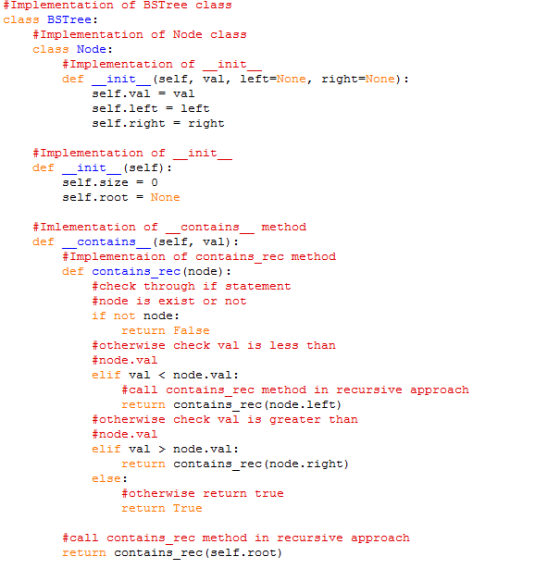
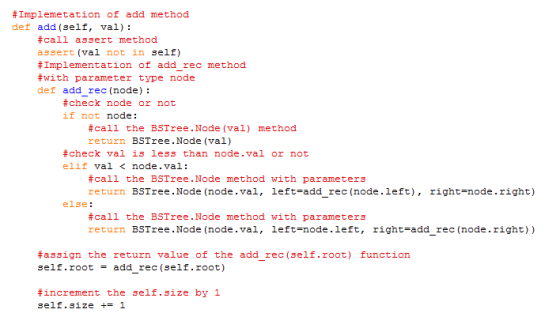
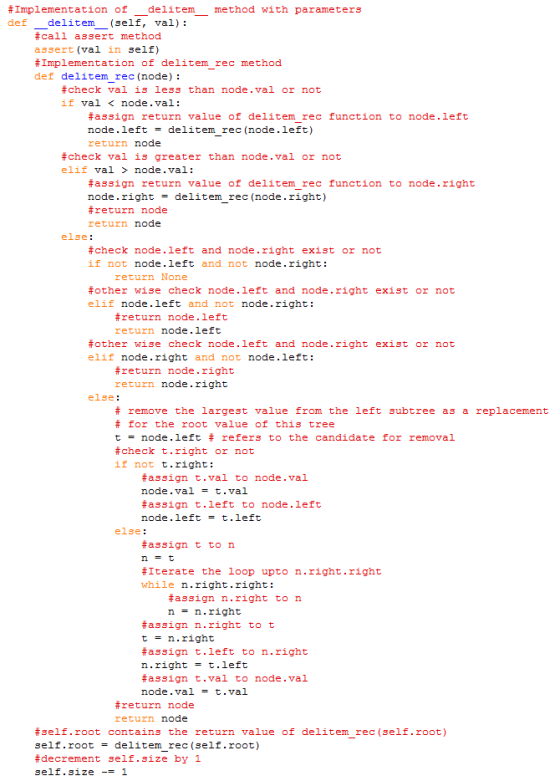
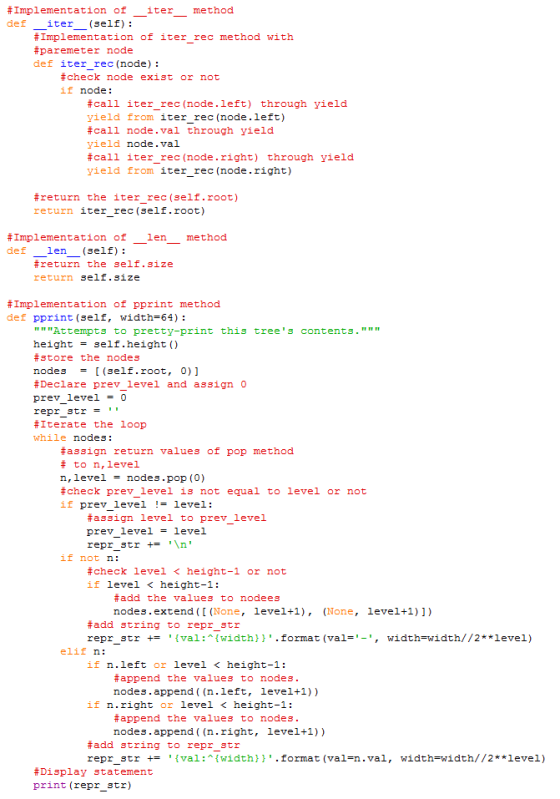
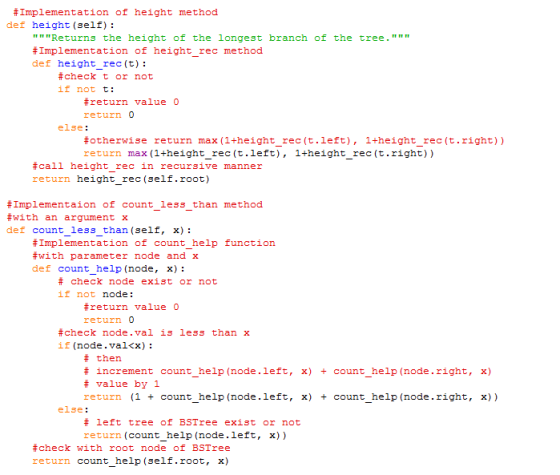
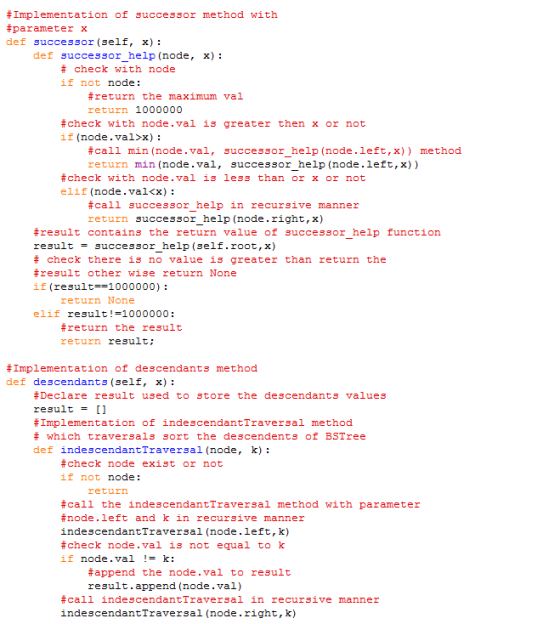
Sample Output:
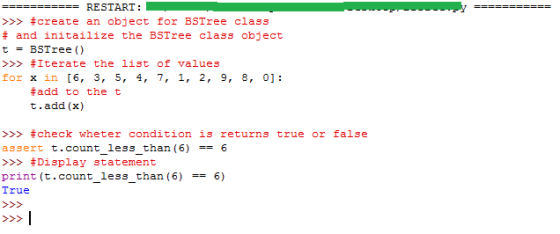
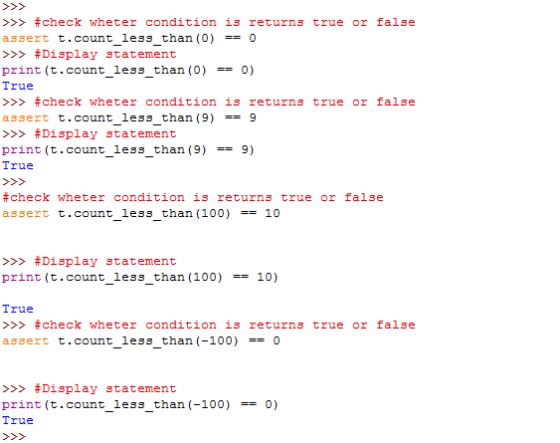
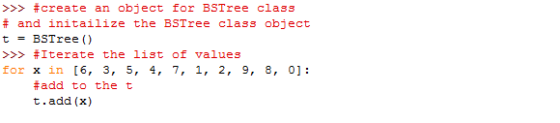
Code to Copy:
#Implementation of BSTree class
class BSTree:
#Implementation of Node class
class Node:
#Implementation of __init__
def __init__(self, val, left=None, right=None):
self.val = val
self.left = left
self.right = right
#Implementation of __init__
def __init__(self):
self.size = 0
self.root = None
#Imlementation of __contains__ method
def __contains__(self, val):
#Implementaion of contains_rec method
def contains_rec(node):
#check through if statement
#node is exist or not
if not node:
return False
#otherwise check val is less than
#node.val
elif val < node.val:
#call contains_rec method in recursive approach
return contains_rec(node.left)
#otherwise check val is greater than
#node.val
elif val > node.val:
return contains_rec(node.right)
else:
#otherwise return true
return True
#call contains_rec method in recursive approach
return contains_rec(self.root)
#Implemetation of add method
def add(self, val):
#call assert method
assert(val not in self)
#Implementation of add_rec method
#with parameter type node
def add_rec(node):
#check node or not
if not node:
#call the BSTree.Node(val) method
return BSTree.Node(val)
#check val is less than node.val or not
elif val < node.val:
#call the BSTree.Node method with parameters
return BSTree.Node(node.val, left=add_rec(node.left), right=node.right)
else:
#call the BSTree.Node method with parameters
return BSTree.Node(node.val, left=node.left, right=add_rec(node.right))
#assign the return value of the add_rec(self.root) function
self.root = add_rec(self.root)
#increment the self.size by 1
self.size += 1
#Implementation of __delitem__ method with parameters
def __delitem__(self, val):
#call assert method
assert(val in self)
#Implementation of delitem_rec method
def delitem_rec(node):
#check val is less than node.val or not
if val < node.val:
#assign return value of delitem_rec function to node.left
node.left = delitem_rec(node.left)
return node
#check val is greater than node.val or not
elif val > node.val:
#assign return value of delitem_rec function to node.right
node.right = delitem_rec(node.right)
#return node
return node
else:
#check node.left and node.right exist or not
if not node.left and not node.right:
return None
#other wise check node.left and node.right exist or not
elif node.left and not node.right:
#return node.left
return node.left
#other wise check node.left and node.right exist or not
elif node.right and not node.left:
#return node.right
return node.right
else:
# remove the largest value from the left subtree as a replacement
# for the root value of this tree
t = node.left # refers to the candidate for removal
#check t.right or not
if not t.right:
#assign t.val to node.val
node.val = t.val
#assign t.left to node.left
node.left = t.left
else:
#assign t to n
n = t
#Iterate the loop upto n.right.right
while n.right.right:
#assign n.right to n
n = n.right
#assign n.right to t
t = n.right
#assign t.left to n.right
n.right = t.left
#assign t.val to node.val
node.val = t.val
#return node
return node
#self.root contains the return value of delitem_rec(self.root)
self.root = delitem_rec(self.root)
#decrement self.size by 1
self.size -= 1
#Implementation of __iter__ method
def __iter__(self):
#Implementation of iter_rec method with
#paremeter node
def iter_rec(node):
#check node exist or not
if node:
#call iter_rec(node.left) through yield
yield from iter_rec(node.left)
#call node.val through yield
yield node.val
#call iter_rec(node.right) through yield
yield from iter_rec(node.right)
#return the iter_rec(self.root)
return iter_rec(self.root)
#Implementation of __len__ method
def __len__(self):
#return the self.size
return self.size
#Implementation of pprint method
def pprint(self, width=64):
"""Attempts to pretty-print this tree's contents."""
height = self.height()
#store the nodes
nodes = [(self.root, 0)]
#Declare prev_level and assign 0
prev_level = 0
repr_str = ''
#Iterate the loop
while nodes:
#assign return values of pop method
# to n,level
n,level = nodes.pop(0)
#check prev_level is not equal to level or not
if prev_level != level:
#assign level to prev_level
prev_level = level
repr_str += '\n'
if not n:
#check level < height-1 or not
if level < height-1:
#add the values to nodees
nodes.extend([(None, level+1), (None, level+1)])
#add string to repr_str
repr_str += '{val:^{width}}'.format(val='-', width=width//2**level)
elif n:
if n.left or level < height-1:
#append the values to nodes.
nodes.append((n.left, level+1))
if n.right or level < height-1:
#append the values to nodes.
nodes.append((n.right, level+1))
#add string to repr_str
repr_str += '{val:^{width}}'.format(val=n.val, width=width//2**level)
#Display statement
print(repr_str)
#Implementation of height method
def height(self):
"""Returns the height of the longest branch of the tree."""
#Implementation of height_rec method
def height_rec(t):
#check t or not
if not t:
#return value 0
return 0
else:
#otherwise return max(1+height_rec(t.left), 1+height_rec(t.right))
return max(1+height_rec(t.left), 1+height_rec(t.right))
#call height_rec in recursive manner
return height_rec(self.root)
#Implementaion of count_less_than method
#with an argument x
def count_less_than(self, x):
#Implementation of count_help function
#with parameter node and x
def count_help(node, x):
# check node exist or not
if not node:
#return value 0
return 0
#check node.val is less than x
if(node.val<x):
# then
# increment count_help(node.left, x) + count_help(node.right, x)
# value by 1
return (1 + count_help(node.left, x) + count_help(node.right, x))
else:
# left tree of BSTree exist or not
return(count_help(node.left, x))
#check with root node of BSTree
return count_help(self.root, x)
#Implementation of successor method with
#parameter x
def successor(self, x):
def successor_help(node, x):
# check with node
if not node:
#return the maximum val
return 1000000
#check with node.val is greater then x or not
if(node.val>x):
#call min(node.val, successor_help(node.left,x)) method
return min(node.val, successor_help(node.left,x))
#check with node.val is less than or x or not
elif(node.val<x):
#call successor_help in recursive manner
return successor_help(node.right,x)
#result contains the return value of successor_help function
result = successor_help(self.root,x)
# check there is no value is greater than return the
#result other wise return None
if(result==1000000):
return None
elif result!=1000000:
#return the result
return result;
#Implementation of descendants method
def descendants(self, x):
#Declare result used to store the descendants values
result = []
#Implementation of indescendantTraversal method
# which traversals sort the descendents of BSTree
def indescendantTraversal(node, k):
#check node exist or not
if not node:
return
#call the indescendantTraversal method with parameter
#node.left and k in recursive manner
indescendantTraversal(node.left,k)
#check node.val is not equal to k
if node.val != k:
#append the node.val to result
result.append(node.val)
#call indescendantTraversal in recursive manner
indescendantTraversal(node.right,k)
call the output statements:
>>> #create an object for BSTree class
# and initailize the BSTree class object
t = BSTree()
>>> #Iterate the list of values
for x in [6, 3, 5, 4, 7, 1, 2, 9, 8, 0]:
#add to the t
t.add(x)
>>> #check wheter condition is returns true or false
assert t.count_less_than(6) == 6
>>> #Display statement
print(t.count_less_than(6) == 6)
>>>
>>> #check wheter condition is returns true or false
assert t.count_less_than(0) == 0
>>> #Display statement
print(t.count_less_than(0) == 0)
>>> #check wheter condition is returns true or false
assert t.count_less_than(9) == 9
>>> #Display statement
print(t.count_less_than(9) == 9)
>>>
#check wheter condition is returns true or false
assert t.count_less_than(100) == 10
>>> #Display statement
print(t.count_less_than(100) == 10)
>>> #check wheter condition is returns true or false
assert t.count_less_than(-100) == 0
>>> #Display statement
print(t.count_less_than(-100) == 0)
>>>
>>>
>>> #create an object for BSTree class
# and initailize the BSTree class object
t = BSTree()
>>> #Iterate the list of values
for x in [6, 3, 5, 4, 7, 1, 2, 9, 8, 0]:
#add to the t
t.add(x)
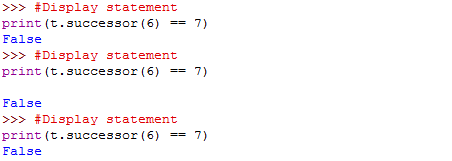
>>> #Display statement
print(t.successor(6) == 7)
>>> #Display statement
print(t.successor(6) == 7)
>>> #Display statement
print(t.successor(6) == 7)
>>> #Display statement
print(t.successor(4) == 5)
>>> #Display statement
print(t.successor(5) == 6)
>>> #Display statement
print(t.successor(8) == 9)
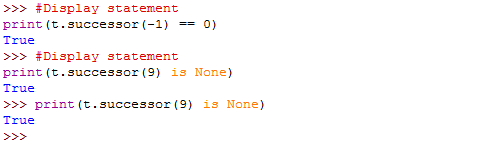
>>> #Display statement
print(t.successor(-1) == 0)
True
>>> #Display statement
print(t.successor(9) is None)
>>> print(t.successor(9) is None)
>>>
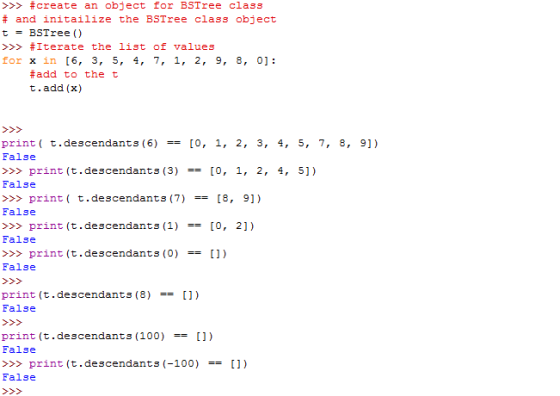
>>> #create an object for BSTree class
# and initailize the BSTree class object
t = BSTree()
>>> #Iterate the list of values
for x in [6, 3, 5, 4, 7, 1, 2, 9, 8, 0]:
#add to the t
t.add(x)
>>>
print( t.descendants(6) == [0, 1, 2, 3, 4, 5, 7, 8, 9])
>>> print(t.descendants(3) == [0, 1, 2, 4, 5])
>>> print( t.descendants(7) == [8, 9])
>>> print(t.descendants(1) == [0, 2])
>>> print(t.descendants(0) == [])
>>>
print(t.descendants(8) == [])
>>>
print(t.descendants(100) == [])
>>> print(t.descendants(-100) == [])
>>>
Add Answer to:
Exercise 1: BSTree operations
For this exercise you'll implement three additional methods in
the binary search...
(Please help me with Coding in Python3) AVLTree complete the following implementation of the balanced (AVL)...
(Please help me with Coding in Python3) AVLTree complete the following implementation of the balanced (AVL) binary search tree. Note that you should not be implementing the map-based API described in the plain (unbalanced) BSTree notebook — i.e., nodes in the AVLTree will only contain a single value. class AVLTree: class Node: def __init__(self, val, left=None, right=None): self.val = val self.left = left self.right = right def rotate_right(self): n = self.left self.val, n.val = n.val, self.val self.left, n.left, self.right, n.right...
Python question. How do i make this code work? im trying to print the value of...
Python question. How do i make this code work? im trying to print the value of the nodes using the level order trasversal class Node: def __init__(self, x): self.val = x self.left = None self.right = None class BinarySearchTree: def insertNode(self, value): self.root = self._insert(self.root, value) def levelOrderTraversal(self, root): if root is None: return [] result, current = [], [root] while current: next_level, vals = [], [] for node in current: vals.append(node.val) if node.left: next_level.append(node.left) if node.right: next_level.append(node.right) current...
PYTHON: Conan is writing a module to contain different implementations of trees. After his first tree,...
PYTHON: Conan is writing a module to contain different implementations of trees. After his first tree, the BinaryTreeclass, he wrote test code and is having problems understanding the error. Locate his problem and explain how you would fix it. class Node(object): def __init__(self, data=None): self.data = data def __str__(self): return "NODE: " + str(self.data) class Tree(object): def __init__(self): self.root_node = None self.size = 0 def __len__(self): return self.size def add(self, data): raise NotImplementedError("Add method not implemented.") def inorder_traversal(self): raise NotImplementedError("inorder_traversal...
Python Program Only: Write the function definition only of the "get(self, index)" function. Plug your method...
Python Program Only: Write the function definition only of the "get(self, index)" function. Plug your method in the code file shared with you and test it in the main to get the element at index 3 of mylist2 . class Node: def __init__(self, e): self.element = e self.next = None class LinkedList: def __init__(self): self.head = None self.tail = None self.size = 0 def addFirst(self, e): newNode = Node(e) newNode.next = self.head self.head = newNode self.size = self.size + 1...
Implement the class MaxHeapPriorityQueue as a heap with the following operations: • MaxHeapPriorityQueue() creates a new...
Implement the class MaxHeapPriorityQueue as a heap with the following operations: • MaxHeapPriorityQueue() creates a new heap that is empty. It needs no parameters and returns nothing. Note that as discussed in the video lecture, the index range of the array implementation of a heap is 1:n, NOT 0:n-1 • parent(index) returns the value of the parent of heap[index]. index is between 1 and the size of the heap. If index<=1 or index>size of the heap, it returns None •...
Implement the class MaxHeapPriorityQueue as a heap with the following operations using python: - ...
Implement the class MaxHeapPriorityQueue as a heap with the following operations using python: - MaxHeapPriorityQueue() creates a new heap that is empty. It needs no parameters and returns nothing. - parent(index) returns the value of the parent of heap[index]. index is between 1 and the size of the heap. If index<=1 or index>size of the heap, it returns None - leftChild(index) returns the value of the left child of heap[index], returns None if there is no value - rightChild(index) returns...
PYTHON QUESTION... Building a Binary Tree with extended Binary Search Tree and AVL tree. Create a...
PYTHON QUESTION... Building a Binary Tree with extended Binary Search Tree and AVL tree. Create a class called MyTree with the methods __init__(x), getLeft(), getRight(), getData(), insert(x) and getHeight(). Each child should itself be a MyTree object. The height of a leaf node should be zero. The insert(x) method should return the node that occupies the original node's position in the tree. Create a class called MyBST that extends MyTree. Override the method insert(x) to meet the definitions of a...
C++ (Using Binary Search Trees) other methods will result in downvote Implement the binary search tree...
C++ (Using Binary Search Trees) other methods will result in downvote Implement the binary search tree methods (bst.cpp) for the binary search tree provided in the header file. Test your implementation with the included test. bst.h bst_test.cpp Note: Your implementation must correspond to declarations in the header file, and pass the test. Do not modify these two. I will compile your code against these. If the compilation fails, you will get down vote. bst.h #ifndef BINARY_SEARCH_TREE_H #define BINARY_SEARCH_TREE_H #include <string>...
Previous code: class BinarySearchTree: def __init__(self, data): self.data = data self.left = None self.right = None de...
 Previous code:
class BinarySearchTree:
def __init__(self, data):
self.data = data
self.left = None
self.right = None
def search(self, find_data):
if self.data == find_data:
return self
elif find_data < self.data and self.left != None:
return self.left.search(find_data)
elif find_data > self.data and self.right != None:
return self.right.search(find_data)
else:
return None
def get_left(self):
return self.left
def get_right(self):
return self.right
def set_left(self, tree):
self.left = tree
def set_right(self, tree):
self.right = tree
def set_data(self, data):
self.data = data
def get_data(self):
return self.data
def traverse(root,order):...
Previous code:
class BinarySearchTree:
def __init__(self, data):
self.data = data
self.left = None
self.right = None
def search(self, find_data):
if self.data == find_data:
return self
elif find_data < self.data and self.left != None:
return self.left.search(find_data)
elif find_data > self.data and self.right != None:
return self.right.search(find_data)
else:
return None
def get_left(self):
return self.left
def get_right(self):
return self.right
def set_left(self, tree):
self.left = tree
def set_right(self, tree):
self.right = tree
def set_data(self, data):
self.data = data
def get_data(self):
return self.data
def traverse(root,order):...
BST JAVA FILE import java.util.*; public class BST <E extends Comparable <E>> { private TreeNode<E>...
BST JAVA FILE import java.util.*; public class BST <E extends Comparable <E>> { private TreeNode<E> overallRoot; public BST() { overallRoot = null; } // ************ ADD ************ // public void add(E addThis) { if (overallRoot == null) { overallRoot = new TreeNode<>(addThis); } else { add(overallRoot, addThis); } } private TreeNode<E> add(TreeNode<E> node, E addThis) { if...
 Previous code:
class BinarySearchTree:
def __init__(self, data):
self.data = data
self.left = None
self.right = None
def search(self, find_data):
if self.data == find_data:
return self
elif find_data < self.data and self.left != None:
return self.left.search(find_data)
elif find_data > self.data and self.right != None:
return self.right.search(find_data)
else:
return None
def get_left(self):
return self.left
def get_right(self):
return self.right
def set_left(self, tree):
self.left = tree
def set_right(self, tree):
self.right = tree
def set_data(self, data):
self.data = data
def get_data(self):
return self.data
def traverse(root,order):...
Previous code:
class BinarySearchTree:
def __init__(self, data):
self.data = data
self.left = None
self.right = None
def search(self, find_data):
if self.data == find_data:
return self
elif find_data < self.data and self.left != None:
return self.left.search(find_data)
elif find_data > self.data and self.right != None:
return self.right.search(find_data)
else:
return None
def get_left(self):
return self.left
def get_right(self):
return self.right
def set_left(self, tree):
self.left = tree
def set_right(self, tree):
self.right = tree
def set_data(self, data):
self.data = data
def get_data(self):
return self.data
def traverse(root,order):...
Most questions answered within 3 hours.
-
Where is the error in this code sequence?
String s1 = "Hello";
String s2 = "ello";...
asked 11 months ago -
Financial data for Joel de Paris, Inc., for last year
follow:
Joel de Paris, Inc.
Balance...
asked 11 months ago -
Consider this reaction:
Al2(SO4)3 (aq)+ BaCl3
(aq) Al2Cl6 (aq)- +
3BaSO4(s) . What is the...
asked 11 months ago -
Suppose that Savneet is considering increasing her
recent random sample from 20 car rentals to 40...
asked 11 months ago -
Trucks arrive at an unloading terminal at an average rate of 120
per hour.
Trucks arrive...
asked 11 months ago -
Why are methanol and ethanol completely soluble in water while
octanol is not very little soluble....
asked 11 months ago -
A facilities manager at a university reads in a research report
that the mean amount of...
asked 11 months ago -
When the CuSO4 is rehydrated by adding water to the anhydrous
compound, is this an endothermic...
asked 11 months ago -
A ray of sunlight is passing from diamond into crown glass; the
angle of incidence is...
asked 11 months ago -
A block of mass 0.249 kg is placed on top of a light, vertical
spring of...
asked 11 months ago -
how do the kidneys compensate in the presences of acidosis
a) trigger hyperventilate
b) reserve acid...
asked 11 months ago -
Question 501 pts
The rental rate of capital to the firm increases. Which of the
following...
asked 11 months ago