Python: Using chr() and ord() write a function called en_crypt() that takes into input a string...
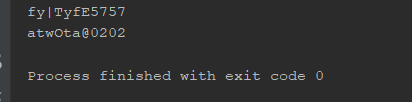
Python: Using chr() and ord() write a function called en_crypt() that takes into input a string and returns a new encrypted version of the input string. Example: "atwOta@0202" should return "fy|TyfE5757", then write a function de_crypt() so that "fy|TyfE5757" returns "atwOta@0202"
Homework Answers
def en_crypt(s):
    result = ''
    for ch in s:
        result += chr(ord(ch) + 5)
    return result


def de_crypt(s):
    result = ''
    for ch in s:
        result += chr(ord(ch) - 5)
    return result


enc = en_crypt('atwOta@0202')
print(enc)
print(de_crypt(enc))
Add Answer to:
Python: Using chr() and ord() write a function called en_crypt()
that takes into input a string...
Write a python function that takes a string as input, and returns a dictionary of frequencies...
Write a python function that takes a string as input, and returns a dictionary of frequencies of all the characters in the string. For example: freq("dabcabcdbbcd") would return {"d":3, "a":2, "b":4, "c":3}. Then write a driver to demonstrate your function.
Write a program in PYTHON that takes a string and an integer as inputs from the...
Write a program in PYTHON that takes a string and an integer as inputs from the user, and then prints a new string that contains the letters from the original string “rotated” by the given amount. For example, “cheer” rotated by 7 places gives the word “jolly” and “melon” rotated by -10 gives the word “cubed.” Use built-in function: ord() to convert a character to a numeric code and chr() to convert numeric code to character.
USING PYTHON! The second function you will write should be called ‘varOrd’. Your function should take...
USING PYTHON! The second function you will write should be called ‘varOrd’. Your function should take two (2) arguments, an integer and a string. The function should return one (1) integer calculated as follows. If the input integer is 1, the function should return the sum of the return value of the ord() function on each character of the string (e.g., varOrd(1, ‘cat’) should return the result of ord(‘c’) + ord(‘a’) + ord(‘t’)). If the input integer is 2, the...
Python 3: Write a function called every_other_character() that takes in a string and returns a new...
Python 3: Write a function called every_other_character() that takes in a string and returns a new string with every other character removed. That is, the new string will include the first, third, fifth, etc. letters of the given string. Must use a while or for loop in the solution.
Write a function called double_str that takes a string argument and returns a new string that...
Write a function called double_str that takes a string argument and returns a new string that has all of the same characters as the argument, except each one is repeated twice. For example: double_str('dog') --> 'ddoogg' looking for python coding below is what I have so far double_str = 'robert' double_str 'robert' for i in range(len(double_str)): print(double_str[i])
Write a Python function called more() that takes three string inputs and outputs a string Formally,...
 Write a Python function called more() that takes three string inputs and outputs a string Formally, the function signature and output are given by rucharist, char: str words str) > str Use the same names for the input arguments as shown above Note that charl and char2 will always be a string of length 1 (ie, it is a single character. The function checks which of charl or char2 appears more often in the word string and returns that character...
Write a Python function, called counting, that takes two arguments (a string and an integer), and...
Write a Python function, called counting, that takes two arguments (a string and an integer), and returns the number of digits in the string argument that are not the same as the integer argument. Include a main function that inputs the two values (string and integer) and outputs the result, with appropriate labelling. You are not permitted to use the Python string methods (such as count(), etc.). Sample input/output: Please enter a string of digits: 34598205 Please enter a 1-digit...
PYTHON Programming short Questions: 1. Write a function takes as input name (string) and age (number)...
PYTHON Programming short Questions: 1. Write a function takes as input name (string) and age (number) and prints: My name is <name> and I am <age> years old(where name and age are the inputs) 2. Write a function that takes as input a and b and returns the result of: ??ab 3. Write a function that takes as input a and b and returns the result of: ??ab if it is valid to divide a and b 4. Write a...
Python 3.0 Please Write a function that takes, as arguments, a binary string, a list of...
Python 3.0 Please Write a function that takes, as arguments, a binary string, a list of characters and the corresponding Huffman code for those characters. It decodes the binary string using the Huffman code, and returns the resulting decoded string. Name this function decodeStringHuffman(binaryString, myCharacters, myCode). For example, >>>decodeStringHuffman("1001100010111010101010111", ["A", "B", "C"], ["1", "00", "01"]) should return the string 'ABAABCCAACCCCCAA'
I need help writing this function in python. Write a function that takes, as input and...
I need help writing this function in python. Write a function that takes, as input and returns a dictionary where each string in L is a key and the vowels of the string are values. This function is called def dictVowel(L). sample input is ["one", "two", "three"] output will be {"one": "oe", "two": "o", "three": "ee"}
 Write a Python function called more() that takes three string inputs and outputs a string Formally, the function signature and output are given by rucharist, char: str words str) > str Use the same names for the input arguments as shown above Note that charl and char2 will always be a string of length 1 (ie, it is a single character. The function checks which of charl or char2 appears more often in the word string and returns that character...
Most questions answered within 3 hours.
-
Where is the error in this code sequence?
String s1 = "Hello";
String s2 = "ello";...
asked 11 months ago -
Financial data for Joel de Paris, Inc., for last year
follow:
Joel de Paris, Inc.
Balance...
asked 11 months ago -
Consider this reaction:
Al2(SO4)3 (aq)+ BaCl3
(aq) Al2Cl6 (aq)- +
3BaSO4(s) . What is the...
asked 11 months ago -
Suppose that Savneet is considering increasing her
recent random sample from 20 car rentals to 40...
asked 11 months ago -
Trucks arrive at an unloading terminal at an average rate of 120
per hour.
Trucks arrive...
asked 11 months ago -
Why are methanol and ethanol completely soluble in water while
octanol is not very little soluble....
asked 11 months ago -
A facilities manager at a university reads in a research report
that the mean amount of...
asked 11 months ago -
When the CuSO4 is rehydrated by adding water to the anhydrous
compound, is this an endothermic...
asked 11 months ago -
A ray of sunlight is passing from diamond into crown glass; the
angle of incidence is...
asked 11 months ago -
A block of mass 0.249 kg is placed on top of a light, vertical
spring of...
asked 11 months ago -
how do the kidneys compensate in the presences of acidosis
a) trigger hyperventilate
b) reserve acid...
asked 11 months ago -
Question 501 pts
The rental rate of capital to the firm increases. Which of the
following...
asked 11 months ago