Question 3: Listed below are ten substantive procedures: 1. Review the company-prepared bank reconciliation. 2. Obtain...
Question 3:
Listed below are ten substantive procedures:
1. Review the company-prepared bank reconciliation.
2. Obtain the company’s depreciation rates from the financial statements and check they have been applied correctly.
3. Perform accounts receivable circularisation.
4. Review a sample of repairs and maintenance expenditure for the year to ensure that it does not include any items that are capital in nature.
5. Ensure that all contingent liabilities have been included in the notes to the accounts.
6. Send a letter to the bank to confirm a loan taken out by the company during the year.
7. Review all invoices received for one month after the year-end to ensure that they do not relate to the current year.
8. Select a sample of non-current assets and sight them.
9. Select a sample of invoices and ensure that they have been properly recorded in the sales ledger.
10. Review the adequacy of the company’s allowance for doubtful debts.
REQUIRED:
(a) For each test, indicate what type of substantive procedure to which it relates (analytical review, tests of details of balances or tests of details of transactions)
(b) Give an assertion (ONLY ONE) to which each test relates and explain why.
Homework Answers


Add Answer to:
Question 3:
Listed below are ten substantive procedures:
1. Review the company-prepared bank reconciliation.
2. Obtain...
Requirement a. Indicate whether each procedure is a test of control, substantive test of transactions, substantive...
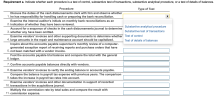 Requirement a. Indicate whether each procedure is a test of control, substantive test of transactions, substantive analytical procedure, or a test of details of balances. Type of Test Procedure Discuss the duties of the cash disbursements clerk with him and observe whether 1. he has responsibility for handling cash or preparing the bank reconciliation. Examine the internal auditor's initials on monthly bank reconciliations as an 2. indication of whether they have been reviewed. Account for a sequence of checks in...
For each of the following audit procedures listed below perform the following: Indicate the type of...
For each of the following audit procedures listed below perform the following: Indicate the type of audit test each represents (A) test of controls only, (B) substantive test of details only, (C) substantive analytical procedure only, (D) dual test. Only one should be selected for each procedure. 1. Recalculate accrued interest for the 12 months ended 12/31/2019. 2. Select a sample of purchases from the purchases journal and agree to vendor invoices and receiving documents. 3. Confirm cash balances and...
1.To conclude that a management review control is effective, the auditor is required to identify a...
1.To conclude that a management review control is effective, the auditor is required to identify a selection of instances in which the control operated, evaluate whether management followed the procedures specified by the control, and properly evaluated and resolved exceptions. A) True B) False 2. Which of the following statements about substantive analytical procedures is correct? A) The results of the procedure provide evidence about the existence or absence of misstatement in an account. B) The results of the procedure...
13-26 (Objectives 13-1, 13-2, 13-5) The following are audit procedures from different transaction cycles: Examine sales...
13-26 (Objectives 13-1, 13-2, 13-5) The following are audit procedures from different transaction cycles: Examine sales invoices for evidence of internal verification of prices, quantities, and extensions. Select items from the client’s perpetual inventory records and examine the items in the company’s warehouse. Use audit software to foot and cross-foot the cash disbursements journal and trace the balance to the general ledger. Examine loan agreements for key information such as interest rate, payment schedules, collateral, and restrictive covenants to determine...
Question 2 (18 marks) The purpose of substantive testing is to verify the assertions made by...
Question 2 (18 marks) The purpose of substantive testing is to verify the assertions made by management in the financial statements. Consider the following unrelated audit tests, which a CPA performed for the audit of the financial statements of a client with a fiscal year-end of December 31, 2017. Required For each of the six audit procedures listed below, identify the primary management assertion being tested and the account balance being verified, name the specific audit procedure being used (e.g....
1. As a part of auditing depreciation expense the auditor tests whether the client has followed...
1. As a part of auditing depreciation expense the auditor tests whether the client has followed a consistent policy and the calculations are correct. Which of the following audit objectives is the auditor addressing? A) Cut-off B) Occurrence C) Completeness D) Accuracy 2. The auditor used positive confirmations to test accounts receivable, but several of the confirmations were not returned. Which of the following auditing procedures would the auditor perform on the non-responses? A) Inspect shipping documents to verify that...
Question: Question 29 Assertions about classes of transactions and events typically include _______. -completeness, accuracy, and...
Question: Question 29 Assertions about classes of transactions and events typically include _______. -completeness, accuracy, and valuation -existence, rights, and cutoff -existence, rights, and obligations -occurrence, cutoff, and completeness Question 30 Assertions about account balances at year-end typically include _______. -existence, occurrence, and cutoff -existence, completeness, and allocation -existence, completeness, and rights and obligations -accuracy, valuation, and occurrence Question 31 Assertions about presentation and disclosure typically include _______. -cutoff, presentation, and disclosure -completeness, accuracy and valuation, and classification and understandability...
auditing Part Two: Multiple Choice Questions: (2.5 marks/ question) 1. To test the existence assertion for...
 auditing
Part Two: Multiple Choice Questions: (2.5 marks/ question) 1. To test the existence assertion for recorded receivables, an auditor would select a sample from the A) Sales orders file. B) Customer purchase orders C) Accounts receivable subsidiary ledger D) Shipping documents (bill of lading) file. 2. When control risk for the existence assertion is assessed at a high level, which of the Gallerine is a likely effect with respect to the auditors' confirmation of receivables? A) The account balances...
auditing
Part Two: Multiple Choice Questions: (2.5 marks/ question) 1. To test the existence assertion for recorded receivables, an auditor would select a sample from the A) Sales orders file. B) Customer purchase orders C) Accounts receivable subsidiary ledger D) Shipping documents (bill of lading) file. 2. When control risk for the existence assertion is assessed at a high level, which of the Gallerine is a likely effect with respect to the auditors' confirmation of receivables? A) The account balances...
DQ 1: The following are various management assertions related to sales and account receivable. Required: For...
DQ 1: The following are various management assertions related to sales and account receivable. Required: For each assertion, indicate whether it is an assertion about classes of transactions and events or an assertion about account balances. Indicate the name of the assertion made by management. MANAGEMENT ASSERTION CATEGORY OF MANAGEMENT ASSERTION NAME OF ASSERTION a. Recorded accounts receivable exist. b. Disclosures related to sales are relevant and understandable. c. Recorded sales transactions have occurred. d. There are no liens or...
Question 1 DinZee Co assembles fridges, microwaves, washing machines and other similar domestic appliances from parts...
Question 1 DinZee Co assembles fridges, microwaves, washing machines and other similar domestic appliances from parts procured from a large number of suppliers. As part of the interim audit work two weeks prior to the company year-end, you are testing the procurement and purchases systems and attending the inventory count. Procurement and purchases system Parts inventory is monitored by the stores manager. When the quantity of a particular part falls below re-order level, an e-mail is sent to the procurement...
 Requirement a. Indicate whether each procedure is a test of control, substantive test of transactions, substantive analytical procedure, or a test of details of balances. Type of Test Procedure Discuss the duties of the cash disbursements clerk with him and observe whether 1. he has responsibility for handling cash or preparing the bank reconciliation. Examine the internal auditor's initials on monthly bank reconciliations as an 2. indication of whether they have been reviewed. Account for a sequence of checks in...
 auditing
Part Two: Multiple Choice Questions: (2.5 marks/ question) 1. To test the existence assertion for recorded receivables, an auditor would select a sample from the A) Sales orders file. B) Customer purchase orders C) Accounts receivable subsidiary ledger D) Shipping documents (bill of lading) file. 2. When control risk for the existence assertion is assessed at a high level, which of the Gallerine is a likely effect with respect to the auditors' confirmation of receivables? A) The account balances...
auditing
Part Two: Multiple Choice Questions: (2.5 marks/ question) 1. To test the existence assertion for recorded receivables, an auditor would select a sample from the A) Sales orders file. B) Customer purchase orders C) Accounts receivable subsidiary ledger D) Shipping documents (bill of lading) file. 2. When control risk for the existence assertion is assessed at a high level, which of the Gallerine is a likely effect with respect to the auditors' confirmation of receivables? A) The account balances...
Most questions answered within 3 hours.
-
Where is the error in this code sequence?
String s1 = "Hello";
String s2 = "ello";...
asked 11 months ago -
Financial data for Joel de Paris, Inc., for last year
follow:
Joel de Paris, Inc.
Balance...
asked 11 months ago -
Consider this reaction:
Al2(SO4)3 (aq)+ BaCl3
(aq) Al2Cl6 (aq)- +
3BaSO4(s) . What is the...
asked 11 months ago -
Suppose that Savneet is considering increasing her
recent random sample from 20 car rentals to 40...
asked 11 months ago -
Trucks arrive at an unloading terminal at an average rate of 120
per hour.
Trucks arrive...
asked 11 months ago -
Why are methanol and ethanol completely soluble in water while
octanol is not very little soluble....
asked 11 months ago -
A facilities manager at a university reads in a research report
that the mean amount of...
asked 11 months ago -
When the CuSO4 is rehydrated by adding water to the anhydrous
compound, is this an endothermic...
asked 11 months ago -
A ray of sunlight is passing from diamond into crown glass; the
angle of incidence is...
asked 11 months ago -
A block of mass 0.249 kg is placed on top of a light, vertical
spring of...
asked 11 months ago -
how do the kidneys compensate in the presences of acidosis
a) trigger hyperventilate
b) reserve acid...
asked 11 months ago -
Question 501 pts
The rental rate of capital to the firm increases. Which of the
following...
asked 11 months ago