For a one step reaction, the activation energy for the forward reaction is 40.0 kJ mol-1,...
For a one step reaction, the activation energy for the
forward reaction is 40.0 kJ mol-1, and the enthalpy of
reaction is -20.0 kJ mol-1. Which statement below is true?
a. The activation energy of the forward reaction would be affected
to a greater extent
than the activation energy of the reverse reaction by addition of a
catalyst.
b. The value for the enthalpy of reaction would be decreased by
addition of a catalyst.
c. The reaction is endothermic.
d. The reverse reaction has a higher activation energy than the
forward reaction.
e. The reaction rate would be decreased by an increase in
temperature.
NB: THE ANSWER IS NEITHER A, B NOR D.
Homework Answers

Add Answer to:
For a one step reaction, the activation energy for the
forward reaction is 40.0 kJ mol-1,...
1. The forward reaction HOCI → HCIO has an activation energy of 311 kJ/mol. The reverse...
 1. The forward reaction HOCI → HCIO has an activation energy of 311 kJ/mol. The reverse reaction HCIO → HOCI has an activation energy of 31 kJ/mol. Both reactions occur at 25 °C. a. Which reaction is exothermic: HOCI → HCIO or HCIO → HOCI? Briefly explain. b. Determine the AE for the reaction HOCI → HCIO. Is the reaction endothermic or exothermic? c. Assuming the Arrhenius constant for the reaction HCIO → HOCI is 5.2 x 10² s', calculate...
Here is ergy diagram for the reaction: 400 300 energy 200 (kJ/mol) 100 C D reaction coordinate Us...
 Here is ergy diagram for the reaction: 400 300 energy 200 (kJ/mol) 100 C D reaction coordinate Use the energy diagram to answer these questions. kJ/mol Exothermic Endothermic Neither Yes, it's kJ/mol What is the heat of reaction? Is the reaction exothermic or endothermic? Can you determine the activation energy? O Yes, it'skJ/mol Can you determine the activation energy of the reverse reaction? No.
Here is ergy diagram for the reaction: 400 300 energy 200 (kJ/mol) 100 C D reaction...
Here is ergy diagram for the reaction: 400 300 energy 200 (kJ/mol) 100 C D reaction coordinate Use the energy diagram to answer these questions. kJ/mol Exothermic Endothermic Neither Yes, it's kJ/mol What is the heat of reaction? Is the reaction exothermic or endothermic? Can you determine the activation energy? O Yes, it'skJ/mol Can you determine the activation energy of the reverse reaction? No.
Here is ergy diagram for the reaction: 400 300 energy 200 (kJ/mol) 100 C D reaction...
A catalyst lowers the activation energy for a particular reaction from 75.0 kJ mol−1to 40.0 kJ...
A catalyst lowers the activation energy for a particular reaction from 75.0 kJ mol−1to 40.0 kJ mol−1. By what factor does the rate constant increase if the catalyst is used at 25.0 °C? Assume that all rate constants obey the Arrhenius equation and that the pre-exponential factors for the uncatalyzed and catalyzed reactions are equal
Suppose that the activation energy for a certain reaction is 30 kJ/mol and the enthalpy of...
Suppose that the activation energy for a certain reaction is 30 kJ/mol and the enthalpy of reaction is -75.0 kJ/mol. What activation energy is required to initiate the reverse reaction that converts the products into reactants?
Suppose that the activation energy for a certain reaction is 30 kJ/mol and the enthalpy of...
 Suppose that the activation energy for a certain reaction is 30 kJ/mol and the enthalpy of reaction is –75.0 kJ/mol. What activation energy is required to initiate the reverse reaction that converts the products into reactants?
d listing r. (Individ For a particular first-order reaction, it takes 24 minutes for the concentration...
 d listing r. (Individ For a particular first-order reaction, it takes 24 minutes for the concentration of the reactant to decrease to 25% of its initial value, what is the value for rate constant (in S-1) for the reaction? A) 2.0-104 s-1 B)9.6 x 10⁻⁴ s-1 C) 1.2 × 10⁻² s-1 D)5.8 102s-1 12. In the first order reaction A → products, [A1-0.400 M initially and 0250 M after 15.0 mun, what willl after 175 min? e A) 1.67-10-3 M...
1) Calculate the activation energy in kJ/mol for the following reaction if the rate constant for...
1) Calculate the activation energy in kJ/mol for the following reaction if the rate constant for the reaction increases from 93.5 M-1s-1 at 497.7 K to 1349.3 M-1s-1 at 636.7 K. do not include units, but make sure your answer is in kJ/mol! 2) A chemist constructs a plot of ln k vs. 1/T for a chemical reaction. The slope of the trendline for the data is -746 K. What is the activation energy for this reaction in kJ/mol? R...
A reaction has the activation energies of 34.5 and 52.7 kJ/mol for the forward and reverse...
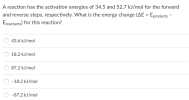 A reaction has the activation energies of 34.5 and 52.7 kJ/mol for the forward and reverse steps, respectively. What is the energy change (AE-Eproducts- Ereactants) for this reaction? 43.6 kJ/mol O 18.2 kJ/mol O 87.2 kJ/mol O -18.2 kJ/mol O-87.2 kJ/mol
The activation energy of an uncatalyzed reaction is 91 kJ/mol . The addition of a catalyst...
The activation energy of an uncatalyzed reaction is 91 kJ/mol . The addition of a catalyst lowers the activation energy to 59 kJ/mol . A.) Assuming that the collision factor remains the same, by what factor will the catalyst increase the rate of the reaction at 26 ∘C ? Express the ratio to two significant digits B.) Assuming that the collision factor remains the same, by what factor will the catalyst increase the rate of the reaction at 120 ∘C...
D. The data below is for the reaction sequence A- Elementary step A, H/kJ mol A-...
 D. The data below is for the reaction sequence A- Elementary step A, H/kJ mol A- B B- C C D B- C- E /kJ mol Hint: Use the data to prepare a graph of the reaction profile and then answer the questions below. Your graph should be properly labelled and drawn to scale. Potential Energy Reaction progress (a) Whichof the following steps has the smallest rate constant? AB Bc (b) Which of the following steps has the largest rate...
 1. The forward reaction HOCI → HCIO has an activation energy of 311 kJ/mol. The reverse reaction HCIO → HOCI has an activation energy of 31 kJ/mol. Both reactions occur at 25 °C. a. Which reaction is exothermic: HOCI → HCIO or HCIO → HOCI? Briefly explain. b. Determine the AE for the reaction HOCI → HCIO. Is the reaction endothermic or exothermic? c. Assuming the Arrhenius constant for the reaction HCIO → HOCI is 5.2 x 10² s', calculate...
 Here is ergy diagram for the reaction: 400 300 energy 200 (kJ/mol) 100 C D reaction coordinate Use the energy diagram to answer these questions. kJ/mol Exothermic Endothermic Neither Yes, it's kJ/mol What is the heat of reaction? Is the reaction exothermic or endothermic? Can you determine the activation energy? O Yes, it'skJ/mol Can you determine the activation energy of the reverse reaction? No.
Here is ergy diagram for the reaction: 400 300 energy 200 (kJ/mol) 100 C D reaction...
Here is ergy diagram for the reaction: 400 300 energy 200 (kJ/mol) 100 C D reaction coordinate Use the energy diagram to answer these questions. kJ/mol Exothermic Endothermic Neither Yes, it's kJ/mol What is the heat of reaction? Is the reaction exothermic or endothermic? Can you determine the activation energy? O Yes, it'skJ/mol Can you determine the activation energy of the reverse reaction? No.
Here is ergy diagram for the reaction: 400 300 energy 200 (kJ/mol) 100 C D reaction...
 Suppose that the activation energy for a certain reaction is 30 kJ/mol and the enthalpy of reaction is –75.0 kJ/mol. What activation energy is required to initiate the reverse reaction that converts the products into reactants?
 d listing r. (Individ For a particular first-order reaction, it takes 24 minutes for the concentration of the reactant to decrease to 25% of its initial value, what is the value for rate constant (in S-1) for the reaction? A) 2.0-104 s-1 B)9.6 x 10⁻⁴ s-1 C) 1.2 × 10⁻² s-1 D)5.8 102s-1 12. In the first order reaction A → products, [A1-0.400 M initially and 0250 M after 15.0 mun, what willl after 175 min? e A) 1.67-10-3 M...
 A reaction has the activation energies of 34.5 and 52.7 kJ/mol for the forward and reverse steps, respectively. What is the energy change (AE-Eproducts- Ereactants) for this reaction? 43.6 kJ/mol O 18.2 kJ/mol O 87.2 kJ/mol O -18.2 kJ/mol O-87.2 kJ/mol
 D. The data below is for the reaction sequence A- Elementary step A, H/kJ mol A- B B- C C D B- C- E /kJ mol Hint: Use the data to prepare a graph of the reaction profile and then answer the questions below. Your graph should be properly labelled and drawn to scale. Potential Energy Reaction progress (a) Whichof the following steps has the smallest rate constant? AB Bc (b) Which of the following steps has the largest rate...
Most questions answered within 3 hours.
-
Where is the error in this code sequence?
String s1 = "Hello";
String s2 = "ello";...
asked 10 months ago -
Financial data for Joel de Paris, Inc., for last year
follow:
Joel de Paris, Inc.
Balance...
asked 10 months ago -
Consider this reaction:
Al2(SO4)3 (aq)+ BaCl3
(aq) Al2Cl6 (aq)- +
3BaSO4(s) . What is the...
asked 10 months ago -
Suppose that Savneet is considering increasing her
recent random sample from 20 car rentals to 40...
asked 10 months ago -
Trucks arrive at an unloading terminal at an average rate of 120
per hour.
Trucks arrive...
asked 10 months ago -
Why are methanol and ethanol completely soluble in water while
octanol is not very little soluble....
asked 10 months ago -
A facilities manager at a university reads in a research report
that the mean amount of...
asked 10 months ago -
When the CuSO4 is rehydrated by adding water to the anhydrous
compound, is this an endothermic...
asked 10 months ago -
A ray of sunlight is passing from diamond into crown glass; the
angle of incidence is...
asked 10 months ago -
A block of mass 0.249 kg is placed on top of a light, vertical
spring of...
asked 10 months ago -
how do the kidneys compensate in the presences of acidosis
a) trigger hyperventilate
b) reserve acid...
asked 10 months ago -
Question 501 pts
The rental rate of capital to the firm increases. Which of the
following...
asked 10 months ago