Suppose we mix 1 mole each of Cl2(g) and Cl(g) at 298K, 1 bar. Which way...
Suppose we mix 1 mole each of Cl2(g) and Cl(g) at 298K, 1 bar. Which way does the reaction proceed, i.e., will you see more Cl2(g) or more Cl(g) form?
Homework Answers
Request Answer!
We need at least 10 more requests to produce the answer.
0 / 10 have requested this problem solution
The more requests, the faster the answer.
Add Answer to:
Suppose we mix 1 mole each of Cl2(g) and Cl(g) at 298K, 1 bar.
Which way...
What is the change in volume for this reaction (ΔVR(1 bar, 298K)) at 298K and 1...
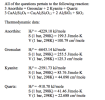 What is the change in volume for this reaction (ΔVR(1 bar,
298K)) at 298K and 1 bar? Are the products or reactants denser?
What is the change in enthalpy for this reaction (ΔHR(1 bar,
298K)) at 298K and 1 bar? Is the reaction exothermic or
endothermic?
What is the change in internal energy for this reaction (ΔER(1
bar, 298K)) at 298K and 1 bar? For this reaction, under these
conditions is q or w the more significant term?
What is...
What is the change in volume for this reaction (ΔVR(1 bar,
298K)) at 298K and 1 bar? Are the products or reactants denser?
What is the change in enthalpy for this reaction (ΔHR(1 bar,
298K)) at 298K and 1 bar? Is the reaction exothermic or
endothermic?
What is the change in internal energy for this reaction (ΔER(1
bar, 298K)) at 298K and 1 bar? For this reaction, under these
conditions is q or w the more significant term?
What is...
1.) 2Cl Cl2(g) K = 3.44 x 10⁵ What happens if the concentrations of Cl is 0.045...
1.) 2Cl Cl2(g) K = 3.44 x 10⁵ What happens if the concentrations of Cl is 0.045 M and the concentration of Cl2 is 0.23 M? A) the reaction will proceed to the right B) the reaction will proceed to the left C) The reaction will stay the same D) Not enough information to figure this out. 2.) We have FeCl2. We can put this into a solution of either 0.1 M Fe(NO3)3 or 0.1 M MgCl2. Which one will result...
The dissociation reaction for chlorine is allowed to occur at 2000 K. Cl2(g) + 2Cl (9) Suppose 0.1 mole of Cl2 is al...
 The dissociation reaction for chlorine is allowed to occur at 2000 K. Cl2(g) + 2Cl (9) Suppose 0.1 mole of Cl2 is allowed to dissociate at this temperature and that AG (CI) = 5.081 kJ/mol at this temperature and total pressure of 1.0 bar. a. What is the extent of reaction for the dissociation? b. What is the degree of dissociation if the pressure is changed to 0.50 bar?
1) For the following reaction: SO2Cl2(g)<-> SO2(g) + Cl2 (g) Kp=2.91x10^3 at 298K In the reaction...
1) For the following reaction: SO2Cl2(g)<-> SO2(g) + Cl2 (g) Kp=2.91x10^3 at 298K In the reaction at equilibrium, the partial pressure of SO2 is 137 torr and that of CL2 is 285 torr. The partial pressure of SO2Cl2 is [x]torr. 2) For the following reaction:NH4HS(s)<->NH3(g) + H2S (g) Kc=8.5x10^-3 At any given point the reaction mixture has solid NH4HS, NH3 at 0.166M and H2S at 0.166M. a) Is the reaction at equilibrium? b)Will more of the solid form, or will...
The Henry's Law constant at 298K for CS2 in water solution is Km= 1100 bar (mole fraction)^-1....
The Henry's Law constant at 298K for CS2 in water solution is Km= 1100 bar (mole fraction)^-1. The equilibrium vapor pressure of water at 298K is P*H20= 3170 pa. Assume CS2 and water form an ideal dilute solution, estimate the total vapor pressure above a solution which has Xcs2 = 3.0*10^-6 .
24-18. Consider the reaction described by Cl2 + Br2 -> 2BrCl at 500 K and a total pressure of ...
 24-18. Consider the reaction described by Cl2 +
Br2 -> 2BrCl at 500 K and a total pressure of one
bar. Suppose that we start with one mole each Cl2 and
Br2 and no BrCl. Show that
24-18. Consider the reaction described by Cl2 (g) + Br2 (g) 2 BrCl(g) at 500 K and a total pressure of one bar. Suppose that we start with one mole each of Cl2(g) and Br (g) and no BrCI(g). Show that where ξ...
24-18. Consider the reaction described by Cl2 +
Br2 -> 2BrCl at 500 K and a total pressure of one
bar. Suppose that we start with one mole each Cl2 and
Br2 and no BrCl. Show that
24-18. Consider the reaction described by Cl2 (g) + Br2 (g) 2 BrCl(g) at 500 K and a total pressure of one bar. Suppose that we start with one mole each of Cl2(g) and Br (g) and no BrCI(g). Show that where ξ...
5. If you have a mixture of 1 mole of gaseous diatomic bromine (Br2(g)) and 1 mole of gaseous monatomic bromine (Br(g))...
 5. If you have a mixture of 1 mole of gaseous diatomic bromine (Br2(g)) and 1 mole of gaseous monatomic bromine (Br(g)) at 350K, which way does the reaction Br2(g) + 2Br(g) go?
Suppose you want to carry out the chemical reaction H2(g) + Cl2(g) + 2HCl(9) and have...
 Suppose you want to carry out the chemical reaction H2(g) + Cl2(g) + 2HCl(9) and have 1 mole of Cl2 gas. Part A What volume in liters of H, gas would you need to have 1 mole of H2, given that the H2 pressure and temperature are 1.12 atm and 25.5 °C? Express your answer with the appropriate units. "! A ROO? VE Value Units Submit Request Answer Part B What would the volume of the product be if it...
Balance each aqueous reduction/ oxidation reaction. 1) H+ + ClO3-1 + Cl ---> H2O + Cl2...
Balance each aqueous reduction/ oxidation reaction. 1) H+ + ClO3-1 + Cl ---> H2O + Cl2 + ClO2 2) Br2 + OH- ---> BrO3- + Br- + H2O Please show your work. Thank you so much
Which of the following statements is/are correct? 1. The bond energy, BE(Cl-Cl), in Cl2 is 244...
Which of the following statements is/are correct? 1. The bond energy, BE(Cl-Cl), in Cl2 is 244 kJ mol-1 since ∆H°f {Br,atomic,g) = 122 kJ mol-1. 2. A compound has a ∆H°f , calculated from average bond energies, of -20 kJ mol-1, whereas its experimental ∆H°f is -80 kJ mol-1. This compound is less stable than predicted by its Lewis structure. 3. A gas phase chemical reaction is found to be exothermic. This means that the sum of the bond energies...
 What is the change in volume for this reaction (ΔVR(1 bar,
298K)) at 298K and 1 bar? Are the products or reactants denser?
What is the change in enthalpy for this reaction (ΔHR(1 bar,
298K)) at 298K and 1 bar? Is the reaction exothermic or
endothermic?
What is the change in internal energy for this reaction (ΔER(1
bar, 298K)) at 298K and 1 bar? For this reaction, under these
conditions is q or w the more significant term?
What is...
What is the change in volume for this reaction (ΔVR(1 bar,
298K)) at 298K and 1 bar? Are the products or reactants denser?
What is the change in enthalpy for this reaction (ΔHR(1 bar,
298K)) at 298K and 1 bar? Is the reaction exothermic or
endothermic?
What is the change in internal energy for this reaction (ΔER(1
bar, 298K)) at 298K and 1 bar? For this reaction, under these
conditions is q or w the more significant term?
What is...
 The dissociation reaction for chlorine is allowed to occur at 2000 K. Cl2(g) + 2Cl (9) Suppose 0.1 mole of Cl2 is allowed to dissociate at this temperature and that AG (CI) = 5.081 kJ/mol at this temperature and total pressure of 1.0 bar. a. What is the extent of reaction for the dissociation? b. What is the degree of dissociation if the pressure is changed to 0.50 bar?
 24-18. Consider the reaction described by Cl2 +
Br2 -> 2BrCl at 500 K and a total pressure of one
bar. Suppose that we start with one mole each Cl2 and
Br2 and no BrCl. Show that
24-18. Consider the reaction described by Cl2 (g) + Br2 (g) 2 BrCl(g) at 500 K and a total pressure of one bar. Suppose that we start with one mole each of Cl2(g) and Br (g) and no BrCI(g). Show that where ξ...
24-18. Consider the reaction described by Cl2 +
Br2 -> 2BrCl at 500 K and a total pressure of one
bar. Suppose that we start with one mole each Cl2 and
Br2 and no BrCl. Show that
24-18. Consider the reaction described by Cl2 (g) + Br2 (g) 2 BrCl(g) at 500 K and a total pressure of one bar. Suppose that we start with one mole each of Cl2(g) and Br (g) and no BrCI(g). Show that where ξ...
 5. If you have a mixture of 1 mole of gaseous diatomic bromine (Br2(g)) and 1 mole of gaseous monatomic bromine (Br(g)) at 350K, which way does the reaction Br2(g) + 2Br(g) go?
 Suppose you want to carry out the chemical reaction H2(g) + Cl2(g) + 2HCl(9) and have 1 mole of Cl2 gas. Part A What volume in liters of H, gas would you need to have 1 mole of H2, given that the H2 pressure and temperature are 1.12 atm and 25.5 °C? Express your answer with the appropriate units. "! A ROO? VE Value Units Submit Request Answer Part B What would the volume of the product be if it...
Most questions answered within 3 hours.
-
Where is the error in this code sequence?
String s1 = "Hello";
String s2 = "ello";...
asked 11 months ago -
Financial data for Joel de Paris, Inc., for last year
follow:
Joel de Paris, Inc.
Balance...
asked 11 months ago -
Consider this reaction:
Al2(SO4)3 (aq)+ BaCl3
(aq) Al2Cl6 (aq)- +
3BaSO4(s) . What is the...
asked 11 months ago -
Suppose that Savneet is considering increasing her
recent random sample from 20 car rentals to 40...
asked 11 months ago -
Trucks arrive at an unloading terminal at an average rate of 120
per hour.
Trucks arrive...
asked 11 months ago -
Why are methanol and ethanol completely soluble in water while
octanol is not very little soluble....
asked 11 months ago -
A facilities manager at a university reads in a research report
that the mean amount of...
asked 11 months ago -
When the CuSO4 is rehydrated by adding water to the anhydrous
compound, is this an endothermic...
asked 11 months ago -
A ray of sunlight is passing from diamond into crown glass; the
angle of incidence is...
asked 11 months ago -
A block of mass 0.249 kg is placed on top of a light, vertical
spring of...
asked 11 months ago -
how do the kidneys compensate in the presences of acidosis
a) trigger hyperventilate
b) reserve acid...
asked 11 months ago -
Question 501 pts
The rental rate of capital to the firm increases. Which of the
following...
asked 11 months ago