The major product of the following reaction has the molecular formula C10H16O3. Draw its structure in...
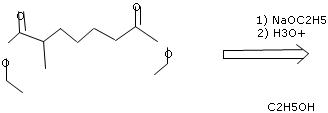
The major product of the following reaction has the molecular formula C10H16O3. Draw its structure in the most stable tautomeric form.
Homework Answers
A reaction is given in which a diester is reacting with sodium ethoxide followed by acidic work up. The correct product of the reaction needs to be written. Sodium ethoxide acts as a base and abstract the acidic hydrogen forming a carbanion.
Acidic hydrogen generally refers to the hydrogen which can be easily abstracted or in other words whose conjugate base formed is stable.
Esters having in the presence of base undergo Claisen condensation and result in the formation ester. Consider the following reaction:

If the compound contains two ester functional group itself then the reaction is termed as Dickman Condensation, that is, intramolecular claisen condensation.
Draw the structure of the given diester and identify the acidic hydrogen that would be abstracted by the base, that is, sodium ethoxide and result in the formation of as shown below:

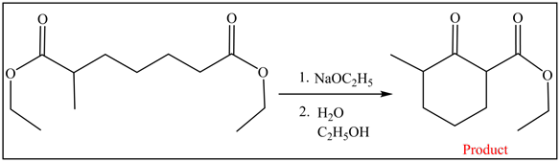
Write the product of the reaction by the intermolecular attack of carbanion at the carbonyl center as shown below:

Hence, the final product of the reaction is as follows:
Add Answer to:
The major product of the following reaction has the molecular
formula C10H16O3. Draw its structure in...
Draw the most stable form of the major product in the following reaction. Draw the most...
 Draw the most stable form of the major product in the following
reaction.
Draw the most stable form of the major product in the following reaction.
Draw the most stable form of the major product in the following
reaction.
Draw the most stable form of the major product in the following reaction.
Predict the major product for the following reaction. A carboxylic acid with molecular formula C_5 H_19...
 Predict the major product for the following reaction. A carboxylic acid with molecular formula C_5 H_19 O_2 is treated with thionyl chloride to give compound A. Compound A has only one signal in its^1HNMR spectrum. Draw the structure of the product that is formed when compound A is treated with excess ammonia. Provide the reagents necessary to carry out the following conversion.
Draw a structural formula for the major organic product of the following reaction:
 Draw a structural formula for the major organic product of the following reaction:Electrophilic addition of HBr to alkenes yields a bromoalkane. The reaction begins with an attack on the hydrogen of the electrophilic HBr by the electrons of the double bond to give a carbocation. This step follows Markovnikov's rule with the electrophilic H atom adding to the sp2 carbon containing the most hydrogens, leading to the formation of the most stable carbocation (1° < 2° < 3°). If possible, a...
Draw the most stable form of the major product in the following reaction.
 Draw the most stable form of the major product in the following reaction.
Draw a structural formula for the major organic product of the reaction shown.
 Electrophilic addition of HBr to alkenes yields a bromoalkane. The reaction begins with an attack on the hydrogen of the electrophilic HBr by the electrons of the double bond to give a carbocation. This step follows Markovnikov's rule with the electrophilic H atom adding to the sp2 carbon containing the most hydrogens, leading to the formation of the most stable carbocation (1° < 2° < 3°). If possible, a 1,2-shift of either a neighboring hydride or methyl group can occur...
Draw the structure of the major product formed in the following reaction of p-cymene with N-bromosuccinimide under the conditions shown.
 Draw the structure of the major product formed in the
following reaction of p-cymene with N-bromosuccinimide under the
conditions shown. The molecular formula of the product is
given.
Draw the structure of the major product formed in the
following reaction of p-cymene with N-bromosuccinimide under the
conditions shown. The molecular formula of the product is
given.
Draw the structure of a compound of molecular formula C4H8O that has a signal in its...
 Draw the structure of a compound of molecular formula C4H8O that has a signal in its 13C NMR spectrum at >= 160 ppm. Then draw the structure of an isomer with no rings of molecular formula C4H8O that has all of its NMR signals at ^13C NMR signals at < 160 ppm. Structure that has a signal >= 160 ppm: draw structure Structure with no rings that has all signals < 160 ppm: draw structure
Draw a structural formula for the major organic product of the reaction shown....
 3.1) Draw a structural formula for the major organic product of the reaction shown.3.2) Draw a structural formula for the more stable carbocation intermediate formed in the reaction shown. 3.3) Draw a structural formula for the more stable carbocation intermediate formed in the reaction shown.
Draw the structure(s) of the major organic product(s) of the following reaction. Draw the structure(s) of...
 Draw the structure(s) of the
major organic product(s) of the following reaction.
Draw the structure(s) of the major organic product(s) of the following reaction. If no reaction occurs, draw the organic starting material. Draw enolates in their carbanion form. Include counter e.g., Na^+, I^-, in your submission, but draw them in their own separate sketcher. For multi-step processes, draw the product(s) of the last step.
Draw the structure(s) of the
major organic product(s) of the following reaction.
Draw the structure(s) of the major organic product(s) of the following reaction. If no reaction occurs, draw the organic starting material. Draw enolates in their carbanion form. Include counter e.g., Na^+, I^-, in your submission, but draw them in their own separate sketcher. For multi-step processes, draw the product(s) of the last step.
2. Draw a structure with the molecular formula C7H10 that has exactly two rings. 4. Give...
 2. Draw a structure with the molecular formula C7H10 that has
exactly two rings.
4. Give IUPAC names for the following structures
(a,b,c,d)
CHEM1014 Homework for Chapter 11 Due Friday, March 20, beginning of class There is not enough room to write the answers on this sheet. Use other sheets of paper for your answers. 1. Draw a structure with the molecular formula C,H, that has exactly one ring. Show all atoms and all bonds 2. Draw a structure with...
2. Draw a structure with the molecular formula C7H10 that has
exactly two rings.
4. Give IUPAC names for the following structures
(a,b,c,d)
CHEM1014 Homework for Chapter 11 Due Friday, March 20, beginning of class There is not enough room to write the answers on this sheet. Use other sheets of paper for your answers. 1. Draw a structure with the molecular formula C,H, that has exactly one ring. Show all atoms and all bonds 2. Draw a structure with...
 Draw the most stable form of the major product in the following
reaction.
Draw the most stable form of the major product in the following reaction.
Draw the most stable form of the major product in the following
reaction.
Draw the most stable form of the major product in the following reaction.
 Predict the major product for the following reaction. A carboxylic acid with molecular formula C_5 H_19 O_2 is treated with thionyl chloride to give compound A. Compound A has only one signal in its^1HNMR spectrum. Draw the structure of the product that is formed when compound A is treated with excess ammonia. Provide the reagents necessary to carry out the following conversion.
 Draw the structure of a compound of molecular formula C4H8O that has a signal in its 13C NMR spectrum at >= 160 ppm. Then draw the structure of an isomer with no rings of molecular formula C4H8O that has all of its NMR signals at ^13C NMR signals at < 160 ppm. Structure that has a signal >= 160 ppm: draw structure Structure with no rings that has all signals < 160 ppm: draw structure
 Draw the structure(s) of the
major organic product(s) of the following reaction.
Draw the structure(s) of the major organic product(s) of the following reaction. If no reaction occurs, draw the organic starting material. Draw enolates in their carbanion form. Include counter e.g., Na^+, I^-, in your submission, but draw them in their own separate sketcher. For multi-step processes, draw the product(s) of the last step.
Draw the structure(s) of the
major organic product(s) of the following reaction.
Draw the structure(s) of the major organic product(s) of the following reaction. If no reaction occurs, draw the organic starting material. Draw enolates in their carbanion form. Include counter e.g., Na^+, I^-, in your submission, but draw them in their own separate sketcher. For multi-step processes, draw the product(s) of the last step.
 2. Draw a structure with the molecular formula C7H10 that has
exactly two rings.
4. Give IUPAC names for the following structures
(a,b,c,d)
CHEM1014 Homework for Chapter 11 Due Friday, March 20, beginning of class There is not enough room to write the answers on this sheet. Use other sheets of paper for your answers. 1. Draw a structure with the molecular formula C,H, that has exactly one ring. Show all atoms and all bonds 2. Draw a structure with...
2. Draw a structure with the molecular formula C7H10 that has
exactly two rings.
4. Give IUPAC names for the following structures
(a,b,c,d)
CHEM1014 Homework for Chapter 11 Due Friday, March 20, beginning of class There is not enough room to write the answers on this sheet. Use other sheets of paper for your answers. 1. Draw a structure with the molecular formula C,H, that has exactly one ring. Show all atoms and all bonds 2. Draw a structure with...
Most questions answered within 3 hours.
-
Where is the error in this code sequence?
String s1 = "Hello";
String s2 = "ello";...
asked 11 months ago -
Financial data for Joel de Paris, Inc., for last year
follow:
Joel de Paris, Inc.
Balance...
asked 11 months ago -
Consider this reaction:
Al2(SO4)3 (aq)+ BaCl3
(aq) Al2Cl6 (aq)- +
3BaSO4(s) . What is the...
asked 11 months ago -
Suppose that Savneet is considering increasing her
recent random sample from 20 car rentals to 40...
asked 11 months ago -
Trucks arrive at an unloading terminal at an average rate of 120
per hour.
Trucks arrive...
asked 11 months ago -
Why are methanol and ethanol completely soluble in water while
octanol is not very little soluble....
asked 11 months ago -
A facilities manager at a university reads in a research report
that the mean amount of...
asked 11 months ago -
When the CuSO4 is rehydrated by adding water to the anhydrous
compound, is this an endothermic...
asked 11 months ago -
A ray of sunlight is passing from diamond into crown glass; the
angle of incidence is...
asked 11 months ago -
A block of mass 0.249 kg is placed on top of a light, vertical
spring of...
asked 11 months ago -
how do the kidneys compensate in the presences of acidosis
a) trigger hyperventilate
b) reserve acid...
asked 11 months ago -
Question 501 pts
The rental rate of capital to the firm increases. Which of the
following...
asked 11 months ago