Draw the mechanism for dehydrobromination of meso-stilbene dibromide by a double hydrohalogenation.
Draw the mechanism for dehydrobromination of meso-stilbene dibromide by a double hydrohalogenation.
Homework Answers

Add Answer to:
Draw the mechanism for dehydrobromination of meso-stilbene
dibromide by a double hydrohalogenation.
After performing dehydrobromination of meso-stilbene dibromide, why did we have to heat the reaction to such...
 After performing dehydrobromination of meso-stilbene dibromide,
why did we have to heat the reaction to such an extreme
temperature? And what is the slow step in this reaction - first or
second? Why?
OH КОН vorovo Br 190 °C Triethylene glycol solvent Diphenylacetylene meso-stilbene dibromide Figure 1. Reaction Scheme.
After performing dehydrobromination of meso-stilbene dibromide,
why did we have to heat the reaction to such an extreme
temperature? And what is the slow step in this reaction - first or
second? Why?
OH КОН vorovo Br 190 °C Triethylene glycol solvent Diphenylacetylene meso-stilbene dibromide Figure 1. Reaction Scheme.
meso-stilbene dibromide when 0.90 g of E-stilbene are reacted 6.(4) Calculate the theoretical yield of meso-stilbene...
 meso-stilbene dibromide when 0.90 g of E-stilbene are reacted 6.(4) Calculate the theoretical yield of meso-stilbene dibromide when 0.90 with excess bromine. 70) Write the structure of the product obtained when cyclohexene is used to decolorize bromine. containing solutions. Br Bra
Write the structure of meso-stilbene dibromide (either 3-D or Fischer projection) showing the stereochemistry at the...
Write the structure of meso-stilbene dibromide (either 3-D or Fischer projection) showing the stereochemistry at the two chiral carbons. Draw one enantiomer of the chiral stereoisomer of stilbene dibromide (either R,R- or S,S-enantiomer).
what is the balanced chemical equation of pyridinium tribromide and E-stilbene that forms meso-stilbene dibromide?
what is the balanced chemical equation of pyridinium tribromide and E-stilbene that forms meso-stilbene dibromide?
Bromination of Stilbene Calculate the theoretical yield of meso-stilbene dibromide. Calculate the percent yield. 0.523 g...
Bromination of Stilbene Calculate the theoretical yield of meso-stilbene dibromide. Calculate the percent yield. 0.523 grams of trans stilbene, with 10 mL of ethanol, 1.2 mL of concentrated aqueous HBr, and 0.8 mL of 30% hydrogen peroxide. Final product weight of meso after experiment: 0.494 g.
Discussion Questions: 1. a) Carefully draw a three-dimensional structure of each stereoisomer of stilbene dibromide. Do...
 Discussion Questions: 1. a) Carefully draw a three-dimensional structure of each stereoisomer of stilbene dibromide. Do not include any identical structures. b) Identify the enantiomeric pair, and identify one pair of structures that are diastereomers. 2. Give careful stereo-drawings representing the complete mechanism for the reaction of cis-stilbene with bromine. Remember to show the two different modes of anti-attack that are possible, depending on whether you add the bromine from above to the left-hand or the right-hand carbon of the...
1. (4 pts) Given the masses of meso-stilbene dibromide and potassium hydroxide, please calculate the theoretical...
 1. (4 pts) Given the masses of meso-stilbene dibromide and potassium hydroxide, please calculate the theoretical yield of the expected reaction product, diphenylacetylene, in grams. Your final answ appear in the box provided, or it will not be counted. Show all work to receive credit. Br +KOH + KOH Br diphenylacetylene meso-stilbene dibromide Molecular Weight (g/mol) 340.058 g/mol 56.105 g/mol mass (grams) 178.234 g/mol 0.800 g 0.400 g
Look up and draw the mechanism for the addition of Br2 to double bonds. Reference the...
 Look up and draw the mechanism for the addition of Br2 to
double bonds. Reference the source from which you acquired the
mechanism.
Give the IUPAC name of the major product in the above-mentioned
reaction.
Draw the major product of obtained in the addition of Br2 to
stilbene.
Is this isomer chiral? What would be the optical rotation if
this sample was placed in a polarimeter?
Would a student obtain the same product if you started with
cis-stilbene instead of...
Look up and draw the mechanism for the addition of Br2 to
double bonds. Reference the source from which you acquired the
mechanism.
Give the IUPAC name of the major product in the above-mentioned
reaction.
Draw the major product of obtained in the addition of Br2 to
stilbene.
Is this isomer chiral? What would be the optical rotation if
this sample was placed in a polarimeter?
Would a student obtain the same product if you started with
cis-stilbene instead of...
for objective, overall reaction of E-Stilbene to stilbene dibromide. BROMINATION OF E-STILBENE LAB REPORT TEMPLATE I....
 for objective, overall reaction of E-Stilbene to stilbene
dibromide.
BROMINATION OF E-STILBENE LAB REPORT TEMPLATE I. Introduction Define addition reactions of alkenes generally and electrophilic bromination of an alkene specifically. Include a separate, labeled figure depicting an overall reaction and mechanism for bromination of E-stilbene. Discuss electrophilic addition stereochemistry and the predicted product. II. Objective Describe the type of reaction performed and the specific starting material. Include a figure (prepared in ChemDraw) depicting the overall reaction performed in the lab...
for objective, overall reaction of E-Stilbene to stilbene
dibromide.
BROMINATION OF E-STILBENE LAB REPORT TEMPLATE I. Introduction Define addition reactions of alkenes generally and electrophilic bromination of an alkene specifically. Include a separate, labeled figure depicting an overall reaction and mechanism for bromination of E-stilbene. Discuss electrophilic addition stereochemistry and the predicted product. II. Objective Describe the type of reaction performed and the specific starting material. Include a figure (prepared in ChemDraw) depicting the overall reaction performed in the lab...
Part 1. trans-Stilbene Dibromide Molecular weights: Stilbene l50.25M stilbene dibromide BA0.00 Starting Material: mg IO3.le mmol,...
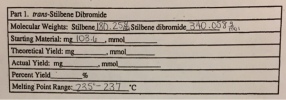 Part 1. trans-Stilbene Dibromide Molecular weights: Stilbene l50.25M stilbene dibromide BA0.00 Starting Material: mg IO3.le mmol, Theoretical Yield: m mmol Actual Yield: m mmol Percent Yield Melting Point Range: 23S- 23 TL "C
 After performing dehydrobromination of meso-stilbene dibromide,
why did we have to heat the reaction to such an extreme
temperature? And what is the slow step in this reaction - first or
second? Why?
OH КОН vorovo Br 190 °C Triethylene glycol solvent Diphenylacetylene meso-stilbene dibromide Figure 1. Reaction Scheme.
After performing dehydrobromination of meso-stilbene dibromide,
why did we have to heat the reaction to such an extreme
temperature? And what is the slow step in this reaction - first or
second? Why?
OH КОН vorovo Br 190 °C Triethylene glycol solvent Diphenylacetylene meso-stilbene dibromide Figure 1. Reaction Scheme.
 meso-stilbene dibromide when 0.90 g of E-stilbene are reacted 6.(4) Calculate the theoretical yield of meso-stilbene dibromide when 0.90 with excess bromine. 70) Write the structure of the product obtained when cyclohexene is used to decolorize bromine. containing solutions. Br Bra
 Discussion Questions: 1. a) Carefully draw a three-dimensional structure of each stereoisomer of stilbene dibromide. Do not include any identical structures. b) Identify the enantiomeric pair, and identify one pair of structures that are diastereomers. 2. Give careful stereo-drawings representing the complete mechanism for the reaction of cis-stilbene with bromine. Remember to show the two different modes of anti-attack that are possible, depending on whether you add the bromine from above to the left-hand or the right-hand carbon of the...
 1. (4 pts) Given the masses of meso-stilbene dibromide and potassium hydroxide, please calculate the theoretical yield of the expected reaction product, diphenylacetylene, in grams. Your final answ appear in the box provided, or it will not be counted. Show all work to receive credit. Br +KOH + KOH Br diphenylacetylene meso-stilbene dibromide Molecular Weight (g/mol) 340.058 g/mol 56.105 g/mol mass (grams) 178.234 g/mol 0.800 g 0.400 g
 Look up and draw the mechanism for the addition of Br2 to
double bonds. Reference the source from which you acquired the
mechanism.
Give the IUPAC name of the major product in the above-mentioned
reaction.
Draw the major product of obtained in the addition of Br2 to
stilbene.
Is this isomer chiral? What would be the optical rotation if
this sample was placed in a polarimeter?
Would a student obtain the same product if you started with
cis-stilbene instead of...
Look up and draw the mechanism for the addition of Br2 to
double bonds. Reference the source from which you acquired the
mechanism.
Give the IUPAC name of the major product in the above-mentioned
reaction.
Draw the major product of obtained in the addition of Br2 to
stilbene.
Is this isomer chiral? What would be the optical rotation if
this sample was placed in a polarimeter?
Would a student obtain the same product if you started with
cis-stilbene instead of...
 for objective, overall reaction of E-Stilbene to stilbene
dibromide.
BROMINATION OF E-STILBENE LAB REPORT TEMPLATE I. Introduction Define addition reactions of alkenes generally and electrophilic bromination of an alkene specifically. Include a separate, labeled figure depicting an overall reaction and mechanism for bromination of E-stilbene. Discuss electrophilic addition stereochemistry and the predicted product. II. Objective Describe the type of reaction performed and the specific starting material. Include a figure (prepared in ChemDraw) depicting the overall reaction performed in the lab...
for objective, overall reaction of E-Stilbene to stilbene
dibromide.
BROMINATION OF E-STILBENE LAB REPORT TEMPLATE I. Introduction Define addition reactions of alkenes generally and electrophilic bromination of an alkene specifically. Include a separate, labeled figure depicting an overall reaction and mechanism for bromination of E-stilbene. Discuss electrophilic addition stereochemistry and the predicted product. II. Objective Describe the type of reaction performed and the specific starting material. Include a figure (prepared in ChemDraw) depicting the overall reaction performed in the lab...
 Part 1. trans-Stilbene Dibromide Molecular weights: Stilbene l50.25M stilbene dibromide BA0.00 Starting Material: mg IO3.le mmol, Theoretical Yield: m mmol Actual Yield: m mmol Percent Yield Melting Point Range: 23S- 23 TL "C
Most questions answered within 3 hours.
-
Where is the error in this code sequence?
String s1 = "Hello";
String s2 = "ello";...
asked 11 months ago -
Financial data for Joel de Paris, Inc., for last year
follow:
Joel de Paris, Inc.
Balance...
asked 11 months ago -
Consider this reaction:
Al2(SO4)3 (aq)+ BaCl3
(aq) Al2Cl6 (aq)- +
3BaSO4(s) . What is the...
asked 11 months ago -
Suppose that Savneet is considering increasing her
recent random sample from 20 car rentals to 40...
asked 11 months ago -
Trucks arrive at an unloading terminal at an average rate of 120
per hour.
Trucks arrive...
asked 11 months ago -
Why are methanol and ethanol completely soluble in water while
octanol is not very little soluble....
asked 11 months ago -
A facilities manager at a university reads in a research report
that the mean amount of...
asked 11 months ago -
When the CuSO4 is rehydrated by adding water to the anhydrous
compound, is this an endothermic...
asked 11 months ago -
A ray of sunlight is passing from diamond into crown glass; the
angle of incidence is...
asked 11 months ago -
A block of mass 0.249 kg is placed on top of a light, vertical
spring of...
asked 11 months ago -
how do the kidneys compensate in the presences of acidosis
a) trigger hyperventilate
b) reserve acid...
asked 11 months ago -
Question 501 pts
The rental rate of capital to the firm increases. Which of the
following...
asked 11 months ago