using C++, NOT C language 1. Write a function called insert() to insert a node to...
Homework Answers
// header files
#include <iostream>
using namespace std;
// define class
class LinkedList
{
protected:
// declare structure for the list
struct ListNode
{
// declare value in node
double value;
// point to the next node
ListNode *next;
ListNode(double value = 0, ListNode *next = NULL)
{
this->value = value;
this->next = next;
}
};
// list head pointer
ListNode *head;
public:
// linked list operations
void insert(double num);
void printNode();
void deleteNode(int pos);
bool memberOf(double x);
LinkedList(const LinkedList &);
~LinkedList();
LinkedList()
{
head = NULL;
}
};
// copy constuctor
LinkedList::LinkedList(const LinkedList & otherList)
{
head = NULL;
// point to new node
ListNode *newNode;
// to move through in other list
ListNode *nodePtr;
// to move through developing list
ListNode *tempPtr;
// validate that other list is empty
if (!otherList.head)
return;
// let nodePtr point to the list to be copied
nodePtr = otherList.head;
// allocate a new node anod store
head = new ListNode();
head->value = nodePtr->value;
head->next = NULL;
// move onto next mode in the list to be copied
nodePtr = nodePtr->next;
// let tempPtr point to the list to be developed
tempPtr = head;
// copy the remaining list
while (nodePtr != NULL)
{
newNode = new ListNode;
newNode->value = nodePtr->value;
newNode->next = NULL;
tempPtr->next = newNode;
tempPtr = newNode;
nodePtr = nodePtr->next;
}
}
// add a new element to the end of the list
void LinkedList::insert(double number)
{
if (head == NULL)
head = new ListNode(number);
else
{
// list is not empty
ListNode *nodePtr = head;
//appendNode new node to the head of the list
head = new ListNode(number, nodePtr);
}
}
// printNode outputs a sequence of all values
void LinkedList::printNode()
{
ListNode *nodePtr = head;
cout << "List: ";
if (head == NULL)
{
cout << "List is empty" << endl;
}
while (nodePtr)
{
// printNode value in current node
cout << nodePtr->value << " ";
nodePtr = nodePtr->next;
}
}
// destrtor deallocates the memory used by the list.
LinkedList::~LinkedList()
{
ListNode *nodePtr = head;
while (nodePtr != NULL)
{
// keep track of node to be deleted
ListNode *garbage = nodePtr;
// move on to next node
nodePtr = nodePtr->next;
// delete the garbage node
delete garbage;
}
}
// remove method
void LinkedList::deleteNode(int pos)
{
// to move through the list
ListNode *nodePtr;
// to point to the previous node
ListNode *previousNode;
int i = 1;
// condition if list is empty
if (!head)
{
cout << "\nERROR: Cannot delete, list is empty";
return;
}
// position nodePtr at the head of list
nodePtr = head;
// to insert at first
if (pos == 1)
{
nodePtr = head->next;
delete head;
head = nodePtr;
}
else
{
while (nodePtr != NULL && i < pos)
{
previousNode = nodePtr;
nodePtr = nodePtr->next;
i++;
}
if (nodePtr)
{
previousNode->next = nodePtr->next;
delete nodePtr;
}
else
cout << "\nFailed to delete position " << pos << " not found";
}
nodePtr = head;
while (nodePtr)
{
// display the value in the node
cout << nodePtr->value << " -> ";
//move to the next node
nodePtr = nodePtr->next;
}
cout << "Null";
}
// main function
int main()
{
// declare a variable of chain list
LinkedList info;
for(int i = 1; i<=10 ; ++i)
info.insert(i*i);
info.printNode();
double x;
int pos;
cout << "\nPlease enter element position to be deleted: ";
cin >> pos;
info.deleteNode(pos);
return 0;
}
=====================================================================
SEE OUTPUT
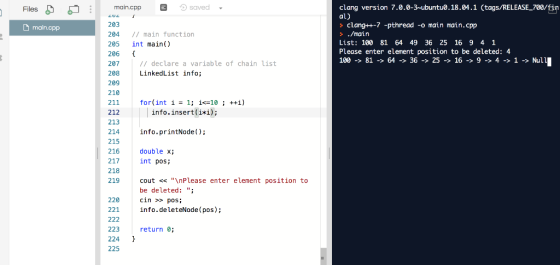
THANKS, PLEASE COMMENT if there is any concern.
Add Answer to:
using C++, NOT C language
1. Write a function called insert() to insert a node to...
Codelab question! This is c++. Consider the following code: // Linked Lists: TRAVERSE struct ListNode {...
Codelab question! This is c++. Consider the following code: // Linked Lists: TRAVERSE struct ListNode { int data; struct ListNode *next; }; Assume that a linked list has been created and head points to a sentinel node. A sentinel node is an empty data node in the beginning of the list. It sometimes holds a sentinel value. The use of sentinel nodes is a popular trick to simplify the insert and delete operations. You may also assume that the list...
Given the following linked list structure called node: struct node { int val; struct node *...
Given the following linked list structure called node: struct node { int val; struct node * ptrNext; }; Assume we have a single list created from this structure with a head pointer called ptrFirst which is declared in the global scope. a. Write a complete C function called CountEven to count all the even values in this singly linked list of arbitrary number of nodes using an iterative (non-recursive) approach. The function takes as parameter the pointer to the starting...
[C++] Create three functions for a singly linked list: - Function 1: Insert a string into...
[C++] Create three functions for a singly linked list: - Function 1: Insert a string into the linked list - Function 1: Insert a node after a given node (Node* curNodeptr, Node* newNodePtr) - Function 2: Delete the node passed to it by a pointer, it will take in the head and curPtr '(Node*, Node*)' struct Node{ string data; Node *next; };
implement a doubly-linked list in C. Each node in the linked list should contain a string,...
implement a doubly-linked list in C. Each node in the linked list should contain a string, a pointer to the previous node (or NULL), and a pointer to the next node (or NULL). The nodes should be sorted by their strings. struct node_t { char* str; struct node_t* prev; struct node_t* next; } To maintain the doubly-linked list, you should keep a pointer to the head node of the list (or NULL if the list is empty), and a pointer...
C LANGUAGE I just need the void push() function, which inserts new node to the front...
C LANGUAGE I just need the void push() function, which inserts new node to the front of the list #include<stdio.h> #include<stdlib.h> typedef struct node { int data; struct node *next; } Node; //Creating head a as a global Node* Node *head; /* Given a node prev_node, insert a new node after the given prev_node */ void insertAfter (Node * prev_node, int new_data) { /*1. check if the given prev_node is NULL */ if (prev_node == NULL) { printf ("the given...
Please slove all these questions in C language Write a function insert At Position N ()...
 Please slove all these questions in C language
Write a function insert At Position N () for a singly-linked list that has the following declaration and precondition: int insert At Position N (strict node **p Head, int n, int new Data); Precondition: n > 0 and the list always has enough nodes to satisfy the position specified by n. The function should allocate memory for a new node, and initialize it with the new Data value. It should then insert...
Please slove all these questions in C language
Write a function insert At Position N () for a singly-linked list that has the following declaration and precondition: int insert At Position N (strict node **p Head, int n, int new Data); Precondition: n > 0 and the list always has enough nodes to satisfy the position specified by n. The function should allocate memory for a new node, and initialize it with the new Data value. It should then insert...
***CODE MUST BE IN C++*** Using the linked list in "basic linked list" which has a...
***CODE MUST BE IN C++*** Using the linked list in "basic linked list" which has a STRUCTURE for each node, write FUNCTION which starts at the head and outputs the value for each node until the last node is reached. Note: your function should work with the structure that is in this program. Please do not use the example which is for a class, but this example canbe helkpful. Also note that the function must work no matter how many nodes...
Exercise-1:15 points Develop a node class and a singly list class. The node class should have two...
 Exercise-1:15 points Develop a node class and a singly list class. The node class should have two state variables namely data and nextNode. The singly list class should contain the following methods . Middlelnsert-insert a node somewhere in the middle of the list . Startinsert-insert a node at start of the Linked list Endinsert-insert a node at the end of the Linked list . Delete-delete a node Traverse-prints all the node's data Reverse -reverses the linked list Note: Choose appropriate...
Exercise-2: 15 points Develop a node class and a doubly list class. The node class should have tw...
 Exercise-2: 15 points Develop a node class and a doubly list class. The node class should have two state variables namely data and nextNode. The doubly list class should contain the following methods: Middlelnsert- insert a node somewhere in the middle of the list Startinsert-insert a node at start of the Linked list Endinsert- insert a node at the end of the Linked list Delete-delete a node Traverse-prints all the node's data Reverse-reverses the linked list . . Note: Choose...
C++ Assignment Project 1 - NodeList Building upon the the ListNode/List code I would like you...
C++ Assignment Project 1 - NodeList Building upon the the ListNode/List code I would like you to extend the interface of a list to have these member functions as well. struct ListNode { int element; ListNode *next; } Write a function to concatenate two linked lists. Given lists l1 = (2, 3, 1)and l2 = (4, 5), after return from l1.concatenate(l2)the list l1should be changed to be l1 = (2, 3, 1, 4, 5). Your function should not change l2and...
 Please slove all these questions in C language
Write a function insert At Position N () for a singly-linked list that has the following declaration and precondition: int insert At Position N (strict node **p Head, int n, int new Data); Precondition: n > 0 and the list always has enough nodes to satisfy the position specified by n. The function should allocate memory for a new node, and initialize it with the new Data value. It should then insert...
Please slove all these questions in C language
Write a function insert At Position N () for a singly-linked list that has the following declaration and precondition: int insert At Position N (strict node **p Head, int n, int new Data); Precondition: n > 0 and the list always has enough nodes to satisfy the position specified by n. The function should allocate memory for a new node, and initialize it with the new Data value. It should then insert...
 Exercise-1:15 points Develop a node class and a singly list class. The node class should have two state variables namely data and nextNode. The singly list class should contain the following methods . Middlelnsert-insert a node somewhere in the middle of the list . Startinsert-insert a node at start of the Linked list Endinsert-insert a node at the end of the Linked list . Delete-delete a node Traverse-prints all the node's data Reverse -reverses the linked list Note: Choose appropriate...
 Exercise-2: 15 points Develop a node class and a doubly list class. The node class should have two state variables namely data and nextNode. The doubly list class should contain the following methods: Middlelnsert- insert a node somewhere in the middle of the list Startinsert-insert a node at start of the Linked list Endinsert- insert a node at the end of the Linked list Delete-delete a node Traverse-prints all the node's data Reverse-reverses the linked list . . Note: Choose...
Most questions answered within 3 hours.
-
Where is the error in this code sequence?
String s1 = "Hello";
String s2 = "ello";...
asked 11 months ago -
Financial data for Joel de Paris, Inc., for last year
follow:
Joel de Paris, Inc.
Balance...
asked 11 months ago -
Consider this reaction:
Al2(SO4)3 (aq)+ BaCl3
(aq) Al2Cl6 (aq)- +
3BaSO4(s) . What is the...
asked 11 months ago -
Suppose that Savneet is considering increasing her
recent random sample from 20 car rentals to 40...
asked 11 months ago -
Trucks arrive at an unloading terminal at an average rate of 120
per hour.
Trucks arrive...
asked 11 months ago -
Why are methanol and ethanol completely soluble in water while
octanol is not very little soluble....
asked 11 months ago -
A facilities manager at a university reads in a research report
that the mean amount of...
asked 11 months ago -
When the CuSO4 is rehydrated by adding water to the anhydrous
compound, is this an endothermic...
asked 11 months ago -
A ray of sunlight is passing from diamond into crown glass; the
angle of incidence is...
asked 11 months ago -
A block of mass 0.249 kg is placed on top of a light, vertical
spring of...
asked 11 months ago -
how do the kidneys compensate in the presences of acidosis
a) trigger hyperventilate
b) reserve acid...
asked 11 months ago -
Question 501 pts
The rental rate of capital to the firm increases. Which of the
following...
asked 11 months ago