Python Programming: Provide trace tables for these loops. a. i = 0 j = 10 n...
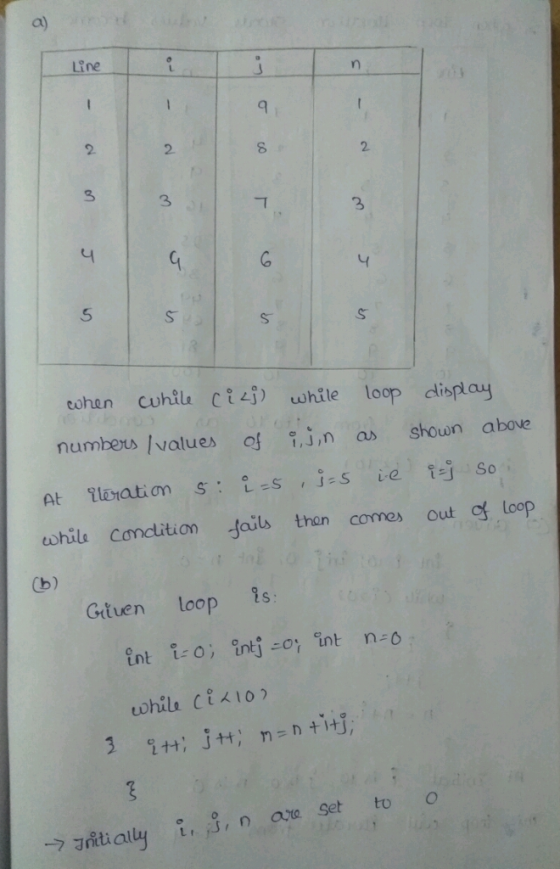
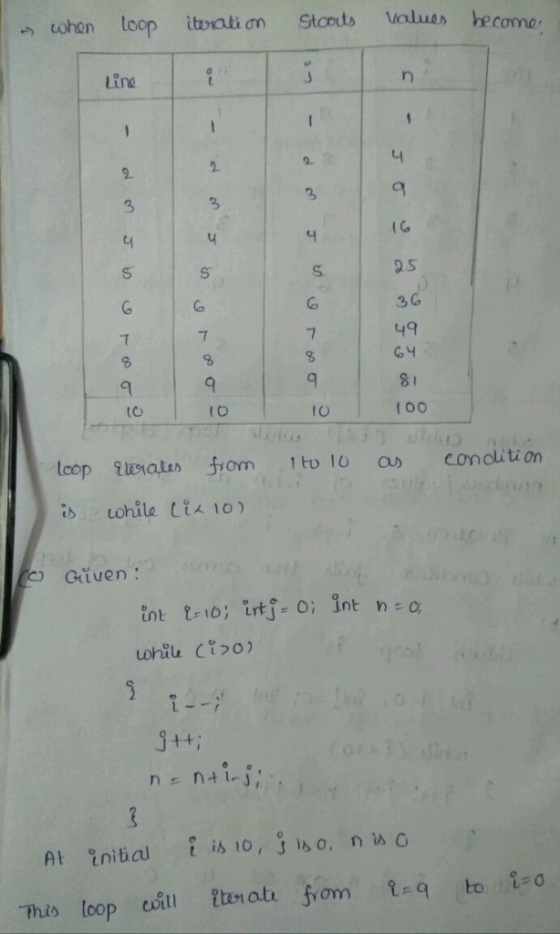
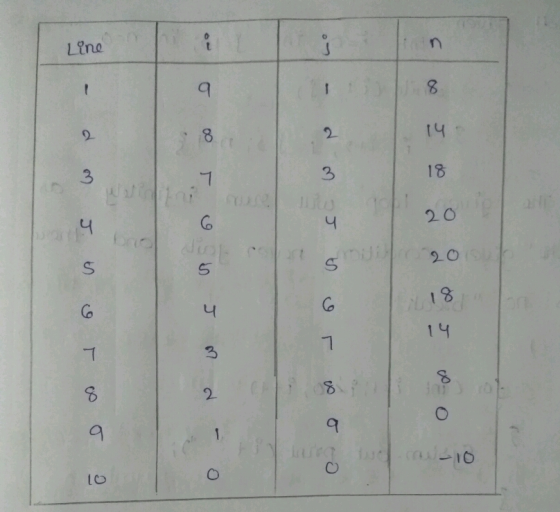
Python Programming: Provide trace tables for these loops. a. i = 0 j = 10 n = 0 while i < j : i = i + 1 j = j − 1 n = n + 1 b. i = 0 j = 0 n = 0 while i < 10 : i = i + 1 n = n + i + j j = j + 1 c. i = 10 j = 0 n = 0 while i > 0 : i = i – 1 j = j + 1 n = n + i − j d. i = 0 j = 10 n = 0 while i != j : i = i + 2 j = j – 2 n = n + 1
Homework Answers
`Hey,
Note: Brother in case of any queries, just comment in box I would be very happy to assist all your queries
d)
| i | j | n |
| 0 | 10 | 0 |
| 2 | 8 | 1 |
| 4 | 6 | 2 |
| 6 | 4 | 3 |
| 8 | 2 | 4 |
| 10 | 0 | 5 |
| 12 | -2 | 6 |
| 14 | -4 | 7 |
| 16 | -6 | 8 |
| 18 | -8 | 9 |
| 20 | -10 | 10 |
| 22 | -12 | 11 |
| 24 | -14 | 12 |
| 26 | -16 | 13 |
| 28 | -18 | 14 |
| 30 | -20 | 15 |
| 32 | -22 | 16 |
|
Up to infinity |
Up to infinity | Up to infinity |
This Loop is continued until i not equals to j.here we are getting infinite values for i,j & n .
Kindly revert for any queries
Thanks.
Add Answer to:
Python Programming: Provide trace tables for these loops. a. i =
0 j = 10 n...
loops a.Create a For loop with a variable i that is type integer. It is equal...
loops a.Create a For loop with a variable i that is type integer. It is equal to 0 . Evaluate if i is less than three, then increment i. Statement should be to trace b. Create a For Loop with a variable i equal to 3. If I is greater than 0, decrement i. The statement should be to trace i c. Declare a variable for i to be an integer with a value of 0. While it is less...
#include<stdio.h> eint main() { int i = 0, j = 0; while (i < 10|| j...
 #include<stdio.h> eint main() { int i = 0, j = 0; while (i < 10|| j < 7) { i++; j++; } printf("%d, %d\n", i, j); getchar(); return 0; } 01,01 10,10 7.7 10,7
Python What do the following loops print? Work out the answer by tracing the code, not...
 Python
What do the following loops print? Work out the answer by tracing the code, not by using the computer. a. s = 2 for n in range (1, 6): s = s + n print(s) b. s = 1 for n in range (1, 11): n = n + 2 s = s + n print(s) c. S = 1 for in range (1, 6) s = s + n n = n + 1 print(s, n) Rewrite the...
Python
What do the following loops print? Work out the answer by tracing the code, not by using the computer. a. s = 2 for n in range (1, 6): s = s + n print(s) b. s = 1 for n in range (1, 11): n = n + 2 s = s + n print(s) c. S = 1 for in range (1, 6) s = s + n n = n + 1 print(s, n) Rewrite the...
Find the following: (a) trace(J). b) trace nm (c) trace (I)
 Find the following: (a) trace(J). b) trace nm (c) trace (I)
using python 1. Translate the following FOR loops to equivalent WHILE loops: a. for count in...
using python 1. Translate the following FOR loops to equivalent WHILE loops: a. for count in range(100): print(count) b. for count in range(1, 101): print(count) c. for count in range(100, 0, –1): print(count)
Poly-Poly + a[i] * power 6. (15%) Consider the nested loops shown below, where N is...
 Poly-Poly + a[i] * power 6. (15%) Consider the nested loops shown below, where N is assumed to be a power of 2. i.e., N-2 for some positive integer k. i=N; while (i>-1){ while (j =N){ j-2 *j; i=i/2. a) Determine the number of outer iterations (associated with the outer while loop) to be executed? Show your work. b) For each outer iteration (for each value of i), determine the number of iterations of the inner while loop to be...
What is the complexity of the following nested loops? for i = n to 1 step...
What is the complexity of the following nested loops? for i = n to 1 step -1 do j ← i while j ≥ 1 Θ(j) statement j ← ëj/2û endwhile endfor
Python programming: Write a while loop that prints a. All squares less than n. For example,...
Python programming: Write a while loop that prints a. All squares less than n. For example, if n is 100, print 0 1 4 9 16 25 36 49 64 81. b. All positive numbers that are divisible by 10 and less than n. For example, if n is 100, print 10 20 30 40 50 60 70 80 90 c. All powers of two less than n. For example, if n is 100, print 1 2 4 8 16...
use python and one loop to solve this problem Q6: Secondary Trace You are given a...
 use python and one loop to solve this problem
Q6: Secondary Trace You are given a function that takes a square array, matrix, and returns the sum of the secondary diagonal values for matrix. This function employs a nested 2D for-loop. Write a function secondary trace single loop that solves the same problem using only one for-loop. For example, on the picture below secondary diagonal consists of values: a03, a12, a21, a30. a00 a01 a02 a03 a10 all a12 a13...
use python and one loop to solve this problem
Q6: Secondary Trace You are given a function that takes a square array, matrix, and returns the sum of the secondary diagonal values for matrix. This function employs a nested 2D for-loop. Write a function secondary trace single loop that solves the same problem using only one for-loop. For example, on the picture below secondary diagonal consists of values: a03, a12, a21, a30. a00 a01 a02 a03 a10 all a12 a13...
Python programming. Provide different code snippets for each of the following complexities. O(n2) O(n) O(1) O(...
 Python programming.
Provide different code snippets for each of the following
complexities.
O(n2)
O(n)
O(1)
O( nlog(n) )
O( log(n) )
10 points] Provide different code snippets for each of the following complexities. O(n) O( log(n))
Python programming.
Provide different code snippets for each of the following
complexities.
O(n2)
O(n)
O(1)
O( nlog(n) )
O( log(n) )
10 points] Provide different code snippets for each of the following complexities. O(n) O( log(n))
 #include<stdio.h> eint main() { int i = 0, j = 0; while (i < 10|| j < 7) { i++; j++; } printf("%d, %d\n", i, j); getchar(); return 0; } 01,01 10,10 7.7 10,7
 Python
What do the following loops print? Work out the answer by tracing the code, not by using the computer. a. s = 2 for n in range (1, 6): s = s + n print(s) b. s = 1 for n in range (1, 11): n = n + 2 s = s + n print(s) c. S = 1 for in range (1, 6) s = s + n n = n + 1 print(s, n) Rewrite the...
Python
What do the following loops print? Work out the answer by tracing the code, not by using the computer. a. s = 2 for n in range (1, 6): s = s + n print(s) b. s = 1 for n in range (1, 11): n = n + 2 s = s + n print(s) c. S = 1 for in range (1, 6) s = s + n n = n + 1 print(s, n) Rewrite the...
 Find the following: (a) trace(J). b) trace nm (c) trace (I)
 Poly-Poly + a[i] * power 6. (15%) Consider the nested loops shown below, where N is assumed to be a power of 2. i.e., N-2 for some positive integer k. i=N; while (i>-1){ while (j =N){ j-2 *j; i=i/2. a) Determine the number of outer iterations (associated with the outer while loop) to be executed? Show your work. b) For each outer iteration (for each value of i), determine the number of iterations of the inner while loop to be...
 use python and one loop to solve this problem
Q6: Secondary Trace You are given a function that takes a square array, matrix, and returns the sum of the secondary diagonal values for matrix. This function employs a nested 2D for-loop. Write a function secondary trace single loop that solves the same problem using only one for-loop. For example, on the picture below secondary diagonal consists of values: a03, a12, a21, a30. a00 a01 a02 a03 a10 all a12 a13...
use python and one loop to solve this problem
Q6: Secondary Trace You are given a function that takes a square array, matrix, and returns the sum of the secondary diagonal values for matrix. This function employs a nested 2D for-loop. Write a function secondary trace single loop that solves the same problem using only one for-loop. For example, on the picture below secondary diagonal consists of values: a03, a12, a21, a30. a00 a01 a02 a03 a10 all a12 a13...
 Python programming.
Provide different code snippets for each of the following
complexities.
O(n2)
O(n)
O(1)
O( nlog(n) )
O( log(n) )
10 points] Provide different code snippets for each of the following complexities. O(n) O( log(n))
Python programming.
Provide different code snippets for each of the following
complexities.
O(n2)
O(n)
O(1)
O( nlog(n) )
O( log(n) )
10 points] Provide different code snippets for each of the following complexities. O(n) O( log(n))
Most questions answered within 3 hours.
-
Where is the error in this code sequence?
String s1 = "Hello";
String s2 = "ello";...
asked 11 months ago -
Financial data for Joel de Paris, Inc., for last year
follow:
Joel de Paris, Inc.
Balance...
asked 11 months ago -
Consider this reaction:
Al2(SO4)3 (aq)+ BaCl3
(aq) Al2Cl6 (aq)- +
3BaSO4(s) . What is the...
asked 11 months ago -
Suppose that Savneet is considering increasing her
recent random sample from 20 car rentals to 40...
asked 11 months ago -
Trucks arrive at an unloading terminal at an average rate of 120
per hour.
Trucks arrive...
asked 11 months ago -
Why are methanol and ethanol completely soluble in water while
octanol is not very little soluble....
asked 11 months ago -
A facilities manager at a university reads in a research report
that the mean amount of...
asked 11 months ago -
When the CuSO4 is rehydrated by adding water to the anhydrous
compound, is this an endothermic...
asked 11 months ago -
A ray of sunlight is passing from diamond into crown glass; the
angle of incidence is...
asked 11 months ago -
A block of mass 0.249 kg is placed on top of a light, vertical
spring of...
asked 11 months ago -
how do the kidneys compensate in the presences of acidosis
a) trigger hyperventilate
b) reserve acid...
asked 11 months ago -
Question 501 pts
The rental rate of capital to the firm increases. Which of the
following...
asked 11 months ago