A 2.00 kg remote controlled car is equipped with a single electric motor that provides the...
A 2.00 kg remote controlled car is equipped with a single electric motor that provides the car with the power necessary for it to accelerate.
a. The maximum power rating of the electric motor is 168 Watts. Using the motor at this maximum rated power, how long will it take to accelerate a 2.00 kg car from 5.00 m/s to 14.5 m/s if we neglect all frictional losses?
b. Calculate the average acceleration of the car during this period.
c. Calculate how far the car moves during this period. Start from the point where the car was moving at the initial velocity of 5.0 m/s and end at the point where the car has achieved the final velocity of 14.5 m/s.
Homework Answers

Add Answer to:
A 2.00 kg remote controlled car is equipped with a single
electric motor that provides the...
Last Name: 1. A 2000-kg electric car is equipped with an 80 kW electric motor. It...
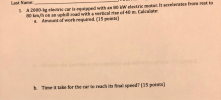 Last Name: 1. A 2000-kg electric car is equipped with an 80 kW electric motor. It accelerates from rest to 80 km/h on an uphill road with a vertical rise of 40 m. Calculate: a. Amount of work required. (15 points) b. Time it take for the car to reach its final speed? (15 points)
A radio-controlled car powered by an electric motor accelerates from rest to 0.500 m/s in 35.0...
A radio-controlled car powered by an electric motor accelerates from rest to 0.500 m/s in 35.0 ms. The total mass of the car is 720 g. What is the average power (in W) delivered to the car by the motor during its acceleration? Please show your work and explain.
Exercise 3.8 Constants A remote-controlled car is moving in a vacant parking lot. The velocity of...
 Exercise 3.8 Constants A remote-controlled car is moving in a vacant parking lot. The velocity of the car as a function of time is given by 0 15.00 m/s-(0.0180 m/s )li+ 2.00 m/s + (0.60 m/tj
A small remote-controlled car with mass 1.60 kg moves at a constant speed of v =...
A small remote-controlled car with mass 1.60 kg moves at a constant speed of v = 12.0 m/s in a track formed by a vertical circle inside a hollow metal cylinder that has a radius of 5.00 m, see Fig below. What is the magnitude of the normal force exerted on the car by the walls of the cylinder at a) point A (bottom of the track)? b) point B (top of the track)?
A small remote-controlled car with mass 1.5 kg moves at a constant speed of 12 m.s...
 A small remote-controlled car with mass 1.5 kg moves at a constant speed of 12 m.s in a vertical circle inside a metal track (see figure). B V = 12.0 m/s 5.00 m A. What is its centripetal acceleration? m.s B. What is the magnitude of the centripetal force acting on the car? N C. What is the magnitude of the force exerted by the track on the car at point B? N
A small remote-controlled car with mass 1.60 kg moves at a constant speed of v= 12.0...
 A small remote-controlled car with mass 1.60 kg moves at a constant speed of v= 12.0 m/s in a track formed by a vertical circle inside a hollow metal cylinder that has a radius of 5.00 m, see Fig below. What is the magnitude of the normal force exerted on the car by the walls of the cylinder at 5.00 m 3. point A (bottom of the track)? (20 points) 4. point B (top of the track)? (20 points)
i already tried poaitive 65.2 A remote-controlled car is moving in a vacant parking lot. The...
 i already tried poaitive 65.2
A remote-controlled car is moving in a vacant parking lot. The velocity of the car as a function of time is given by v = [5.00 m/s - (0.0180 m/s^3)t^2]i + [2.00 m/s + (0.550 m/s^2)t]j. What is the direction (in degrees counterclockwise from +x-axis) of the acceleration of the car at t = 7.05 s ? Express your answer to three significant figures and include the appropriate units.
i already tried poaitive 65.2
A remote-controlled car is moving in a vacant parking lot. The velocity of the car as a function of time is given by v = [5.00 m/s - (0.0180 m/s^3)t^2]i + [2.00 m/s + (0.550 m/s^2)t]j. What is the direction (in degrees counterclockwise from +x-axis) of the acceleration of the car at t = 7.05 s ? Express your answer to three significant figures and include the appropriate units.
please help Question 16 (5 points) Two masses of mass 3.5 kg and 8.0 kg are...
 please help
Question 16 (5 points) Two masses of mass 3.5 kg and 8.0 kg are initially stationary, and no external forces act on these objects. if the objects are 48 cm apart, and the two masses attract each other and meet, how far does the 3.5-kg mass move, in cm, from its original position to the point where the masses meet? (Enter number only; do not include units.) Your Answer: Answer Question 17 (5 points) The power of an...
please help
Question 16 (5 points) Two masses of mass 3.5 kg and 8.0 kg are initially stationary, and no external forces act on these objects. if the objects are 48 cm apart, and the two masses attract each other and meet, how far does the 3.5-kg mass move, in cm, from its original position to the point where the masses meet? (Enter number only; do not include units.) Your Answer: Answer Question 17 (5 points) The power of an...
first picture has the information you need to do the other parts A remote-controlled car is...
 first picture has the information you need to do the other
parts
A remote-controlled car is moving in a vacant parking lot. The velocity of the car as a function of time is given by ū– (5.00 m/s – (0.0180 m/s”){%)+ [2.00 m/s + (0.550 m/s?)t)ì. Part C What is the magnitude of the velocity of the car at t = 6.73 s? Express your answer to three significant figures and include the app ? v= Value Units Submit Request...
first picture has the information you need to do the other
parts
A remote-controlled car is moving in a vacant parking lot. The velocity of the car as a function of time is given by ū– (5.00 m/s – (0.0180 m/s”){%)+ [2.00 m/s + (0.550 m/s?)t)ì. Part C What is the magnitude of the velocity of the car at t = 6.73 s? Express your answer to three significant figures and include the app ? v= Value Units Submit Request...
Consider a Porsche 911 sports car with a mass of 1900 kg. The air drag force...
 Consider a Porsche 911 sports car with a mass of 1900 kg. The air drag force at highway speeds can be approximately calculated as: F_drag = 1/2 C p Av^2 where p = 1.2 kg/m^3 is the density of air, A is the front area of the car, C is the drag coefficient and v is the velocity. For the Porsche 911, we can take A - 2.3 m^2 and C = 0.28. What is the power necessary to overcome...
 Last Name: 1. A 2000-kg electric car is equipped with an 80 kW electric motor. It accelerates from rest to 80 km/h on an uphill road with a vertical rise of 40 m. Calculate: a. Amount of work required. (15 points) b. Time it take for the car to reach its final speed? (15 points)
 Exercise 3.8 Constants A remote-controlled car is moving in a vacant parking lot. The velocity of the car as a function of time is given by 0 15.00 m/s-(0.0180 m/s )li+ 2.00 m/s + (0.60 m/tj
 A small remote-controlled car with mass 1.5 kg moves at a constant speed of 12 m.s in a vertical circle inside a metal track (see figure). B V = 12.0 m/s 5.00 m A. What is its centripetal acceleration? m.s B. What is the magnitude of the centripetal force acting on the car? N C. What is the magnitude of the force exerted by the track on the car at point B? N
 A small remote-controlled car with mass 1.60 kg moves at a constant speed of v= 12.0 m/s in a track formed by a vertical circle inside a hollow metal cylinder that has a radius of 5.00 m, see Fig below. What is the magnitude of the normal force exerted on the car by the walls of the cylinder at 5.00 m 3. point A (bottom of the track)? (20 points) 4. point B (top of the track)? (20 points)
 i already tried poaitive 65.2
A remote-controlled car is moving in a vacant parking lot. The velocity of the car as a function of time is given by v = [5.00 m/s - (0.0180 m/s^3)t^2]i + [2.00 m/s + (0.550 m/s^2)t]j. What is the direction (in degrees counterclockwise from +x-axis) of the acceleration of the car at t = 7.05 s ? Express your answer to three significant figures and include the appropriate units.
i already tried poaitive 65.2
A remote-controlled car is moving in a vacant parking lot. The velocity of the car as a function of time is given by v = [5.00 m/s - (0.0180 m/s^3)t^2]i + [2.00 m/s + (0.550 m/s^2)t]j. What is the direction (in degrees counterclockwise from +x-axis) of the acceleration of the car at t = 7.05 s ? Express your answer to three significant figures and include the appropriate units.
 please help
Question 16 (5 points) Two masses of mass 3.5 kg and 8.0 kg are initially stationary, and no external forces act on these objects. if the objects are 48 cm apart, and the two masses attract each other and meet, how far does the 3.5-kg mass move, in cm, from its original position to the point where the masses meet? (Enter number only; do not include units.) Your Answer: Answer Question 17 (5 points) The power of an...
please help
Question 16 (5 points) Two masses of mass 3.5 kg and 8.0 kg are initially stationary, and no external forces act on these objects. if the objects are 48 cm apart, and the two masses attract each other and meet, how far does the 3.5-kg mass move, in cm, from its original position to the point where the masses meet? (Enter number only; do not include units.) Your Answer: Answer Question 17 (5 points) The power of an...
 first picture has the information you need to do the other
parts
A remote-controlled car is moving in a vacant parking lot. The velocity of the car as a function of time is given by ū– (5.00 m/s – (0.0180 m/s”){%)+ [2.00 m/s + (0.550 m/s?)t)ì. Part C What is the magnitude of the velocity of the car at t = 6.73 s? Express your answer to three significant figures and include the app ? v= Value Units Submit Request...
first picture has the information you need to do the other
parts
A remote-controlled car is moving in a vacant parking lot. The velocity of the car as a function of time is given by ū– (5.00 m/s – (0.0180 m/s”){%)+ [2.00 m/s + (0.550 m/s?)t)ì. Part C What is the magnitude of the velocity of the car at t = 6.73 s? Express your answer to three significant figures and include the app ? v= Value Units Submit Request...
 Consider a Porsche 911 sports car with a mass of 1900 kg. The air drag force at highway speeds can be approximately calculated as: F_drag = 1/2 C p Av^2 where p = 1.2 kg/m^3 is the density of air, A is the front area of the car, C is the drag coefficient and v is the velocity. For the Porsche 911, we can take A - 2.3 m^2 and C = 0.28. What is the power necessary to overcome...
Most questions answered within 3 hours.
-
Where is the error in this code sequence?
String s1 = "Hello";
String s2 = "ello";...
asked 10 months ago -
Financial data for Joel de Paris, Inc., for last year
follow:
Joel de Paris, Inc.
Balance...
asked 10 months ago -
Consider this reaction:
Al2(SO4)3 (aq)+ BaCl3
(aq) Al2Cl6 (aq)- +
3BaSO4(s) . What is the...
asked 10 months ago -
Suppose that Savneet is considering increasing her
recent random sample from 20 car rentals to 40...
asked 10 months ago -
Trucks arrive at an unloading terminal at an average rate of 120
per hour.
Trucks arrive...
asked 10 months ago -
Why are methanol and ethanol completely soluble in water while
octanol is not very little soluble....
asked 10 months ago -
A facilities manager at a university reads in a research report
that the mean amount of...
asked 10 months ago -
When the CuSO4 is rehydrated by adding water to the anhydrous
compound, is this an endothermic...
asked 10 months ago -
A ray of sunlight is passing from diamond into crown glass; the
angle of incidence is...
asked 10 months ago -
A block of mass 0.249 kg is placed on top of a light, vertical
spring of...
asked 10 months ago -
how do the kidneys compensate in the presences of acidosis
a) trigger hyperventilate
b) reserve acid...
asked 10 months ago -
Question 501 pts
The rental rate of capital to the firm increases. Which of the
following...
asked 10 months ago