Do small changes in permeability produce small changes in Vm for both Na+ and K+? Are...
Homework Answers
Concepts
Formula Used: Goldman equation

where PK, PNa and PCl= permeabilities for K+, Na+ and Cl- ions, respectively. Vm is the membrane potential. z is the valence the ion. Since, Cl- ion is not included, hence,

Answer:
Increasing permeability of a membrane for ion shifts the membrane potential towards the equilibrium potential for that type of ion.
Now, we can assume Goldman equation to be a logarithmic equation of type y = log(x)
Differentiating this equation we get,

Assume  to be Vm and
  to be the term containing permeability. This equation indicates
that the magnitude of
depends on the magnitude of
and x.
to be the term containing permeability. This equation indicates
that the magnitude of
depends on the magnitude of
and x.
- if
 , increase in
  is much more than the increase in
  .
. - if
 increase in
is less in comparison to increase in
.
increase in
is less in comparison to increase in
.
 , increase in
  increase in
 Living membranes are highly permeable to potassium but have limited permeability for sodium.
Hence, even a small change (increase) in the permeability of potassium shifts the Vm value towards the Eion (equilibrium potential) of potassium.
However, a large amount of change (increase) in the permeability of sodium is required to shift the Vm value to the Eion of sodium ion. This is because of the permeability of sodium ions. It is very less for biological membranes.
Add Answer to:
Do
small changes in permeability produce small changes in Vm for both
Na+ and K+? Are...
What is the membrane potential (Vm) if the permeability of Calcium is raised to 60? Consider...
 What is the membrane potential (Vm) if the permeability of
Calcium is raised to 60?
Consider this cell. Use this information to answer the following questions. IN OUT Relative Permeability [Na+]mM 0.05 10 100 [K+]mM 1.0 [CI]mM 0.05 [Ca++]mM 0.001 0.00001 [A-]mM 105
What is the membrane potential (Vm) if the permeability of
Calcium is raised to 60?
Consider this cell. Use this information to answer the following questions. IN OUT Relative Permeability [Na+]mM 0.05 10 100 [K+]mM 1.0 [CI]mM 0.05 [Ca++]mM 0.001 0.00001 [A-]mM 105
balance of Na+ is clearly important. If very large changes in Na+ are required to alter...
balance of Na+ is clearly important. If very large changes in Na+ are required to alter the membrane potential, then what effect do more subtle changes of Na+ have on cells
In the operation of the Na+-K+ pump: A) a Na+ is transported out of the cell...
In the operation of the Na+-K+ pump: A) a Na+ is transported out of the cell for every K+ transported into the cell. B) Na+ and K+ are both transported out of the cell. C) the membrane transport protein is phosphorylated by ATP. D) conformational changes in the membrane protein are inhibited. E) Na+ and K+ bind to the lipid portion of the membrane.
(OHow does the relative permeability of the membrane to Na and K throughout the course of...
 (OHow does the relative permeability of the membrane to Na and K throughout the course of the action potential change compared with that at the resting membrane potential? From the following, select the statement(s) which are CORRECT: Select one or more: a. The number of potassium voltage-gated channels that open determine the amplitude of the action potential b. During the peak of an action potential, there is a 500x increase in the concentration of Na+ that move into the cell....
ssignment: Ch 4,5 ng Activity Figure 5.23 0 150 mM K+ No ion permeability = no...
 ssignment: Ch 4,5 ng Activity Figure 5.23 0 150 mM K+ No ion permeability = no membrane potential e 0 + + 0 The first Kion leaves the cell 0 + Concentration gradient K+ leak channel 5 mM K 0 + + + -1 Equilibrium potential of -90 mV + Electrical gradient
small lipids like short-chain fatty acids water (H20) electrolytes (K+, Na+, Cl-) small peptides small carbohydrates...
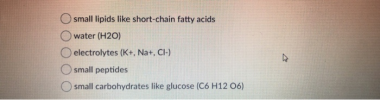 small lipids like short-chain fatty acids water (H20) electrolytes (K+, Na+, Cl-) small peptides small carbohydrates like glucose (C6H12 06) which class of molecule has the highest probabilities of simple diffusion across a membrane? small lipids like short-chain fatty acids water (H20) electrolytes (K+, Na+, Cl-) small peptides small carbohydrates like glucose (C6 H12 06)
Each component gives membranes different purposes. For example, the lipid component provides a permeability barrier for...
Each component gives membranes different purposes. For example, the lipid component provides a permeability barrier for the cell – meaning, since the lipid bilayer has a nonpolar region from the hydrophobic lipid tails, any charged molecule will have a difficult time getting through. Therefore, small, uncharged molecules (i.e. nonpolar) can diffuse through the membrane the best due to the membrane properties. Small, partially charged molecules (i.e. polar) can diffuse across the membrane as well, but large polar molecules or fully...
You are working with a mammalian cell that has K+ leak channels, Na+ leak channels, and...
You are working with a mammalian cell that has K+ leak channels, Na+ leak channels, and Na+ /K+ ATPase. In the extracellular solution, you use NaCl and KCl in which both the Na+ and K+ ions were radioactively labeled. The ion concentrations are as follows: inside [K+ ] = 150 mM, inside [Na+ ] = 10 mM, outside [K+ ] = 15 mM, outside [Na+ ] = 140 mM. a. When the Na+ ions are at electrochemical equilibrium, what is...
Changes in K+ ion concentrations are often dangerous. Simply doubling the concentration of K+ in the...
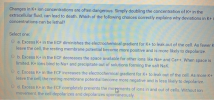 Changes in K+ ion concentrations are often dangerous. Simply doubling the concentration of K+ in the extracellular fluid, can lead to death. Which of the following choices correctly explains why deviations in K+ concentrations can be lethal? Select one: a. Excess K+ in the ECF diminishes the electrochemical gradient for K+ to leak out of the cell. As fewerk leave the cell, the resting membrane potential become more positive and is more likely to depolarize. b. Excess K+ in the...
choices for A: Na+/K+ pumps, voltage gated K+ channels, voltage gated Ca+ channels, voltage gated Na+...
 choices for A: Na+/K+ pumps, voltage gated K+ channels,
voltage gated Ca+ channels, voltage gated Na+ channels
choices for B: bidirectionally, unidirectionally
choices for C: Na+/K+ pumps, voltage gated K+ channels,
voltage gated Ca+ channels, voltage gated Na+ channels
choices for D: Na+/K+ pumps, voltage gated K+ channels,
voltage gated Ca+ channels, voltage gated Na+ channels
Consider this graph illustrating the generation of an action potential across the plasma membrane of a stimulated neuron. +40 ACTION POTENTIAL plasma membrane potential...
choices for A: Na+/K+ pumps, voltage gated K+ channels,
voltage gated Ca+ channels, voltage gated Na+ channels
choices for B: bidirectionally, unidirectionally
choices for C: Na+/K+ pumps, voltage gated K+ channels,
voltage gated Ca+ channels, voltage gated Na+ channels
choices for D: Na+/K+ pumps, voltage gated K+ channels,
voltage gated Ca+ channels, voltage gated Na+ channels
Consider this graph illustrating the generation of an action potential across the plasma membrane of a stimulated neuron. +40 ACTION POTENTIAL plasma membrane potential...
 What is the membrane potential (Vm) if the permeability of
Calcium is raised to 60?
Consider this cell. Use this information to answer the following questions. IN OUT Relative Permeability [Na+]mM 0.05 10 100 [K+]mM 1.0 [CI]mM 0.05 [Ca++]mM 0.001 0.00001 [A-]mM 105
What is the membrane potential (Vm) if the permeability of
Calcium is raised to 60?
Consider this cell. Use this information to answer the following questions. IN OUT Relative Permeability [Na+]mM 0.05 10 100 [K+]mM 1.0 [CI]mM 0.05 [Ca++]mM 0.001 0.00001 [A-]mM 105
 (OHow does the relative permeability of the membrane to Na and K throughout the course of the action potential change compared with that at the resting membrane potential? From the following, select the statement(s) which are CORRECT: Select one or more: a. The number of potassium voltage-gated channels that open determine the amplitude of the action potential b. During the peak of an action potential, there is a 500x increase in the concentration of Na+ that move into the cell....
 ssignment: Ch 4,5 ng Activity Figure 5.23 0 150 mM K+ No ion permeability = no membrane potential e 0 + + 0 The first Kion leaves the cell 0 + Concentration gradient K+ leak channel 5 mM K 0 + + + -1 Equilibrium potential of -90 mV + Electrical gradient
 small lipids like short-chain fatty acids water (H20) electrolytes (K+, Na+, Cl-) small peptides small carbohydrates like glucose (C6H12 06) which class of molecule has the highest probabilities of simple diffusion across a membrane? small lipids like short-chain fatty acids water (H20) electrolytes (K+, Na+, Cl-) small peptides small carbohydrates like glucose (C6 H12 06)
 Changes in K+ ion concentrations are often dangerous. Simply doubling the concentration of K+ in the extracellular fluid, can lead to death. Which of the following choices correctly explains why deviations in K+ concentrations can be lethal? Select one: a. Excess K+ in the ECF diminishes the electrochemical gradient for K+ to leak out of the cell. As fewerk leave the cell, the resting membrane potential become more positive and is more likely to depolarize. b. Excess K+ in the...
 choices for A: Na+/K+ pumps, voltage gated K+ channels,
voltage gated Ca+ channels, voltage gated Na+ channels
choices for B: bidirectionally, unidirectionally
choices for C: Na+/K+ pumps, voltage gated K+ channels,
voltage gated Ca+ channels, voltage gated Na+ channels
choices for D: Na+/K+ pumps, voltage gated K+ channels,
voltage gated Ca+ channels, voltage gated Na+ channels
Consider this graph illustrating the generation of an action potential across the plasma membrane of a stimulated neuron. +40 ACTION POTENTIAL plasma membrane potential...
choices for A: Na+/K+ pumps, voltage gated K+ channels,
voltage gated Ca+ channels, voltage gated Na+ channels
choices for B: bidirectionally, unidirectionally
choices for C: Na+/K+ pumps, voltage gated K+ channels,
voltage gated Ca+ channels, voltage gated Na+ channels
choices for D: Na+/K+ pumps, voltage gated K+ channels,
voltage gated Ca+ channels, voltage gated Na+ channels
Consider this graph illustrating the generation of an action potential across the plasma membrane of a stimulated neuron. +40 ACTION POTENTIAL plasma membrane potential...
Most questions answered within 3 hours.
-
Where is the error in this code sequence?
String s1 = "Hello";
String s2 = "ello";...
asked 11 months ago -
Financial data for Joel de Paris, Inc., for last year
follow:
Joel de Paris, Inc.
Balance...
asked 11 months ago -
Consider this reaction:
Al2(SO4)3 (aq)+ BaCl3
(aq) Al2Cl6 (aq)- +
3BaSO4(s) . What is the...
asked 11 months ago -
Suppose that Savneet is considering increasing her
recent random sample from 20 car rentals to 40...
asked 11 months ago -
Trucks arrive at an unloading terminal at an average rate of 120
per hour.
Trucks arrive...
asked 11 months ago -
Why are methanol and ethanol completely soluble in water while
octanol is not very little soluble....
asked 11 months ago -
A facilities manager at a university reads in a research report
that the mean amount of...
asked 11 months ago -
When the CuSO4 is rehydrated by adding water to the anhydrous
compound, is this an endothermic...
asked 11 months ago -
A ray of sunlight is passing from diamond into crown glass; the
angle of incidence is...
asked 11 months ago -
A block of mass 0.249 kg is placed on top of a light, vertical
spring of...
asked 11 months ago -
how do the kidneys compensate in the presences of acidosis
a) trigger hyperventilate
b) reserve acid...
asked 11 months ago -
Question 501 pts
The rental rate of capital to the firm increases. Which of the
following...
asked 11 months ago