One end of a strong magnet is brought close to the end of a metal bar...
Homework Answers
1. Permanent magnet : if it get attracted ar one end and repelled at another then it is permanent magnet
2. Ferromagnetic: If it attracted at bit the end
3. Not a magnet : if both end shows no magnetic force ( because if it is magnetic then it must repel or attract .
Add Answer to:
One end of a strong magnet is brought close to the end of a
metal bar...
A non-magnetic metal ring is suspended from a thread. It is spinning. You bring a strong...
A non-magnetic metal ring is suspended from a thread. It is spinning. You bring a strong magnet near the ring but not touching it and the ring stops rotating. What is happening? A. The ring is being repelled by the magnet. B. The ring is being attracted to the magnet. C. The part of the ring approaching the magnet is repelled from the magnet and the part of the ring moving away from the magnet is attracted to the magnet....
A bar magnetic is brought close to a flat conducting metal surface. What can be said...
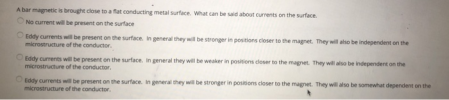 A bar magnetic is brought close to a flat conducting metal surface. What can be said about currents on the surface. No current will be present on the surface Eddy currents will be present on the surface. In general they will be stronger in positions closer to the magnet. They will also be independent on the microstructure of the conductor. Eddy currents will be present on the surface. In general they will be weaker in positions closer to the magnet....
The earth's magnetic field appears as if it were produced by a strong permanent magnet embedded...
 The earth's magnetic field
appears as if it were produced by a strong permanent magnet
embedded in its core. In the figures below, the earth is shown with
the northern hemisphere on top, its core magnet is illustrated by
the overlayed bar magnet, and a compass is illustrated as a diamond
with a black tip at its magnetic north end. Which figure has the
core magnet and compass magnet in roughly the proper
orientation?
The earth's magnetic field
appears as if it were produced by a strong permanent magnet
embedded in its core. In the figures below, the earth is shown with
the northern hemisphere on top, its core magnet is illustrated by
the overlayed bar magnet, and a compass is illustrated as a diamond
with a black tip at its magnetic north end. Which figure has the
core magnet and compass magnet in roughly the proper
orientation?
A sample of paramagnetic material is located very close to a bar magnet, in a region...
A sample of paramagnetic material is located very close to a bar magnet, in a region in which the field of the magnet appears almost uniform over small distances. If the magnet is suddenly pulled away from the sample so that the sample is no longer in the quasi-uniform region of the magnetic field, how will the sample respond? a) the sample will accelerate towards the magnet b.) the sample will move toward the magnet at constant speed c.) the...
1. The stack of magnets works as one big bar magnet. Do the poles change when...
1. The stack of magnets works as one big bar magnet. Do the poles change when you divide the magnet into pieces? 2. In step 3 of the experiment, do both sides of the magnet attract the metal surface? Explain how a single magnet can repel the rest of the stack, but still stick to the other surface. 3. How does the magnet attract something that is originally non?magnetic? 1. Describe the direction of the compass needle as you moved...
2. The south pole of a bar magnet is brought close to a 250s-turn/m, 60-cm long...
 2. The south pole of a bar magnet is brought close to a 250s-turn/m, 60-cm long copper solenoid with a radius of 7 cm. The wire has a cross-sectional area of 1.33 x 10⁵ m² and is being kept at 25°C. Copper wire has a resistivity of 1.72 x 10% Om at 20°C and a temperature coefficient of resistivity of 3.9 x 10C!. If there is an induced current of 3 A after 0.2 s, what is the strength and...
1-Iron pipes, steel beams, and other steel structures that remain stationary are often found to be...
1-Iron pipes, steel beams, and other steel structures that remain stationary are often found to be magnetized with a distinct polarity. Explain how this can happen. 2-Suppose you have two bars, one of which is a permanent magnet and the other of which is not a magnet, but is made from a ferromagnetic material like iron. The two bars look exactly alike. Explain how you can determine the identities of the look-alike bars with the aid of a third bar...
You throw a bar magnet downward with its south end pointing down (see figure below). The...
 You throw a bar magnet downward with its south end pointing down
(see figure below). The bar magnet has a magnetic dipole moment of
1.6 A·m2. Lying on the table is a nearly flat circular
coil of N= 1175 turns of wire, with radius R= 6 cm. The coil is
connected to an oscilloscope, which has a very large
resistance.
At the instant when the magnet is h= 30 cm above the table, the
oscilloscope indicates a voltage of magnitude...
You throw a bar magnet downward with its south end pointing down
(see figure below). The bar magnet has a magnetic dipole moment of
1.6 A·m2. Lying on the table is a nearly flat circular
coil of N= 1175 turns of wire, with radius R= 6 cm. The coil is
connected to an oscilloscope, which has a very large
resistance.
At the instant when the magnet is h= 30 cm above the table, the
oscilloscope indicates a voltage of magnitude...
You strike the end of a metal bar that is 5 m long, simultaneously starting an...
You strike the end of a metal bar that is 5 m long, simultaneously starting an electronic timer, which is then stopped when a microphone at the other end of the bar first detects a sound. The measured time for sound to go from one end of the bar to the other is 0.3 ms, and the density of the bar is measured to be 7 g/cm3. What is Young's modulus for this material?
A 0.392 m long metal bar is pulled to the left by an force F ....
A 0.392 m long metal bar is pulled to the left by an force F . The bar rides on parallel metal rails connected through a 48.4 Ω resistor, as shown in the following figure(Figure 1), so the apparatus makes a complete circuit. You can ignore the resistance of the bar and rails. The circuit is in a uniform 0.638 T magnetic field that is directed out of the plane of the figure. At the instant when the bar is...
 A bar magnetic is brought close to a flat conducting metal surface. What can be said about currents on the surface. No current will be present on the surface Eddy currents will be present on the surface. In general they will be stronger in positions closer to the magnet. They will also be independent on the microstructure of the conductor. Eddy currents will be present on the surface. In general they will be weaker in positions closer to the magnet....
 The earth's magnetic field
appears as if it were produced by a strong permanent magnet
embedded in its core. In the figures below, the earth is shown with
the northern hemisphere on top, its core magnet is illustrated by
the overlayed bar magnet, and a compass is illustrated as a diamond
with a black tip at its magnetic north end. Which figure has the
core magnet and compass magnet in roughly the proper
orientation?
The earth's magnetic field
appears as if it were produced by a strong permanent magnet
embedded in its core. In the figures below, the earth is shown with
the northern hemisphere on top, its core magnet is illustrated by
the overlayed bar magnet, and a compass is illustrated as a diamond
with a black tip at its magnetic north end. Which figure has the
core magnet and compass magnet in roughly the proper
orientation?
 2. The south pole of a bar magnet is brought close to a 250s-turn/m, 60-cm long copper solenoid with a radius of 7 cm. The wire has a cross-sectional area of 1.33 x 10⁵ m² and is being kept at 25°C. Copper wire has a resistivity of 1.72 x 10% Om at 20°C and a temperature coefficient of resistivity of 3.9 x 10C!. If there is an induced current of 3 A after 0.2 s, what is the strength and...
Most questions answered within 3 hours.
-
Where is the error in this code sequence?
String s1 = "Hello";
String s2 = "ello";...
asked 11 months ago -
Financial data for Joel de Paris, Inc., for last year
follow:
Joel de Paris, Inc.
Balance...
asked 11 months ago -
Consider this reaction:
Al2(SO4)3 (aq)+ BaCl3
(aq) Al2Cl6 (aq)- +
3BaSO4(s) . What is the...
asked 11 months ago -
Suppose that Savneet is considering increasing her
recent random sample from 20 car rentals to 40...
asked 11 months ago -
Trucks arrive at an unloading terminal at an average rate of 120
per hour.
Trucks arrive...
asked 11 months ago -
Why are methanol and ethanol completely soluble in water while
octanol is not very little soluble....
asked 11 months ago -
A facilities manager at a university reads in a research report
that the mean amount of...
asked 11 months ago -
When the CuSO4 is rehydrated by adding water to the anhydrous
compound, is this an endothermic...
asked 11 months ago -
A ray of sunlight is passing from diamond into crown glass; the
angle of incidence is...
asked 11 months ago -
A block of mass 0.249 kg is placed on top of a light, vertical
spring of...
asked 11 months ago -
how do the kidneys compensate in the presences of acidosis
a) trigger hyperventilate
b) reserve acid...
asked 11 months ago -
Question 501 pts
The rental rate of capital to the firm increases. Which of the
following...
asked 11 months ago