Be sure to answer all parts. Indicate whether or not each of the following molecules or...
| Be sure to answer all parts. Indicate whether or not each of the following molecules or ions exhibits resonance.
|
Homework Answers
Sol :-
| Molecules or ions | Resonance form or not |
| (a). N2 | No Resonance |
| (b).OF2 | No Resonance |
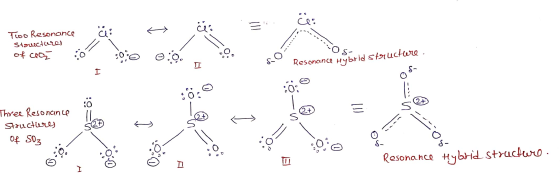
| (c).ClO2- | Resonance |
| (b).HCN | No Resonance |
| (b).SO3 | Resonance |
Explanation :-
Add Answer to:
Be sure to answer all parts.
Indicate whether or not each of the following molecules or...
Be sure to answer all parts. For each of the following pairs of elements, state whether...
Be sure to answer all parts. For each of the following pairs of elements, state whether the binary compound they form is likely to be ionic or covalent. Write the empirical formula and name of the compound: Formula Name Type (a) K and Br (select)potassium bromatepotassium bromidepotassium dibromidepotassium bromite ionic covalent (b) C and Br (select)carbon monobromidecarbon bromitecarbon bromatecarbon tetrabromide ionic covalent
11) Assign the point group for the following molecules and indicate whether you expect the molecule to be polar or not. Be sure to show your work. (20 points) (a) HOF (b) CIFs (c) HCN (d) trans-P...
 11) Assign the point group for the following molecules and indicate whether you expect the molecule to be polar or not. Be sure to show your work. (20 points) (a) HOF (b) CIFs (c) HCN (d) trans-PCLF
11) Assign the point group for the following molecules and indicate whether you expect the molecule to be polar or not. Be sure to show your work. (20 points) (a) HOF (b) CIFs (c) HCN (d) trans-PCLF
11) Assign the point group for the following molecules and indicate whether you expect the molecule to be polar or not. Be sure to show your work. (20 points) (a) HOF (b) CIFs (c) HCN (d) trans-PCLF
Be sure to answer all parts. For each of the following pairs of elements, state whether...
 Be sure to answer all parts. For each of the following pairs of elements, state whether the binary compound they form is likely to be ionic or covalent. Write the empirical formula and name of the compound. (a) Al and F o ionic o covalent Empirical formula: Name: (select) (b) S and F o ionic covalent Empirical formula: Name: (select)
3 attempts left Check my work Be sure to answer all parts. Indicate the number of unpaired electr...
 3 attempts left Check my work Be sure to answer all parts. Indicate the number of unpaired electrons present in each of the following atoms. (a) P: unpaired e- (b) Pb: unpaired e (c) Mn: unpaired e
3 attempts left Check my work Be sure to answer all parts. Indicate the number of unpaired electrons present in each of the following atoms. (a) P: unpaired e- (b) Pb: unpaired e (c) Mn: unpaired e
3 attempts left Check my work Be sure to answer all parts. Indicate the number of unpaired electrons present in each of the following atoms. (a) P: unpaired e- (b) Pb: unpaired e (c) Mn: unpaired e
Part A Indicate whether aqueous solutions of each of the following solutes contain only ions, only...
 Part A Indicate whether aqueous solutions of each of the following solutes contain only ions, only molecules, or mostly molecules and a few ions: Drag the appropriate items to their respective bins. Reset EHelp hydrocyanic acid, HCN, a weak electrolyte KBr a strong electrolyte methanol, CH40, a nonelectrolyte Only ions Only molecules Mostly molecules and a few ions Submit
For each of the following molecules and ions: i.) Write the Lewis structure ii.) Indicate the...
For each of the following molecules and ions: i.) Write the Lewis structure ii.) Indicate the molecular geometry iii.) Indicate the approximate bond angles A.) Sulfur trioxide, SO3 B.) triiodide ion, I3- C.) sulfur hexafluoride, SF6
1. Use VSEPR theory to predict the molecular geometry for each of the following molecules, indicate...
 1. Use VSEPR theory to predict the molecular geometry for each of the following molecules, indicate whether each bond in it is a a or m bond, and provide the hybridization scheme for each non-hydrogen atom а. Н.С %3 снCH %3D CH, b. (носн»),С(СH,)соон с. CH,соосH(CHә)сн — снс 3D ссн, e. (CH3),СHCH,CH(NH,)C0OH d. CH,онсH(NH,)соон 2. Write the resonance structures and resonance hybrid for each of the following ions. Use curved arrows to show the shifts in electrons. ь. CH3 d....
Be sure to answer all parts. Determine whether each salt forms an acidic, basic, or neutral...
 Be sure to answer all parts. Determine whether each salt forms an acidic, basic, or neutral solution when it dissolves in water. a. NaI (select) b. NHANO3 (select) с. MgBr> (select) TABLE 91 Relative Strength of Acids and Their Conjugate Bases
Be sure to answer all parts. For each of the molecules below, draw the structural formula...
Be sure to answer all parts. For each of the molecules below, draw the structural formula (showing all atoms and bonds) and the line formulas. 2-Methylpentane
11. Which of the following molecules are linear? (Indicate all possible answers) (A) CO2 (B) HCN...
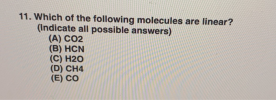 11. Which of the following molecules are linear? (Indicate all possible answers) (A) CO2 (B) HCN (C) H20 (D) CH4 (E) CO
 11) Assign the point group for the following molecules and indicate whether you expect the molecule to be polar or not. Be sure to show your work. (20 points) (a) HOF (b) CIFs (c) HCN (d) trans-PCLF
11) Assign the point group for the following molecules and indicate whether you expect the molecule to be polar or not. Be sure to show your work. (20 points) (a) HOF (b) CIFs (c) HCN (d) trans-PCLF
11) Assign the point group for the following molecules and indicate whether you expect the molecule to be polar or not. Be sure to show your work. (20 points) (a) HOF (b) CIFs (c) HCN (d) trans-PCLF
 Be sure to answer all parts. For each of the following pairs of elements, state whether the binary compound they form is likely to be ionic or covalent. Write the empirical formula and name of the compound. (a) Al and F o ionic o covalent Empirical formula: Name: (select) (b) S and F o ionic covalent Empirical formula: Name: (select)
 3 attempts left Check my work Be sure to answer all parts. Indicate the number of unpaired electrons present in each of the following atoms. (a) P: unpaired e- (b) Pb: unpaired e (c) Mn: unpaired e
3 attempts left Check my work Be sure to answer all parts. Indicate the number of unpaired electrons present in each of the following atoms. (a) P: unpaired e- (b) Pb: unpaired e (c) Mn: unpaired e
3 attempts left Check my work Be sure to answer all parts. Indicate the number of unpaired electrons present in each of the following atoms. (a) P: unpaired e- (b) Pb: unpaired e (c) Mn: unpaired e
 Part A Indicate whether aqueous solutions of each of the following solutes contain only ions, only molecules, or mostly molecules and a few ions: Drag the appropriate items to their respective bins. Reset EHelp hydrocyanic acid, HCN, a weak electrolyte KBr a strong electrolyte methanol, CH40, a nonelectrolyte Only ions Only molecules Mostly molecules and a few ions Submit
 1. Use VSEPR theory to predict the molecular geometry for each of the following molecules, indicate whether each bond in it is a a or m bond, and provide the hybridization scheme for each non-hydrogen atom а. Н.С %3 снCH %3D CH, b. (носн»),С(СH,)соон с. CH,соосH(CHә)сн — снс 3D ссн, e. (CH3),СHCH,CH(NH,)C0OH d. CH,онсH(NH,)соон 2. Write the resonance structures and resonance hybrid for each of the following ions. Use curved arrows to show the shifts in electrons. ь. CH3 d....
 Be sure to answer all parts. Determine whether each salt forms an acidic, basic, or neutral solution when it dissolves in water. a. NaI (select) b. NHANO3 (select) с. MgBr> (select) TABLE 91 Relative Strength of Acids and Their Conjugate Bases
 11. Which of the following molecules are linear? (Indicate all possible answers) (A) CO2 (B) HCN (C) H20 (D) CH4 (E) CO
Most questions answered within 3 hours.
-
Where is the error in this code sequence?
String s1 = "Hello";
String s2 = "ello";...
asked 10 months ago -
Financial data for Joel de Paris, Inc., for last year
follow:
Joel de Paris, Inc.
Balance...
asked 10 months ago -
Consider this reaction:
Al2(SO4)3 (aq)+ BaCl3
(aq) Al2Cl6 (aq)- +
3BaSO4(s) . What is the...
asked 10 months ago -
Suppose that Savneet is considering increasing her
recent random sample from 20 car rentals to 40...
asked 10 months ago -
Trucks arrive at an unloading terminal at an average rate of 120
per hour.
Trucks arrive...
asked 10 months ago -
Why are methanol and ethanol completely soluble in water while
octanol is not very little soluble....
asked 10 months ago -
A facilities manager at a university reads in a research report
that the mean amount of...
asked 10 months ago -
When the CuSO4 is rehydrated by adding water to the anhydrous
compound, is this an endothermic...
asked 10 months ago -
A ray of sunlight is passing from diamond into crown glass; the
angle of incidence is...
asked 10 months ago -
A block of mass 0.249 kg is placed on top of a light, vertical
spring of...
asked 10 months ago -
how do the kidneys compensate in the presences of acidosis
a) trigger hyperventilate
b) reserve acid...
asked 10 months ago -
Question 501 pts
The rental rate of capital to the firm increases. Which of the
following...
asked 10 months ago