When 1.00 g of metallic chromium is heated with elemental chlorine gas, 3.045 g of a...
When 1.00 g of metallic chromium is heated with elemental chlorine gas, 3.045 g of a chromium chloride salt results. Calculate the empirical formula of the compound.
Homework Answers

Add Answer to:
When 1.00 g of metallic chromium is heated with elemental
chlorine gas, 3.045 g of a...
When 4.1 grams of chromium metal is heated and reacted with 9.3 grams of chlorine gas,...
When 4.1 grams of chromium metal is heated and reacted with 9.3 grams of chlorine gas, a) what mass of chromium (III) chloride will be produced? b) what is the limiting reactant c) How many grams of non-limiting reactant will be left over?
27. A 1.23 g sample of copper metal is reacted completely with chlorine gas to produce...
 27. A 1.23 g sample of copper metal is reacted completely with chlorine gas to produce 2.61 g of copper chloride. Determine the empirical formula and empirical formula mass for this compound.
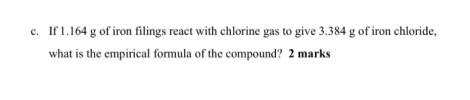
write clearly c. If 1.164 g of iron filings react with chlorine gas to give 3.384...
 write clearly
c. If 1.164 g of iron filings react with chlorine gas to give 3.384 g of iron chloride, what is the empirical formula of the compound? 2 marks
write clearly
c. If 1.164 g of iron filings react with chlorine gas to give 3.384 g of iron chloride, what is the empirical formula of the compound? 2 marks
A 24.82 gram sample of copper is heated in the presence of excess chlorine. A metal...
 A 24.82 gram sample of copper is heated in the presence of excess chlorine. A metal chloride is formed with a mass of 38.66 g. Determine the empirical formula of the metal chloride. Enter the elements in the order Cu, CI empirical formula =
16. When 3.5 g of Fe combines with elemental oxygen, it forms 5.0 grams of a...
 16. When 3.5 g of Fe combines with elemental oxygen, it forms 5.0 grams of a binary compound Fe.O, - made of Fe and O atoms only. Find its empirical formula (3 pts): In the 5.0 gram quantity of the compound, the mass of the Fe atoms is In the 5.0 gram quantity of the compound, the number of moles of the Fe atoms is: (Fe) (Fe) x mol(Fe) (Fe) In the 5.0 gram quantity of the compound, the mass...
Find the empirical formula for a compound which contains 32.8% chromium and 67.2% chlorine.
Find the empirical formula for a compound which contains 32.8% chromium and 67.2% chlorine.
35a When 4.752 grams of a hydrocarbon, CxHy, were burned in a combustion analysis apparatus, 16.06...
35a When 4.752 grams of a hydrocarbon, CxHy, were burned in a combustion analysis apparatus, 16.06 grams of CO2 and 3.289 grams of H2O were produced. In a separate experiment, the molar mass of the compound was found to be 26.04 g/mol. Determine the empirical formula and the molecular formula of the hydrocarbon. 35 part b A 4.079 gram sample of an organic compound containing C, H and O is analyzed by combustion analysis and 9.273 grams of CO2 and...
A student, Legna, massed out 10.12 g of chromium(iii)chloride hexahydrate to synthesize a transition metal coordination...
A student, Legna, massed out 10.12 g of chromium(iii)chloride hexahydrate to synthesize a transition metal coordination complex. She obtained 7.20 g of a complex containing Chromium (Cr), Ammonia (NH3), and Chlorine (Cl). Samples of this compound were used to perform all analyses for the remainder of the advanced study assignment. The following data were obtained. analysis 1: no heat applied mass of compound used .4988g mass of crucible plus AgCl 19.2859g mass of crucible 18.4628g MM AgCl 143.32 g/mol MM...
A iron carbonyl compound is heated to release CO and leave elemental iron behind. Treatment of...
 A iron carbonyl compound is heated to release CO
and leave elemental iron behind. Treatment of
6.544 g of the compound releases
2.085 L of CO(g) at 25.00 °C and
1.960 atm pressure. Determine the empirical
formula of this compound. Given that its molar mass is
195.90, choose its structural formula from the
metal carbonyls shown below, where M = Fe.
Pick one of the below.
Occo co Oc—MAMco oc' do co 1000000 00 -00 05 06 0000 occo OCCO...
A iron carbonyl compound is heated to release CO
and leave elemental iron behind. Treatment of
6.544 g of the compound releases
2.085 L of CO(g) at 25.00 °C and
1.960 atm pressure. Determine the empirical
formula of this compound. Given that its molar mass is
195.90, choose its structural formula from the
metal carbonyls shown below, where M = Fe.
Pick one of the below.
Occo co Oc—MAMco oc' do co 1000000 00 -00 05 06 0000 occo OCCO...
Phosphorus pentachloride (PCl5) decomposes when heated to phosphorus trichloride and molecular chlorine according to the following...
Phosphorus pentachloride (PCl5) decomposes when heated to phosphorus trichloride and molecular chlorine according to the following equation: PCl5 (g) -> PCl3 (g) + Cl2 (g) When 2.53 mol of PCl5 is put in a 1.00 L container and allowed to come to equilibrium, the mixture is found to contain 0.277 mol of PCl3. How many moles of each gas are present at equilibrium?
 27. A 1.23 g sample of copper metal is reacted completely with chlorine gas to produce 2.61 g of copper chloride. Determine the empirical formula and empirical formula mass for this compound.
 write clearly
c. If 1.164 g of iron filings react with chlorine gas to give 3.384 g of iron chloride, what is the empirical formula of the compound? 2 marks
write clearly
c. If 1.164 g of iron filings react with chlorine gas to give 3.384 g of iron chloride, what is the empirical formula of the compound? 2 marks
 A 24.82 gram sample of copper is heated in the presence of excess chlorine. A metal chloride is formed with a mass of 38.66 g. Determine the empirical formula of the metal chloride. Enter the elements in the order Cu, CI empirical formula =
 16. When 3.5 g of Fe combines with elemental oxygen, it forms 5.0 grams of a binary compound Fe.O, - made of Fe and O atoms only. Find its empirical formula (3 pts): In the 5.0 gram quantity of the compound, the mass of the Fe atoms is In the 5.0 gram quantity of the compound, the number of moles of the Fe atoms is: (Fe) (Fe) x mol(Fe) (Fe) In the 5.0 gram quantity of the compound, the mass...
 A iron carbonyl compound is heated to release CO
and leave elemental iron behind. Treatment of
6.544 g of the compound releases
2.085 L of CO(g) at 25.00 °C and
1.960 atm pressure. Determine the empirical
formula of this compound. Given that its molar mass is
195.90, choose its structural formula from the
metal carbonyls shown below, where M = Fe.
Pick one of the below.
Occo co Oc—MAMco oc' do co 1000000 00 -00 05 06 0000 occo OCCO...
A iron carbonyl compound is heated to release CO
and leave elemental iron behind. Treatment of
6.544 g of the compound releases
2.085 L of CO(g) at 25.00 °C and
1.960 atm pressure. Determine the empirical
formula of this compound. Given that its molar mass is
195.90, choose its structural formula from the
metal carbonyls shown below, where M = Fe.
Pick one of the below.
Occo co Oc—MAMco oc' do co 1000000 00 -00 05 06 0000 occo OCCO...
Most questions answered within 3 hours.
-
Where is the error in this code sequence?
String s1 = "Hello";
String s2 = "ello";...
asked 11 months ago -
Financial data for Joel de Paris, Inc., for last year
follow:
Joel de Paris, Inc.
Balance...
asked 11 months ago -
Consider this reaction:
Al2(SO4)3 (aq)+ BaCl3
(aq) Al2Cl6 (aq)- +
3BaSO4(s) . What is the...
asked 11 months ago -
Suppose that Savneet is considering increasing her
recent random sample from 20 car rentals to 40...
asked 11 months ago -
Trucks arrive at an unloading terminal at an average rate of 120
per hour.
Trucks arrive...
asked 11 months ago -
Why are methanol and ethanol completely soluble in water while
octanol is not very little soluble....
asked 11 months ago -
A facilities manager at a university reads in a research report
that the mean amount of...
asked 11 months ago -
When the CuSO4 is rehydrated by adding water to the anhydrous
compound, is this an endothermic...
asked 11 months ago -
A ray of sunlight is passing from diamond into crown glass; the
angle of incidence is...
asked 11 months ago -
A block of mass 0.249 kg is placed on top of a light, vertical
spring of...
asked 11 months ago -
how do the kidneys compensate in the presences of acidosis
a) trigger hyperventilate
b) reserve acid...
asked 11 months ago -
Question 501 pts
The rental rate of capital to the firm increases. Which of the
following...
asked 11 months ago