1.Assume that an appliance manufacturer is employing variable factors X and Y in such amounts that...
1.Assume that an appliance manufacturer is employing variable factors X and Y in such amounts that the MRPs of the last units of X and Y employed are $100 and $60 respectively. Factor X can be hired at $50 per unit and factor Y at $20 per unit. If you are the manager of the firm, what is your proper employment strategy for maximizing your firm’s profit?
2.Assume that labour and capital are substitutes in production. If there is an increase in the price of capital, how can this lead to either an increase or decrease in the demand for labour?
Homework Answers
1) at profit maximisation, MRTS= MRP1/MRP2 = P1/P2
MRP1/MRP2= 100/60= 1.67
P1/P2= 50/20= 2.5
Since MRP1/MRP2 is less than P1/P2, firm should less of X and more of Y to get both the ratios equal, in order to maximise profit.
2) if labor and capital are substitutes and if price of capital increases such that marginal rate of substitution is greater than price ratio of labor and capital, increase in price of capital leads to increase in demand for labor.
Add Answer to:
1.Assume that an appliance manufacturer is employing variable
factors X and Y in such amounts that...
Countries X and Z produce a composite output Y by employing two factors labor (N) and...
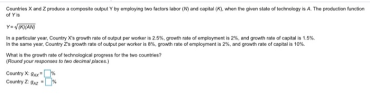 Countries X and Z produce a composite output Y by employing two factors labor (N) and capital (K), when the given state of technology is A. The production function of Y is Y= (KAN) In a particular year, Country X's growth rate of output per worker is 2.5%, growth rate of employment is 2%, and growth rate of capital is 1.5% In the same year, Country Z's growth rate of output per worker is 8%, growth rate of employment is...
1-Home produces 2 goods X and Y . Home country has two factors of production, Labor...
1-Home produces 2 goods X and Y . Home country has two factors of production, Labor and Capital. All consumers at Home have preferences over two goods that can be represented by the utility function U(X,) =XY . The factor requirements per unit of output of the two goods are also fixed and they are shown in the following table: Good X Good Y Labour 1/3 2/3 Capital 2/3 1/3 Home country has 360 units of Labour and 600 units...
(10 marks) Suppose there exist 2 countries, Home and Foreign; 2 goods, X and Y; and...
(10 marks) Suppose there exist 2 countries, Home and Foreign; 2 goods, X and Y; and 2 factors of production, labour (L) and capital (K). Each country can produce both goods. X is labour-intensive and Y is capital-intensive. Home is labour-abundant and Foreign is capital-abundant. Assume that the standard assumptions of the Heckscher-Ohlin model hold. When answering the following question, please support each of your arguments with detailed analysis and draw the relevant diagrams to support your answer. Consider a...
Suppose there exist 2 countries, Home and Foreign; 2 goods, X and Y; and 2 factors...
Suppose there exist 2 countries, Home and Foreign; 2 goods, X and Y; and 2 factors of production, labor (L) and capital (K). Each country can produce both goods. X is labor-intensive and Y is capital-intensive. Home is labor-abundant and Foreign is capital-abundant. Assume that the standard assumptions of the Heckscher-Ohlin model hold. When answering the following question, please support each of your arguments with detailed analysis and draw the relevant diagrams to support your answer. Consider a move from...
Only question b and f need aid Question B1 Where x is an output produced using...
 Only question b and f need aid
Question B1 Where x is an output produced using inputs labour (l) and capital (k) a) Do the following production functions exhibit decreasing, constant, or increasing returns to scale? Explain your answers (2 marks each) - x = 5070.3k0.3 x = 2020.45 k0.55 x = 570.610k0.6 Suppose our price-taking and wage-taking firm can produce a single output x using inputs labour (l) and capital (k) according to the production function: x = f(1,k)...
Only question b and f need aid
Question B1 Where x is an output produced using inputs labour (l) and capital (k) a) Do the following production functions exhibit decreasing, constant, or increasing returns to scale? Explain your answers (2 marks each) - x = 5070.3k0.3 x = 2020.45 k0.55 x = 570.610k0.6 Suppose our price-taking and wage-taking firm can produce a single output x using inputs labour (l) and capital (k) according to the production function: x = f(1,k)...
1. Consumer’s utility function is: U (X,Y) = 10X + Y. Consumer’s income M is 40...
1. Consumer’s utility function is: U (X,Y) = 10X + Y. Consumer’s income M is 40 euros, the price per unit of good X (i.e. Px ) is 5 euros and the price per unit of good Y (i.e. Py) is 1 euro. a) What is the marginal utility of good X (MUx) for the consumer? ( Answer: MUx = 10) b) What is the marginal utility of good Y (MUy) for the consumer? ( Answer: MUy = 1) c)...
Question 1 (1 point) (1 Point) We assume that the representative consumer's preferences exhibit the properties...
 Question 1 (1 point) (1 Point) We assume that the representative consumer's preferences exhibit the properties that Oa) they evolve over time and that more is always preferred to less. Ob) more is sometimes preferred to less and that consumption and leisure are both normal goods c) more is preferred to less and that the consumer prefers diversity d) the consumer likes diversity and that more is sometimes preferred to less. Question 2 (1 point) (1 Point) A good is...
3. Heckscher-Ohlin theory. Assume there are two nations (1 and 2), two goods (X and Y),...
 3. Heckscher-Ohlin theory. Assume there are two nations (1 and 2), two goods (X and Y), two factors of production (L and K). Commodity X is labor intensive, commodity Y is capital intensive. All assumptions are made following the standard H-O theory 3.1 Suppose nation 1 is L-abundant, and nation 2 is K-abundant. Please graph the production possibility frontiers of both nations. 3.2. What is the no-trade equilibrium in both nations? Please show on the graph and explain. 3.3. What...
1)Jay Co. is a contract manufacturer that produces two products, Prod A and Prod B; and...
1)Jay Co. is a contract manufacturer that produces two products, Prod A and Prod B; and supply the two products to various retailers. The numbers of units for Prod A and Prod B that Jay Co is contracted to supply for next four months are given in the following table: Month 1 Month 2 Month 3 Month 4 PROD A 1000 4000 1000 3000 PROD B 500 1500 250 1500 The production processes for Prod A and Prod B are...
My explanation about these requirements are as follow:- Please i need more ideas to support my...
My explanation about these requirements are as follow:- Please i need more ideas to support my work Reflect on the two (02) following topics: 1) The Law of Increasing Returns to a factor of production. 2) The Law of Diminishing Returns to a factor of production. Be explicit and analytical. Also, provide appropriate examples to support your analysis. ANS 1) The Law of Increasing Returns to a factor of production. Be explicit and analytical. Also, provide appropriate examples to support...
 Countries X and Z produce a composite output Y by employing two factors labor (N) and capital (K), when the given state of technology is A. The production function of Y is Y= (KAN) In a particular year, Country X's growth rate of output per worker is 2.5%, growth rate of employment is 2%, and growth rate of capital is 1.5% In the same year, Country Z's growth rate of output per worker is 8%, growth rate of employment is...
 Only question b and f need aid
Question B1 Where x is an output produced using inputs labour (l) and capital (k) a) Do the following production functions exhibit decreasing, constant, or increasing returns to scale? Explain your answers (2 marks each) - x = 5070.3k0.3 x = 2020.45 k0.55 x = 570.610k0.6 Suppose our price-taking and wage-taking firm can produce a single output x using inputs labour (l) and capital (k) according to the production function: x = f(1,k)...
Only question b and f need aid
Question B1 Where x is an output produced using inputs labour (l) and capital (k) a) Do the following production functions exhibit decreasing, constant, or increasing returns to scale? Explain your answers (2 marks each) - x = 5070.3k0.3 x = 2020.45 k0.55 x = 570.610k0.6 Suppose our price-taking and wage-taking firm can produce a single output x using inputs labour (l) and capital (k) according to the production function: x = f(1,k)...
 Question 1 (1 point) (1 Point) We assume that the representative consumer's preferences exhibit the properties that Oa) they evolve over time and that more is always preferred to less. Ob) more is sometimes preferred to less and that consumption and leisure are both normal goods c) more is preferred to less and that the consumer prefers diversity d) the consumer likes diversity and that more is sometimes preferred to less. Question 2 (1 point) (1 Point) A good is...
 3. Heckscher-Ohlin theory. Assume there are two nations (1 and 2), two goods (X and Y), two factors of production (L and K). Commodity X is labor intensive, commodity Y is capital intensive. All assumptions are made following the standard H-O theory 3.1 Suppose nation 1 is L-abundant, and nation 2 is K-abundant. Please graph the production possibility frontiers of both nations. 3.2. What is the no-trade equilibrium in both nations? Please show on the graph and explain. 3.3. What...
Most questions answered within 3 hours.
-
Where is the error in this code sequence?
String s1 = "Hello";
String s2 = "ello";...
asked 11 months ago -
Financial data for Joel de Paris, Inc., for last year
follow:
Joel de Paris, Inc.
Balance...
asked 11 months ago -
Consider this reaction:
Al2(SO4)3 (aq)+ BaCl3
(aq) Al2Cl6 (aq)- +
3BaSO4(s) . What is the...
asked 11 months ago -
Suppose that Savneet is considering increasing her
recent random sample from 20 car rentals to 40...
asked 11 months ago -
Trucks arrive at an unloading terminal at an average rate of 120
per hour.
Trucks arrive...
asked 11 months ago -
Why are methanol and ethanol completely soluble in water while
octanol is not very little soluble....
asked 11 months ago -
A facilities manager at a university reads in a research report
that the mean amount of...
asked 11 months ago -
When the CuSO4 is rehydrated by adding water to the anhydrous
compound, is this an endothermic...
asked 11 months ago -
A ray of sunlight is passing from diamond into crown glass; the
angle of incidence is...
asked 11 months ago -
A block of mass 0.249 kg is placed on top of a light, vertical
spring of...
asked 11 months ago -
how do the kidneys compensate in the presences of acidosis
a) trigger hyperventilate
b) reserve acid...
asked 11 months ago -
Question 501 pts
The rental rate of capital to the firm increases. Which of the
following...
asked 11 months ago