C++ QUESTION 13 Still using the same code, what are the values of x AFTER the...
C++
QUESTION 13
-
Still using the same code, what are the values of x AFTER the call to function Squirrel?
void Chipmunk(int a, int b, int& c);
A. 1 B. 2 C. 3 D. 4 E. 5
void Squirrel(int& a, int& b);
int Feature(int b, int c);
int main( )
{
int w = 1;
int x = 2;
int y = 3;
int z = 4;
Chipmunk(w, x, y);
Squirrel(x, y);
Chipmunk(z, y, x);
z = Feature(x, w);
return 0;
}
void Chipmunk(int a, int b, int& c)
{
a += 2;
c = a + b;
}
void Squirrel(int& a, int& b)
{
int temp;
temp = a;
a = b;
b = temp;
}
int Feature(int b, int c)
{
b = c;
c = b;
return c;
}
1 points
QUESTION 14
-
Still using the same code, what is the value of y AFTER the call to function Squirrel?
void Chipmunk(int a, int b, int& c);
A. 1 B. 2 C. 3 D. 4 E. 5
void Squirrel(int& a, int& b);
int Feature(int b, int c);
int main( )
{
int w = 1;
int x = 2;
int y = 3;
int z = 4;
Chipmunk(w, x, y);
Squirrel(x, y);
Chipmunk(z, y, x);
z = Feature(x, w);
return 0;
}
void Chipmunk(int a, int b, int& c)
{
a += 2;
c = a + b;
}
void Squirrel(int& a, int& b)
{
int temp;
temp = a;
a = b;
b = temp;
}
int Feature(int b, int c)
{
b = c;
c = b;
return c;
}
QUESTION 15
-
Still using the same code, what is the values of z AFTER the call to function Squirrel?
void Chipmunk(int a, int b, int& c);
A. 1 B. 2 C. 3 D. 4 E. 5
void Squirrel(int& a, int& b);
int Feature(int b, int c);
int main( )
{
int w = 1;
int x = 2;
int y = 3;
int z = 4;
Chipmunk(w, x, y);
Squirrel(x, y);
Chipmunk(z, y, x);
z = Feature(x, w);
return 0;
}
void Chipmunk(int a, int b, int& c)
{
a += 2;
c = a + b;
}
void Squirrel(int& a, int& b)
{
int temp;
temp = a;
a = b;
b = temp;
}
int Feature(int b, int c)
{
b = c;
c = b;
return c;
}
QUESTION 16
-
Still using the same code, what is the value of w AFTER the second call to function Chipmunk?
void Chipmunk(int a, int b, int& c);
A. 1 B. 2 C. 4 D. 6 E. 8
void Squirrel(int& a, int& b);
int Feature(int b, int c);
int main( )
{
int w = 1;
int x = 2;
int y = 3;
int z = 4;
Chipmunk(w, x, y);
Squirrel(x, y);
Chipmunk(z, y, x);
z = Feature(x, w);
return 0;
}
void Chipmunk(int a, int b, int& c)
{
a += 2;
c = a + b;
}
void Squirrel(int& a, int& b)
{
int temp;
temp = a;
a = b;
b = temp;
}
int Feature(int b, int c)
{
b = c;
c = b;
return c;
}
QUESTION 17
-
Still using the same code, what is the value of x AFTER the second call to function Chipmunk?
void Chipmunk(int a, int b, int& c);
A. 1 B. 2 C. 4 D. 6 E. 8
void Squirrel(int& a, int& b);
int Feature(int b, int c);
int main( )
{
int w = 1;
int x = 2;
int y = 3;
int z = 4;
Chipmunk(w, x, y);
Squirrel(x, y);
Chipmunk(z, y, x);
z = Feature(x, w);
return 0;
}
void Chipmunk(int a, int b, int& c)
{
a += 2;
c = a + b;
}
void Squirrel(int& a, int& b)
{
int temp;
temp = a;
a = b;
b = temp;
}
int Feature(int b, int c)
{
b = c;
c = b;
return c;
}
QUESTION 18
-
Still using the same code, what is the value of y AFTER the second call to function Chipmunk?
void Chipmunk(int a, int b, int& c);
A. 1 B. 2 C. 4 D. 6 E. 8
void Squirrel(int& a, int& b);
int Feature(int b, int c);
int main( )
{
int w = 1;
int x = 2;
int y = 3;
int z = 4;
Chipmunk(w, x, y);
Squirrel(x, y);
Chipmunk(z, y, x);
z = Feature(x, w);
return 0;
}
void Chipmunk(int a, int b, int& c)
{
a += 2;
c = a + b;
}
void Squirrel(int& a, int& b)
{
int temp;
temp = a;
a = b;
b = temp;
}
int Feature(int b, int c)
{
b = c;
c = b;
return c;
}
QUESTION 19
-
Still using the same code, what is the value of z AFTER the second call to function Chipmunk?
void Chipmunk(int a, int b, int& c);
A. 1 B. 2 C. 4 D. 6 E. 8
void Squirrel(int& a, int& b);
int Feature(int b, int c);
int main( )
{
int w = 1;
int x = 2;
int y = 3;
int z = 4;
Chipmunk(w, x, y);
Squirrel(x, y);
Chipmunk(z, y, x);
z = Feature(x, w);
return 0;
}
void Chipmunk(int a, int b, int& c)
{
a += 2;
c = a + b;
}
void Squirrel(int& a, int& b)
{
int temp;
temp = a;
a = b;
b = temp;
}
int Feature(int b, int c)
{
b = c;
c = b;
return c;
}
QUESTION 20
-
Still using the same code, what is the value of w AFTER the call to function Feature?
void Chipmunk(int a, int b, int& c);
A. 1 B. 2 C. 4 D. 6 E. 8
void Squirrel(int& a, int& b);
int Feature(int b, int c);
int main( )
{
int w = 1;
int x = 2;
int y = 3;
int z = 4;
Chipmunk(w, x, y);
Squirrel(x, y);
Chipmunk(z, y, x);
z = Feature(x, w);
return 0;
}
void Chipmunk(int a, int b, int& c)
{
a += 2;
c = a + b;
}
void Squirrel(int& a, int& b)
{
int temp;
temp = a;
a = b;
b = temp;
}
int Feature(int b, int c)
{
b = c;
c = b;
return c;
}
QUESTION 21
-
Still using the same code, what is the value of x AFTER the call to function Feature?
void Chipmunk(int a, int b, int& c);
void Squirrel(int& a, int& b);
int Feature(int b, int c);
int main( )
{
int w = 1;
int x = 2;
int y = 3;
int z = 4;
Chipmunk(w, x, y);
Squirrel(x, y);
Chipmunk(z, y, x);
z = Feature(x, w);
return 0;
}
void Chipmunk(int a, int b, int& c)
{
a += 2;
c = a + b;
}
void Squirrel(int& a, int& b)
{
int temp;
temp = a;
a = b;
b = temp;
}
int Feature(int b, int c)
{
b = c;
c = b;
return c;
}
A. 1 B. 2 C. 4 D. 6 E. 8
Homework Answers
ANSWER:-
QUESTION (13):-
OPTION(E) 5
QUESTION (14):-
OPTION (B) 2
QUESTION (15):-
OPTION (D) 4
QUESTION (16):-
OPTION (A) 1
QUESTION (17):-
OPTION (E) 8
QUESTION (18):-
OPTION (B) 2
QUESTION (19):-
OPTION (C) 4
QUESTION (20):-
OPTION (A) 1
QUESTION (21):-
OPTION (E) 8
Add Answer to:
C++
QUESTION 13
Still using the same code, what are the values of x AFTER the...
QUESTION 62 Consider the following code: void Pancake(int x, int& y, int z); void Waffle(int& x,...
QUESTION 62 Consider the following code: void Pancake(int x, int& y, int z); void Waffle(int& x, int& y); int Doughnut(int y, int z); int main( ) { int a = 1; int b = 2; int c = 3; int d = 4; Pancake(a, b, c); Waffle(b, c); Pancake(d, c, b); d = Doughnut(b, a); return 0; } void Pancake(int x, int& y, int z) { y += 3; ...
Study the c++ code below and answer the question on templates after // A polymorphic swap...
Study the c++ code below and answer the question on templates after // A polymorphic swap function for any type of object (an example) template<typename T> void MySwap( T& x, T& y) { T temp; temp = x; x = y; y = temp; } // A polymorphic class holding an [x,y] position of any type template<class T> class Position { public: Position(T x=0, T y=0) : x_(x), y_(y) {} friend std::ostream& operator<<(std::ostream& os, const Position& p) { return os...
QUESTION 6 What is the output of following C code? struct numbers { int x...
QUESTION 6 What is the output of following C code? struct numbers { int x = 2; int y = 3; } int main() { struct numbers nums; nums.x = 110; nums.y = 100; printf("%d\n%d", nums.x, nums.y); return 0; } A. Compile-time Error B. 110 100 C. 2 3 D. Run-time Error 2 points QUESTION 7 What is the output of following C code? typedef struct student { char *stud; }s1; int main() { s1 s; s.stud...
C++ 1. A?B?C?D? which one is correct 2. 3A, 3B #include<iostream> using namespace std; void swap0(int*...
 C++
1.
A?B?C?D? which one is correct
2.
3A, 3B
#include<iostream> using namespace std; void swap0(int* ptri, int* ptr2) { int *temp; temp = ptr1; ptr1 = ptr2; ptr2 = temp; void swap1(int ptri, int ptr2){ int temp; temp = ptri; ptr1 = ptr2; ptr2 = temp; portion void swap2(int *&ptri, int *&ptr2){ int* temp; temp = ptr1; ptr1 = ptr2; ptr2 = temp; void swap3(int &ptri, int &ptr2) { int temp; temp = ptr1; ptr1 = ptr2; ptr2 =...
C++
1.
A?B?C?D? which one is correct
2.
3A, 3B
#include<iostream> using namespace std; void swap0(int* ptri, int* ptr2) { int *temp; temp = ptr1; ptr1 = ptr2; ptr2 = temp; void swap1(int ptri, int ptr2){ int temp; temp = ptri; ptr1 = ptr2; ptr2 = temp; portion void swap2(int *&ptri, int *&ptr2){ int* temp; temp = ptr1; ptr1 = ptr2; ptr2 = temp; void swap3(int &ptri, int &ptr2) { int temp; temp = ptr1; ptr1 = ptr2; ptr2 =...
Question 3 Run the following code and explain, using your own words, what is happening with...
Question 3 Run the following code and explain, using your own words, what is happening with each variable (w,x,y,z) and what is the difference between ++x and w++ (is there any influence on the result between prefix or postfix ++ operator?). Provide a snippet of the output showing the result. int main() { int w = 20, x = 20; int y = 5, z = 5; y = y + (++x); z = z + (w++); cout << "x="...
Name: Homework #13 What are the two memory pools for programs running a modern operating system? ...
 code in C++
Name: Homework #13 What are the two memory pools for programs running a modern operating system? 1. Given the following program: 2. sincludeciostream> using nanespace std; void func1(int); int main() int a 5, b 10; func1(a): return 0; void func1(int a) int z(2]: int ys a. What is on the stack before the first function call (assume a memory starting address of ex1018)? b. What is on the stack after the function call is executed (before returning...
code in C++
Name: Homework #13 What are the two memory pools for programs running a modern operating system? 1. Given the following program: 2. sincludeciostream> using nanespace std; void func1(int); int main() int a 5, b 10; func1(a): return 0; void func1(int a) int z(2]: int ys a. What is on the stack before the first function call (assume a memory starting address of ex1018)? b. What is on the stack after the function call is executed (before returning...
What is the value of the variable x at the point given in the code? public...
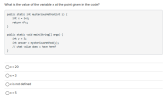 What is the value of the variable x at the point given in the code? public static int mysteriousmethod(int z) { int x = 2+z; return 4*x; } public static void main(String[] args) { int y = 3; int answer = mysterious Method(y); // what value does x have here? } Ox = 20 Ox= 3 Ox is not defined Ox=5
use the same code. but the code needs some modifications. so use this same code and...
 use the same code. but the code needs some modifications. so
use this same code and modify it and provide a output
Java Program to Implement Merge Sort import java.util.Scanner Class MergeSort public class MergeSort Merge Sort function / public static yoid sortfintfl a, int low, int high) int N-high-low; if (N1) return; int mid- low +N/2; Il recursively sort sort(a, low, mid); sort(a, mid, high); I/ merge two sorted subarrays int] temp new int[N]; int i- low, j-mid; for...
use the same code. but the code needs some modifications. so
use this same code and modify it and provide a output
Java Program to Implement Merge Sort import java.util.Scanner Class MergeSort public class MergeSort Merge Sort function / public static yoid sortfintfl a, int low, int high) int N-high-low; if (N1) return; int mid- low +N/2; Il recursively sort sort(a, low, mid); sort(a, mid, high); I/ merge two sorted subarrays int] temp new int[N]; int i- low, j-mid; for...
Consider the following code C++ like program: int i, j, arr[5]; //arr is an array starting...
Consider the following code C++ like program: int i, j, arr[5]; //arr is an array starting at index 0 void exchange(int x, int y) { int temp:= x; x:= y; y:= temp; } main(){ for (j = 0; j < 5; j++) arr[j]:= j; i:= 1; exchange(i, arr[i+1]); output(i, arr[2]); //print i and arr[2] } What is the output of the code if both parameters in function swapping are passed by: a- value? b- reference? c- value-result?
JAVA question For the following code, remember to make a table to keep track of the...
JAVA question For the following code, remember to make a table to keep track of the various x y z values. public class Mystery6 { public static void main(String[] args) { int x = 1; int y = 2; int z = 3; z = mystery(y, x, y); // Statement 1 System.out.println(x + " " + y + " " + z); // Statement 2 x = mystery(z, y, x); // Statement 3 System.out.println(x + " " + y +...
 C++
1.
A?B?C?D? which one is correct
2.
3A, 3B
#include<iostream> using namespace std; void swap0(int* ptri, int* ptr2) { int *temp; temp = ptr1; ptr1 = ptr2; ptr2 = temp; void swap1(int ptri, int ptr2){ int temp; temp = ptri; ptr1 = ptr2; ptr2 = temp; portion void swap2(int *&ptri, int *&ptr2){ int* temp; temp = ptr1; ptr1 = ptr2; ptr2 = temp; void swap3(int &ptri, int &ptr2) { int temp; temp = ptr1; ptr1 = ptr2; ptr2 =...
C++
1.
A?B?C?D? which one is correct
2.
3A, 3B
#include<iostream> using namespace std; void swap0(int* ptri, int* ptr2) { int *temp; temp = ptr1; ptr1 = ptr2; ptr2 = temp; void swap1(int ptri, int ptr2){ int temp; temp = ptri; ptr1 = ptr2; ptr2 = temp; portion void swap2(int *&ptri, int *&ptr2){ int* temp; temp = ptr1; ptr1 = ptr2; ptr2 = temp; void swap3(int &ptri, int &ptr2) { int temp; temp = ptr1; ptr1 = ptr2; ptr2 =...
 code in C++
Name: Homework #13 What are the two memory pools for programs running a modern operating system? 1. Given the following program: 2. sincludeciostream> using nanespace std; void func1(int); int main() int a 5, b 10; func1(a): return 0; void func1(int a) int z(2]: int ys a. What is on the stack before the first function call (assume a memory starting address of ex1018)? b. What is on the stack after the function call is executed (before returning...
code in C++
Name: Homework #13 What are the two memory pools for programs running a modern operating system? 1. Given the following program: 2. sincludeciostream> using nanespace std; void func1(int); int main() int a 5, b 10; func1(a): return 0; void func1(int a) int z(2]: int ys a. What is on the stack before the first function call (assume a memory starting address of ex1018)? b. What is on the stack after the function call is executed (before returning...
 What is the value of the variable x at the point given in the code? public static int mysteriousmethod(int z) { int x = 2+z; return 4*x; } public static void main(String[] args) { int y = 3; int answer = mysterious Method(y); // what value does x have here? } Ox = 20 Ox= 3 Ox is not defined Ox=5
 use the same code. but the code needs some modifications. so
use this same code and modify it and provide a output
Java Program to Implement Merge Sort import java.util.Scanner Class MergeSort public class MergeSort Merge Sort function / public static yoid sortfintfl a, int low, int high) int N-high-low; if (N1) return; int mid- low +N/2; Il recursively sort sort(a, low, mid); sort(a, mid, high); I/ merge two sorted subarrays int] temp new int[N]; int i- low, j-mid; for...
use the same code. but the code needs some modifications. so
use this same code and modify it and provide a output
Java Program to Implement Merge Sort import java.util.Scanner Class MergeSort public class MergeSort Merge Sort function / public static yoid sortfintfl a, int low, int high) int N-high-low; if (N1) return; int mid- low +N/2; Il recursively sort sort(a, low, mid); sort(a, mid, high); I/ merge two sorted subarrays int] temp new int[N]; int i- low, j-mid; for...
Most questions answered within 3 hours.
-
Where is the error in this code sequence?
String s1 = "Hello";
String s2 = "ello";...
asked 11 months ago -
Financial data for Joel de Paris, Inc., for last year
follow:
Joel de Paris, Inc.
Balance...
asked 11 months ago -
Consider this reaction:
Al2(SO4)3 (aq)+ BaCl3
(aq) Al2Cl6 (aq)- +
3BaSO4(s) . What is the...
asked 11 months ago -
Suppose that Savneet is considering increasing her
recent random sample from 20 car rentals to 40...
asked 11 months ago -
Trucks arrive at an unloading terminal at an average rate of 120
per hour.
Trucks arrive...
asked 11 months ago -
Why are methanol and ethanol completely soluble in water while
octanol is not very little soluble....
asked 11 months ago -
A facilities manager at a university reads in a research report
that the mean amount of...
asked 11 months ago -
When the CuSO4 is rehydrated by adding water to the anhydrous
compound, is this an endothermic...
asked 11 months ago -
A ray of sunlight is passing from diamond into crown glass; the
angle of incidence is...
asked 11 months ago -
A block of mass 0.249 kg is placed on top of a light, vertical
spring of...
asked 11 months ago -
how do the kidneys compensate in the presences of acidosis
a) trigger hyperventilate
b) reserve acid...
asked 11 months ago -
Question 501 pts
The rental rate of capital to the firm increases. Which of the
following...
asked 11 months ago