Assume that large-company stocks had an average return of 12.1 percent and a standard deviation of...
Assume that large-company stocks had an average return of 12.1 percent and a standard deviation of 19.6 percent for a 40-year period. What range of returns would you expect to see on these stocks 95 percent of the time? Which answer?
-30.3 percent to 53.2 percent
-30.3 percent to 73.9 percent
-30.3 percent to 64.1 percent
-27.1 percent to 53.2 percent
-27.1 percent to 51.3 percent
Homework Answers

Add Answer to:
Assume that large-company stocks had an average return of 12.1
percent and a standard deviation of...
assume that mid-size company stocks had an average return of 11.2% and a standard deviation of...
assume that mid-size company stocks had an average return of 11.2% and a standard deviation of 18.4% for a 50 yeah period. what range of returns would you expect to see on these stocks 95% of the time? a. -30.3% to 64.1% b. -27.1% to 59.4%
Assume that a stocks had an expected return of 12.00 percent and a standard deviation of...
Assume that a stocks had an expected return of 12.00 percent and a standard deviation of 4.50 percent. What is the low end of returns would you expect to see 95 percent of the time? (Enter your answers as a percentage rounded to 2 decimal places. For example, enter 8.43% instead of 0.0843)
Average return Standard Deviation 12.1 % Series Large-company stocks Small-company stocks Long-term corporate bonds Long-term government...
 Average return Standard Deviation 12.1 % Series Large-company stocks Small-company stocks Long-term corporate bonds Long-term government bonds Intermediate-term government bonds U.S. Treasury bills Inflation 19.8% 31.7 16.5 6.4 8.3 6.0 9.9 5.2 5.6 3.4 3.1 3.0 4.0 a. What range of returns would you expect to see 68 percent of the time for long-term corporate bonds? (A negative answer should be indicated by a minus sign. Enter your answers from lowest to highest. Do not round intermediate calculations and enter...
Assume that a stocks had an expected return of 12.00 percent and a standard deviation of 7.00 percent
Question 8Assume that a stocks had an expected return of 12.00 percent and a standard deviation of 7.00 percent. What is the low end of returns would you expect to see 95 percent of the time? (Enter your answers as a percentage rounded to 2 decimal places. For example, enter 8.43% instead of 0.0843) Question 10 Calculate the expected return on a portfolio that contains 30% of a stock with an expected return of -1% and 70% of a stock with an...
Assume that a portfolio of stocks had an average return of 12% and a standard deviation...
Assume that a portfolio of stocks had an average return of 12% and a standard deviation of 19% over a certain holding period. In which range do the returns fall 99% of the time, assuming the returns are distributed normally? Multiple Choice between -26% and 50% between -45% and 69% between -7% and 31% between -17% and 48%
Consider the following table for different assets for 1926 through 2017 Average return Standard Deviation 12.1...
 Consider the following table for different assets for 1926 through 2017 Average return Standard Deviation 12.1 % Series Large-company stocks Small-company stocks Long-term corporate bonds Long-term government bonds Intermediate-term government 19.8% 16.5 31.7 6.4 8.3 6.0 9.9 5.2 5.6 bonds 3.4 U.S. Treasury bills Inflation 3.1 3.0 4.0 a. What range of returns would you expect to see 68 percent of the time for long-term corporate bonds? (A negative answer should be indicated by a minus sign. Enter your answers...
Question 4 (1 point) Assume that a stocks had an expected return of 11.50 percent and...
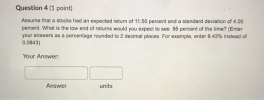 Question 4 (1 point) Assume that a stocks had an expected return of 11.50 percent and a standard deviation of 4.00 percent. What is the low end of returns would you expect to see 95 percent of the time? (Enter your answers as a percentage rounded to 2 decimal places. For example, enter 8.43% instead of 0.0843) Your Answer: Answer units
Over a particular period, an asset had an average return of 10.9 percent and a standard deviation of 21.2 percent. What...
 Over a particular period, an asset had an average return of 10.9 percent and a standard deviation of 21.2 percent. What range of returns would you expect to see 68 percent of the time for this asset? (A negative answer should be indicated by a minus sign. Input your answers from lowest to highest to receive credit for your answers. Do not round intermediate calculations and enter your answers as a percent rounded to 2 decimal places, e.g., 32.16.) Expected...
Over a particular period, an asset had an average return of 6.1 percent and a standard...
 Over a particular period, an asset had an average return of 6.1 percent and a standard deviation of 8.8 percent. What range of returns would you expect to see 95 percent of the time for this asset? (A negative answer should be indicated by a minus sign. Input your answers from lowest to highest to receive credit for your answers. Do not round intermediate calculations and enter your answers as a percent rounded to 2 decimal places, e.g., 32.16.) Expected...
Over a particular period, an asset had an average return of 11.4 percent and a standard...
Over a particular period, an asset had an average return of 11.4 percent and a standard deviation of 20.1 percent. What range of returns would you expect to see 95 percent of the time for this asset? (A negative answer should be indicated by a minus sign. Input your answers from lowest to highest to receive credit for your answers. Do not round intermediate calculations and enter your answers as a percent rounded to 2 decimal places, e.g., 32.16.) Expected...
 Average return Standard Deviation 12.1 % Series Large-company stocks Small-company stocks Long-term corporate bonds Long-term government bonds Intermediate-term government bonds U.S. Treasury bills Inflation 19.8% 31.7 16.5 6.4 8.3 6.0 9.9 5.2 5.6 3.4 3.1 3.0 4.0 a. What range of returns would you expect to see 68 percent of the time for long-term corporate bonds? (A negative answer should be indicated by a minus sign. Enter your answers from lowest to highest. Do not round intermediate calculations and enter...
 Consider the following table for different assets for 1926 through 2017 Average return Standard Deviation 12.1 % Series Large-company stocks Small-company stocks Long-term corporate bonds Long-term government bonds Intermediate-term government 19.8% 16.5 31.7 6.4 8.3 6.0 9.9 5.2 5.6 bonds 3.4 U.S. Treasury bills Inflation 3.1 3.0 4.0 a. What range of returns would you expect to see 68 percent of the time for long-term corporate bonds? (A negative answer should be indicated by a minus sign. Enter your answers...
 Question 4 (1 point) Assume that a stocks had an expected return of 11.50 percent and a standard deviation of 4.00 percent. What is the low end of returns would you expect to see 95 percent of the time? (Enter your answers as a percentage rounded to 2 decimal places. For example, enter 8.43% instead of 0.0843) Your Answer: Answer units
 Over a particular period, an asset had an average return of 10.9 percent and a standard deviation of 21.2 percent. What range of returns would you expect to see 68 percent of the time for this asset? (A negative answer should be indicated by a minus sign. Input your answers from lowest to highest to receive credit for your answers. Do not round intermediate calculations and enter your answers as a percent rounded to 2 decimal places, e.g., 32.16.) Expected...
 Over a particular period, an asset had an average return of 6.1 percent and a standard deviation of 8.8 percent. What range of returns would you expect to see 95 percent of the time for this asset? (A negative answer should be indicated by a minus sign. Input your answers from lowest to highest to receive credit for your answers. Do not round intermediate calculations and enter your answers as a percent rounded to 2 decimal places, e.g., 32.16.) Expected...
Most questions answered within 3 hours.
-
Where is the error in this code sequence?
String s1 = "Hello";
String s2 = "ello";...
asked 10 months ago -
Financial data for Joel de Paris, Inc., for last year
follow:
Joel de Paris, Inc.
Balance...
asked 10 months ago -
Consider this reaction:
Al2(SO4)3 (aq)+ BaCl3
(aq) Al2Cl6 (aq)- +
3BaSO4(s) . What is the...
asked 10 months ago -
Suppose that Savneet is considering increasing her
recent random sample from 20 car rentals to 40...
asked 10 months ago -
Trucks arrive at an unloading terminal at an average rate of 120
per hour.
Trucks arrive...
asked 10 months ago -
Why are methanol and ethanol completely soluble in water while
octanol is not very little soluble....
asked 10 months ago -
A facilities manager at a university reads in a research report
that the mean amount of...
asked 10 months ago -
When the CuSO4 is rehydrated by adding water to the anhydrous
compound, is this an endothermic...
asked 10 months ago -
A ray of sunlight is passing from diamond into crown glass; the
angle of incidence is...
asked 10 months ago -
A block of mass 0.249 kg is placed on top of a light, vertical
spring of...
asked 10 months ago -
how do the kidneys compensate in the presences of acidosis
a) trigger hyperventilate
b) reserve acid...
asked 10 months ago -
Question 501 pts
The rental rate of capital to the firm increases. Which of the
following...
asked 10 months ago