If you, as an investor, plan to buy 100 shares of Google, which of the following...
If you, as an investor, plan to buy 100 shares of Google, which of the following market you should go to? A. Money market B. Primary market C. Secondary market D. Bond market E. None of the above
Homework Answers
Primary Market, is Initial Public Offer. This happens rarely.
Secondary market means, Buying and selling shares/ securities through stock exchange.
If we want to buy/ sell any security, we will do transaction through Secondary market.
Thus Option C is correct.
Add Answer to:
If you, as an investor, plan to buy 100 shares of Google, which
of the following...
Suppose you buy 100 shares of Google stock which has a current price of $1,265.13 a...
Suppose you buy 100 shares of Google stock which has a current price of $1,265.13 a share. You want to ensure that you do not lose more than $200 a share. Which of the following option strategies would allow you to do this? A. A covered call B. A naked call C. A protective put D. You cannot ensure that you will not have losses with stocks
Suppose you buy 100 shares of Google stock which has a current price of $1,265.13 a...
Suppose you buy 100 shares of Google stock which has a current price of $1,265.13 a share. You want to ensure that you do not lose more than $200 a share. Which of the following option strategies would allow you to do this? A. A covered call B. A naked call C. A protective put D. You cannot ensure that you will not have losses with stocks Suppose I buy 100 shares of AMD and want to limit my losses...
Question 2 You plan to buy 500 shares of “UNIc” at $20. Given that the initial...
 Question 2
You plan to buy 500 shares of “UNIc” at $20. Given that
the initial margin is 40% and maintenance margin is 30%. At what
price you will receive a margin call?
Can anyone help me with those two questions with
detailed explanations? Appreciate with thanks.
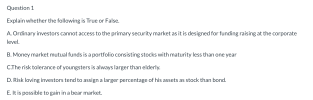
Question 1 Explain whether the following is True or False. A. Ordinary investors cannot access to the primary security market as it is designed for funding raising at the corporate level. B. Money...
Question 2
You plan to buy 500 shares of “UNIc” at $20. Given that
the initial margin is 40% and maintenance margin is 30%. At what
price you will receive a margin call?
Can anyone help me with those two questions with
detailed explanations? Appreciate with thanks.
Question 1 Explain whether the following is True or False. A. Ordinary investors cannot access to the primary security market as it is designed for funding raising at the corporate level. B. Money...
Which of the following statements is CORRECT? If you purchase 100 shares of Disney stock from...
Which of the following statements is CORRECT? If you purchase 100 shares of Disney stock from your brother-in-law, this is an example of a primary market transaction. As they are generally defined, capital market transactions involve debt securities with maturities of less than one year. If Disney issues additional shares of common stock through an investment banker, this would be a secondary market transaction. If Sheila saves $10,000 and buys a certificate of deposit (CD) that will mature in six...
Where do institutional investor (such as: pension funds and mutual funds) mostly buy their stocks? Which...
Where do institutional investor (such as: pension funds and mutual funds) mostly buy their stocks? Which of the following financial assets is least likely to have an active secondary market? Which asset is most likely traded in OTC? Primary market; Coins; American Depository Receipts Primary market; Bank loans made to smaller firms; Bonds Secondary market; Common stock of a large public firm; Mutual funds Secondary market; Debt issued by the U.S. Treasury; Government treasury Institutional investor market; Bonds of a...
Mike calls his broker and instructs him to immediately buy 2,000 shares of Borgwarner Inc, which...
Mike calls his broker and instructs him to immediately buy 2,000 shares of Borgwarner Inc, which is traded on the New York Stock Exchange (NYSE). A. Physical asset market B. Futures market C. Secondary market D. Primary market E. Private market
If you purchase 100 Telstra shares on the ASX today, the transaction is most likely occurring...
If you purchase 100 Telstra shares on the ASX today, the transaction is most likely occurring a) in the secondary market b) in the debt market c) in the primary market d) in the private placement market e) in a rights issue
recute/displayLearningUnit?course_id=_23444_18_content_id=971868 1 Which of the following statements is CORRECT? If you purchase 100 shares of Disney...
 recute/displayLearningUnit?course_id=_23444_18_content_id=971868 1 Which of the following statements is CORRECT? If you purchase 100 shares of Disney stock from your brother-in-law, this is an example of a primary market transaction. If Disney issues additional shares of common stock through an investment banker, this would be a secondary market transaction. The NYSE is an example of an over-the-counter market. Only institutions, and not individuals, can engage in the derivatives markets. As they are generally defined, money market transactions involve debt securities with...
help _may limit 10. Consider the following short sale example: an investor borrows 100 shares of...
 help
_may limit 10. Consider the following short sale example: an investor borrows 100 shares of a stock from the broker, put down 50% as the initial margin, and sells the stock at $100/share in the market. Suppose the stock price later goes up from $100/share to $150/share, put a the potential loss for the investor. A. limit sell order at $120/share B. limit buy order at $120/share C. stop buy order at $120/share D. stop loss order at $120/share
help
_may limit 10. Consider the following short sale example: an investor borrows 100 shares of a stock from the broker, put down 50% as the initial margin, and sells the stock at $100/share in the market. Suppose the stock price later goes up from $100/share to $150/share, put a the potential loss for the investor. A. limit sell order at $120/share B. limit buy order at $120/share C. stop buy order at $120/share D. stop loss order at $120/share
our Section: 1. Which of the following trading strategy prefers the options to be out-of-the-money! A....
 our Section: 1. Which of the following trading strategy prefers the options to be out-of-the-money! A. Selling Put B. Selling Call C. Covered Call D. All above E. None above 2. Which of the following option strategy requires the SAME exercise price of options? A. Bearish spread B. Bullish spread C. Straddle D. All above E. None above 3. An European put option gives its holder the right to : A. buy the underlying asset at the exercise price on...
 Question 2
You plan to buy 500 shares of “UNIc” at $20. Given that
the initial margin is 40% and maintenance margin is 30%. At what
price you will receive a margin call?
Can anyone help me with those two questions with
detailed explanations? Appreciate with thanks.
Question 1 Explain whether the following is True or False. A. Ordinary investors cannot access to the primary security market as it is designed for funding raising at the corporate level. B. Money...
Question 2
You plan to buy 500 shares of “UNIc” at $20. Given that
the initial margin is 40% and maintenance margin is 30%. At what
price you will receive a margin call?
Can anyone help me with those two questions with
detailed explanations? Appreciate with thanks.
Question 1 Explain whether the following is True or False. A. Ordinary investors cannot access to the primary security market as it is designed for funding raising at the corporate level. B. Money...
 recute/displayLearningUnit?course_id=_23444_18_content_id=971868 1 Which of the following statements is CORRECT? If you purchase 100 shares of Disney stock from your brother-in-law, this is an example of a primary market transaction. If Disney issues additional shares of common stock through an investment banker, this would be a secondary market transaction. The NYSE is an example of an over-the-counter market. Only institutions, and not individuals, can engage in the derivatives markets. As they are generally defined, money market transactions involve debt securities with...
 help
_may limit 10. Consider the following short sale example: an investor borrows 100 shares of a stock from the broker, put down 50% as the initial margin, and sells the stock at $100/share in the market. Suppose the stock price later goes up from $100/share to $150/share, put a the potential loss for the investor. A. limit sell order at $120/share B. limit buy order at $120/share C. stop buy order at $120/share D. stop loss order at $120/share
help
_may limit 10. Consider the following short sale example: an investor borrows 100 shares of a stock from the broker, put down 50% as the initial margin, and sells the stock at $100/share in the market. Suppose the stock price later goes up from $100/share to $150/share, put a the potential loss for the investor. A. limit sell order at $120/share B. limit buy order at $120/share C. stop buy order at $120/share D. stop loss order at $120/share
 our Section: 1. Which of the following trading strategy prefers the options to be out-of-the-money! A. Selling Put B. Selling Call C. Covered Call D. All above E. None above 2. Which of the following option strategy requires the SAME exercise price of options? A. Bearish spread B. Bullish spread C. Straddle D. All above E. None above 3. An European put option gives its holder the right to : A. buy the underlying asset at the exercise price on...
Most questions answered within 3 hours.
-
Where is the error in this code sequence?
String s1 = "Hello";
String s2 = "ello";...
asked 11 months ago -
Financial data for Joel de Paris, Inc., for last year
follow:
Joel de Paris, Inc.
Balance...
asked 11 months ago -
Consider this reaction:
Al2(SO4)3 (aq)+ BaCl3
(aq) Al2Cl6 (aq)- +
3BaSO4(s) . What is the...
asked 11 months ago -
Suppose that Savneet is considering increasing her
recent random sample from 20 car rentals to 40...
asked 11 months ago -
Trucks arrive at an unloading terminal at an average rate of 120
per hour.
Trucks arrive...
asked 11 months ago -
Why are methanol and ethanol completely soluble in water while
octanol is not very little soluble....
asked 11 months ago -
A facilities manager at a university reads in a research report
that the mean amount of...
asked 11 months ago -
When the CuSO4 is rehydrated by adding water to the anhydrous
compound, is this an endothermic...
asked 11 months ago -
A ray of sunlight is passing from diamond into crown glass; the
angle of incidence is...
asked 11 months ago -
A block of mass 0.249 kg is placed on top of a light, vertical
spring of...
asked 11 months ago -
how do the kidneys compensate in the presences of acidosis
a) trigger hyperventilate
b) reserve acid...
asked 11 months ago -
Question 501 pts
The rental rate of capital to the firm increases. Which of the
following...
asked 11 months ago