An insulating elastic string is 20 cm long and obeys Hooke's Law with a spring constant...
An insulating elastic string is 20 cm long and obeys Hooke's Law with a spring constant of 1 N/m. It is connected to two small identical conducting spheres that carry positive charges of q1 and q2. The repulsion of the spheres causes the string to stretch to a length of 25 cm. A conducting wire is connected between the spheres and then removed. This equalizes the charge on the two spheres while conserving the total charge, and the string stretches by an additional 1 cm.
a) What is the initial and final repulsive force between the two spheres (i.e. before and after the wire is connected then removed)?
b) What are the initial and final charges in micro Columbs (uC) on each of the spheres?
c) What is the initial and final electric field at the point located 50 cm vertically above the midpoint of the elastic string? Give both the magnitudes and the angles with respect to the vertical.
Homework Answers


Add Answer to:
An insulating elastic string is 20 cm long and obeys Hooke's Law
with a spring constant...
When a 3.70-kg object is hung vertically on a certain light spring that obeys Hooke's law,...
When a 3.70-kg object is hung vertically on a certain light spring that obeys Hooke's law, the spring stretches 2.60 cm. (a) If the 3.70-kg object is removed, how far will the spring stretch if a 1.50-kg block is hung on it? --------------------- cm (b) How much work must an external agent do to stretch the same spring 4.00 cm from its unstretched position? ---------------------- J
When a 3.80-kg object is hung vertically on a certain light spring that obeys Hooke's law,...
 When a 3.80-kg object is hung vertically on a certain light spring that obeys Hooke's law, the spring stretches 2.30 cm. (a) If the 3.80-kg object is removed, how far will the spring stretch if a 1.50-kg block is hung on it? x When an object is 'hung' from a spring, the spring force is equal in magnitude to the gravitational force. cm (6) How much work must an external agent do to stretch the same spring 4.00 cm from...
You have a light spring which obeys Hooke's law. This spring stretches 2.24 cm vertically when...
You have a light spring which obeys Hooke's law. This spring stretches 2.24 cm vertically when a 3.00 kg object is suspended from it. Determine the following. (a)the force constant of the spring (in N/m) N/m (b)the distance (in cm) the spring stretches if you replace the 3.00 kg object with a 1.50 kg object cm (c)the amount of work (in J) an external agent must do to stretch the spring 7.90 cm from its unstretched position J
Two conducting spheres have identical radii Initially they have charges of opposite sign and unequal magnitudes...
 Two conducting spheres have identical radii Initially they have charges of opposite sign and unequal magnitudes with the magnitude of the positive charge larger than the mag- nitude of the negative charge. They attract each other with a force of 0.231 N when sepa rated by 0.5 m Initial The spheres are suddenly connected by a thin conducting wire, which is then removed. Connected Now the spheres repel each other with a force of 0.022 N Final What is the...
A) two conducting... (seen in picture) B)What is the negative charge? charges, tw0 p ch having...
 A) two conducting... (seen in picture)
B)What is the negative charge?
charges, tw0 p ch having a magnitude of 59 uC at the vertices of an equilateral cm on a side) 4. gain protons. 5. lose electrons. +q 024 (part 1 of 2) 10.0 points Two conducting spheres have identical radii. Initially they have charges of opposite sign and unequal magnitudes with the magnitude of the positive charge larger than the mag- nitude of the negative charge. They attract -q...
A) two conducting... (seen in picture)
B)What is the negative charge?
charges, tw0 p ch having a magnitude of 59 uC at the vertices of an equilateral cm on a side) 4. gain protons. 5. lose electrons. +q 024 (part 1 of 2) 10.0 points Two conducting spheres have identical radii. Initially they have charges of opposite sign and unequal magnitudes with the magnitude of the positive charge larger than the mag- nitude of the negative charge. They attract -q...
Two spherical conductors A (radius 2.0 cm) and B (radius 3.0 cm) have initial charges of...
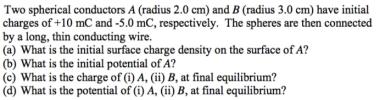 Two spherical conductors A (radius 2.0 cm) and B (radius 3.0 cm) have initial charges of +10 mC and-5.0 mC, respectively. The spheres are then connected by a long, thin conducting wire (a) What is the initial surface charge density on the surface of A? (b) What is the initial potential of A? (c) What is the charge of (i) A, (ii) B, at final equilibrium? (d) What is the potential of (i) A, ii) B, at final equilibrium?
Two identical conducting spheres, fixed in place, attract each other with an electrostatic force of 0.117...
Two identical conducting spheres, fixed in place, attract each other with an electrostatic force of 0.117 N when their center-to-center separation is 54.3 cm. The spheres are then connected by a thin conducting wire. When the wire is removed, the spheres repel each other with an electrostatic force of 0.0533 N. Of the initial charges on the spheres, with a positive net charge, what was (a) the negative charge on one of them and (b) the positive charge on the...
Two identical conducting spheres, fixed in place, attract each other with an electrostatic force of 0.117...
Two identical conducting spheres, fixed in place, attract each other with an electrostatic force of 0.117 N when their center-to-center separation is 54.3 cm. The spheres are then connected by a thin conducting wire. When the wire is removed, the spheres repel each other with an electrostatic force of 0.0533 N. Of the initial charges on the spheres, with a positive net charge, what was (a) the negative charge on one of them and (b) the positive charge on the...
Two identical conducting spheres, fixed in place, attract each other with an electrostatic force of 0.121...
Two identical conducting spheres, fixed in place, attract each other with an electrostatic force of 0.121 N when their center-to-center separation is 68.6 cm. The spheres are then connected by a thin conducting wire. When the wire is removed, the spheres repel each other with an electrostatic force of 0.0358 N. Of the initial charges on the spheres, with a positive net charge, what was (a) the negative charge on one of them and (b) the positive charge on the...
Two identical conducting spheres, fixed in place, attract each other with an electrostatic force of 0.113...
Two identical conducting spheres, fixed in place, attract each other with an electrostatic force of 0.113 N when their center-to-center separation is 64.7 cm. The spheres are then connected by a thin conducting wire. When the wire is removed, the spheres repel each other with an electrostatic force of 0.0300 N. Of the initial charges on the spheres, with a positive net charge, what was (a) the negative charge on one of them and (b) the positive charge on the...
 When a 3.80-kg object is hung vertically on a certain light spring that obeys Hooke's law, the spring stretches 2.30 cm. (a) If the 3.80-kg object is removed, how far will the spring stretch if a 1.50-kg block is hung on it? x When an object is 'hung' from a spring, the spring force is equal in magnitude to the gravitational force. cm (6) How much work must an external agent do to stretch the same spring 4.00 cm from...
 Two conducting spheres have identical radii Initially they have charges of opposite sign and unequal magnitudes with the magnitude of the positive charge larger than the mag- nitude of the negative charge. They attract each other with a force of 0.231 N when sepa rated by 0.5 m Initial The spheres are suddenly connected by a thin conducting wire, which is then removed. Connected Now the spheres repel each other with a force of 0.022 N Final What is the...
 A) two conducting... (seen in picture)
B)What is the negative charge?
charges, tw0 p ch having a magnitude of 59 uC at the vertices of an equilateral cm on a side) 4. gain protons. 5. lose electrons. +q 024 (part 1 of 2) 10.0 points Two conducting spheres have identical radii. Initially they have charges of opposite sign and unequal magnitudes with the magnitude of the positive charge larger than the mag- nitude of the negative charge. They attract -q...
A) two conducting... (seen in picture)
B)What is the negative charge?
charges, tw0 p ch having a magnitude of 59 uC at the vertices of an equilateral cm on a side) 4. gain protons. 5. lose electrons. +q 024 (part 1 of 2) 10.0 points Two conducting spheres have identical radii. Initially they have charges of opposite sign and unequal magnitudes with the magnitude of the positive charge larger than the mag- nitude of the negative charge. They attract -q...
 Two spherical conductors A (radius 2.0 cm) and B (radius 3.0 cm) have initial charges of +10 mC and-5.0 mC, respectively. The spheres are then connected by a long, thin conducting wire (a) What is the initial surface charge density on the surface of A? (b) What is the initial potential of A? (c) What is the charge of (i) A, (ii) B, at final equilibrium? (d) What is the potential of (i) A, ii) B, at final equilibrium?
Most questions answered within 3 hours.
-
Where is the error in this code sequence?
String s1 = "Hello";
String s2 = "ello";...
asked 10 months ago -
Financial data for Joel de Paris, Inc., for last year
follow:
Joel de Paris, Inc.
Balance...
asked 10 months ago -
Consider this reaction:
Al2(SO4)3 (aq)+ BaCl3
(aq) Al2Cl6 (aq)- +
3BaSO4(s) . What is the...
asked 10 months ago -
Suppose that Savneet is considering increasing her
recent random sample from 20 car rentals to 40...
asked 10 months ago -
Trucks arrive at an unloading terminal at an average rate of 120
per hour.
Trucks arrive...
asked 10 months ago -
Why are methanol and ethanol completely soluble in water while
octanol is not very little soluble....
asked 10 months ago -
A facilities manager at a university reads in a research report
that the mean amount of...
asked 10 months ago -
When the CuSO4 is rehydrated by adding water to the anhydrous
compound, is this an endothermic...
asked 10 months ago -
A ray of sunlight is passing from diamond into crown glass; the
angle of incidence is...
asked 10 months ago -
A block of mass 0.249 kg is placed on top of a light, vertical
spring of...
asked 10 months ago -
how do the kidneys compensate in the presences of acidosis
a) trigger hyperventilate
b) reserve acid...
asked 10 months ago -
Question 501 pts
The rental rate of capital to the firm increases. Which of the
following...
asked 10 months ago