A large department store is curious about what sections of the store make the most sales....
A large department store is curious about what sections of the store make the most sales. The manager has data from ten years prior that show 30% of sales come from Clothing, 25% Home Appliances, 18% Housewares, 13% Cosmetics, 12% Jewelry, and 2% Other. In a random sample of 550 current sales, 188 came from Clothing, 153 Home Appliances, 83 Housewares, 54 Cosmetics, 61 Jewelry, and 11 Other. At α=0.10, can the manager conclude that the distribution of sales among the departments has changed? Enter the test statistic - round to 4 decimal places. Test statistic =
Homework Answers
The statistical software output for this problem is :
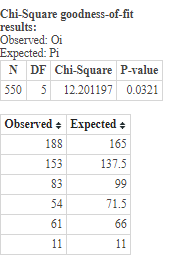
test statistic = 12.2012
Add Answer to:
A large department store is curious about what sections of the
store make the most sales....
Only need help with question 5 2 CASE The Human Resource Function of Harrison Brothers Corporation...
 Only need help with question 5
2 CASE The Human Resource Function of Harrison Brothers Corporation COMPANY HISTORY Harrison Brothers Corporation n was founded in upstate New York on September 15, 1898, by Aubrey and William Harrison. Harrison Brothers is a multi-line traditional department store tha t cares mainly men's, wome expanded to include household furnishings and other items for the home. The long-term goal of the company is to become the leading chain of department stores in the Northeast,...
Only need help with question 5
2 CASE The Human Resource Function of Harrison Brothers Corporation COMPANY HISTORY Harrison Brothers Corporation n was founded in upstate New York on September 15, 1898, by Aubrey and William Harrison. Harrison Brothers is a multi-line traditional department store tha t cares mainly men's, wome expanded to include household furnishings and other items for the home. The long-term goal of the company is to become the leading chain of department stores in the Northeast,...
Fraud at Berry, CPA’s BERRY, CERTIFIED PUBLIC ACCOUNTANTS Brief History of the Firm In 1999, John...
Fraud at Berry, CPA’s BERRY, CERTIFIED PUBLIC ACCOUNTANTS Brief History of the Firm In 1999, John Berry graduated from college with an accounting degree. After 10 years at an international accounting firm, John decided to start his firm, Berry, CPA’s. The firm, located in Oakwood, caters to local clients; specifically, John and his staff of four professionals specialize in non-public companies. The majority of the services provided by Berry, CPA’s are tax planning and preparation; however, the firm also performs...
Case study Company Case Campbell Soup Company: Watching What You Eat You might think that a well-known, veteran consumer products company like the Campbell Soup Company has it made. After all, when pe...
Case study Company Case Campbell Soup Company: Watching What You Eat You might think that a well-known, veteran consumer products company like the Campbell Soup Company has it made. After all, when people think of soup, they think of Campbell’s. In the $5 billion U.S. soup market, Campbell dominates with a 44 percent share. Selling products under such an iconic brand name should be a snap. But if you ask Denise Morrison, CEO of Campbell, she’ll tell you a different...
 Only need help with question 5
2 CASE The Human Resource Function of Harrison Brothers Corporation COMPANY HISTORY Harrison Brothers Corporation n was founded in upstate New York on September 15, 1898, by Aubrey and William Harrison. Harrison Brothers is a multi-line traditional department store tha t cares mainly men's, wome expanded to include household furnishings and other items for the home. The long-term goal of the company is to become the leading chain of department stores in the Northeast,...
Only need help with question 5
2 CASE The Human Resource Function of Harrison Brothers Corporation COMPANY HISTORY Harrison Brothers Corporation n was founded in upstate New York on September 15, 1898, by Aubrey and William Harrison. Harrison Brothers is a multi-line traditional department store tha t cares mainly men's, wome expanded to include household furnishings and other items for the home. The long-term goal of the company is to become the leading chain of department stores in the Northeast,...
Most questions answered within 3 hours.
-
Where is the error in this code sequence?
String s1 = "Hello";
String s2 = "ello";...
asked 10 months ago -
Financial data for Joel de Paris, Inc., for last year
follow:
Joel de Paris, Inc.
Balance...
asked 10 months ago -
Consider this reaction:
Al2(SO4)3 (aq)+ BaCl3
(aq) Al2Cl6 (aq)- +
3BaSO4(s) . What is the...
asked 10 months ago -
Suppose that Savneet is considering increasing her
recent random sample from 20 car rentals to 40...
asked 10 months ago -
Trucks arrive at an unloading terminal at an average rate of 120
per hour.
Trucks arrive...
asked 10 months ago -
Why are methanol and ethanol completely soluble in water while
octanol is not very little soluble....
asked 10 months ago -
A facilities manager at a university reads in a research report
that the mean amount of...
asked 10 months ago -
When the CuSO4 is rehydrated by adding water to the anhydrous
compound, is this an endothermic...
asked 10 months ago -
A ray of sunlight is passing from diamond into crown glass; the
angle of incidence is...
asked 10 months ago -
A block of mass 0.249 kg is placed on top of a light, vertical
spring of...
asked 10 months ago -
how do the kidneys compensate in the presences of acidosis
a) trigger hyperventilate
b) reserve acid...
asked 10 months ago -
Question 501 pts
The rental rate of capital to the firm increases. Which of the
following...
asked 10 months ago