The equilibrium constant for the formation of Cu(CN)42- is 2.0 x 1030. Calculate the value of...
The equilibrium constant for the formation of Cu(CN)42- is 2.0 x 1030. Calculate the value of pCu2+, or -log[Cu2+], if we were to dissolve 2.79 g of CuCl2 in 1.000 L of a solution 0.873 M in NaCN. The addition of CuCl2 does not alter the volume (the final volume is still 1.000 L).
Homework Answers

Add Answer to:
The equilibrium constant for the formation of Cu(CN)42- is 2.0 x
1030. Calculate the value of...
The equilibrium constant for the formation of Cu(CN)42- is 2.0 x 1030. Calculate the value of...
The equilibrium constant for the formation of Cu(CN)42- is 2.0 x 1030. Calculate the value of pCu2+, or -log[Cu2+], if we were to dissolve 2.59 g of CuCl2 in 1.000 L of a solution 0.892 M in NaCN. The addition of CuCl2 does not alter the volume (the final volume is still 1.000 L).
The equilibrium constant for the formation of Cu(CN)42- is 2.0 x 1030. Calculate the value of...
The equilibrium constant for the formation of Cu(CN)42- is 2.0 x 1030. Calculate the value of pCu2+, or -log[Cu2+], if we were to dissolve 2.77 g of CuCl2 in 1.000 L of a solution 0.846 M in NaCN. The addition of CuCl2 does not alter the volume (the final volume is still 1.000 L).
a) The solubility product, Ksp, of Cd3(PO4)2 is 2.5 x 10⁻³³. What is the solubility (in...
a) The solubility product, Ksp, of Cd3(PO4)2 is 2.5 x 10⁻³³. What is the solubility (in g/L) of Cd3(PO4)2 in pure water? b) The solubility product of Cu(OH)2 is 4.8 x 10⁻²⁰. Calculate the value of pCu2+, or -log[Cu2+], in an aqueous solution of NaOH which has a pH of 12.38 and is saturated in Cu(OH)2. c) The equilibrium constant for the formation of Cu(CN)42- is 2.0 x 1030. Calculate the value of pCu2+, or -log[Cu2+], if we were to...
Question 1 : The solubility product, Kp. of Cd3(PO4)2 is 2.5 x 10⁻³³ What is the...
 Question 1 : The solubility product, Kp. of Cd3(PO4)2 is 2.5 x 10⁻³³ What is the solubility (in g/L) of Cd3(PO4), in pure water? Question 2 The solubility product of Cu(OH), is 4.8 x 10⁻²⁰ Calculate the value of pCu2+ or -log(Cu2+1, in an aqueous solution of NaOH which has a pH of 12.84 and is saturated in Cu(OH)2 Question 3 The equilibrium constant for the formation of Cu(CN), is 2.0 x 1030 Calculate the value of pCu2+ or -log(Cu2+1,...
The formation constant, Kf, of Fe(CN)63-(aq), Fe3+(aq) + 6 CN-(aq) ⇌ Fe(CN)63-(aq), is 1.0 x 1042....
The formation constant, Kf, of Fe(CN)63-(aq), Fe3+(aq) + 6 CN-(aq) ⇌ Fe(CN)63-(aq), is 1.0 x 1042. What are the equilibrium concentrations of Fe3+(aq), CN-(aq), and Fe(CN)63-(aq) if we add 0.113 mol of Fe(NO3)3 to 1.000 L of a 0.965 M aqueous solution of NaCN? Assume the volume remains fixed at 1.000 L.
For the following half-reaction, E° = 1.103 V. Calculate the formation constant (Kf) for Cu(CN)2–. Cu2+(aq)...
For the following half-reaction, E° = 1.103 V. Calculate the formation constant (Kf) for Cu(CN)2–. Cu2+(aq) + 2CN–(aq) + e– → Cu(CN)2–(aq)
The formation constant of M(CN),1'-is 2.50 x 101, where M is a generic metal A 0.130...
 The formation constant of M(CN),1'-is 2.50 x 101, where M is a generic metal A 0.130 wole quantity of M(NO3)> is alled to a liter of' 1.010 M NaCN solution. What is the concentration of Mº ions at equilibrium? M? 1- 3.513 x10⁻¹⁴
a. Using the Ksp value for Cu(OH)2 (1.6 x 10⁻¹⁹) and the overall formation constant for...
a. Using the Ksp value for Cu(OH)2 (1.6 x 10⁻¹⁹) and the overall formation constant for Cu(NH3)42+ (1.0 x 10¹³), calculate the value for the equilibrium constant for the following reaction: Cu(OH)2 (s) + 4NH3 (aq) ⇌ Cu(NH3)42+(aq) + 2OH -(aq) b. Use the value of the equilibrium constant you calculated in part a to calculate the solubility (in mol/L) of Cu(OH)2 in 5.0 M NH3. In 5.0 M NH3 the concentration of OH - is 0.0095 M.
The formation constant* of [M(CN)2]-is 5.30 x 10¹⁸, where M is a generic metal. A 0.170...
 The formation constant* of [M(CN)2]-is 5.30 x 10¹⁸, where M is a generic metal. A 0.170 mole quantity of M(NO3) is added to a liter of 0.650 M NaCN solution. What is the concentration of M+ ions at equilibrium? [M2+] =
The formation constant of M(CN)614-is 2.50 x 10'7, where M is a generic metal. A 0.130...
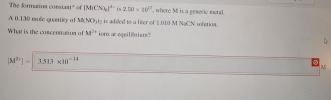 The formation constant of M(CN)614-is 2.50 x 10'7, where M is a generic metal. A 0.130 mole quantity of M(NO3)2 is added to a liter of 1.010 M NaCN solution. What is the concentration of M2+ ions at equilibrium? [M²+] = 3.513 x10⁻¹⁴
 Question 1 : The solubility product, Kp. of Cd3(PO4)2 is 2.5 x 10⁻³³ What is the solubility (in g/L) of Cd3(PO4), in pure water? Question 2 The solubility product of Cu(OH), is 4.8 x 10⁻²⁰ Calculate the value of pCu2+ or -log(Cu2+1, in an aqueous solution of NaOH which has a pH of 12.84 and is saturated in Cu(OH)2 Question 3 The equilibrium constant for the formation of Cu(CN), is 2.0 x 1030 Calculate the value of pCu2+ or -log(Cu2+1,...
 The formation constant of M(CN),1'-is 2.50 x 101, where M is a generic metal A 0.130 wole quantity of M(NO3)> is alled to a liter of' 1.010 M NaCN solution. What is the concentration of Mº ions at equilibrium? M? 1- 3.513 x10⁻¹⁴
 The formation constant* of [M(CN)2]-is 5.30 x 10¹⁸, where M is a generic metal. A 0.170 mole quantity of M(NO3) is added to a liter of 0.650 M NaCN solution. What is the concentration of M+ ions at equilibrium? [M2+] =
 The formation constant of M(CN)614-is 2.50 x 10'7, where M is a generic metal. A 0.130 mole quantity of M(NO3)2 is added to a liter of 1.010 M NaCN solution. What is the concentration of M2+ ions at equilibrium? [M²+] = 3.513 x10⁻¹⁴
Most questions answered within 3 hours.
-
Where is the error in this code sequence?
String s1 = "Hello";
String s2 = "ello";...
asked 10 months ago -
Financial data for Joel de Paris, Inc., for last year
follow:
Joel de Paris, Inc.
Balance...
asked 10 months ago -
Consider this reaction:
Al2(SO4)3 (aq)+ BaCl3
(aq) Al2Cl6 (aq)- +
3BaSO4(s) . What is the...
asked 10 months ago -
Suppose that Savneet is considering increasing her
recent random sample from 20 car rentals to 40...
asked 10 months ago -
Trucks arrive at an unloading terminal at an average rate of 120
per hour.
Trucks arrive...
asked 10 months ago -
Why are methanol and ethanol completely soluble in water while
octanol is not very little soluble....
asked 10 months ago -
A facilities manager at a university reads in a research report
that the mean amount of...
asked 10 months ago -
When the CuSO4 is rehydrated by adding water to the anhydrous
compound, is this an endothermic...
asked 10 months ago -
A ray of sunlight is passing from diamond into crown glass; the
angle of incidence is...
asked 10 months ago -
A block of mass 0.249 kg is placed on top of a light, vertical
spring of...
asked 10 months ago -
how do the kidneys compensate in the presences of acidosis
a) trigger hyperventilate
b) reserve acid...
asked 10 months ago -
Question 501 pts
The rental rate of capital to the firm increases. Which of the
following...
asked 10 months ago