the magnitude of the diffusion coefficient is indicative of: 1) temperature 2) atomic motion 3) concentration...
the magnitude of the diffusion coefficient is indicative of:
1) temperature
2) atomic motion
3) concentration of atoms
4) pressure
Homework Answers

Add Answer to:
the magnitude of the diffusion coefficient is indicative of:
1) temperature
2) atomic motion
3) concentration...
UTVER VIS Concentration of Nitrogen (wt%): = 0.21 Position in mm= 7.2 Diffusion Coefficient for Nitrogen...
 UTVER VIS Concentration of Nitrogen (wt%): = 0.21 Position in mm= 7.2 Diffusion Coefficient for Nitrogen in Iron at 700°C -8.90E-10 Nitrogen in Iron Heat Treatment Time (hours): = 8 Carburizing Time (hrs): = 7 Steel Alloy Case Depth (mm): 4.8 Steel Alloy New Case Depth (mm) - 9.9 Activation Energy kJ/mol: = 103 Temperature for Problem 3 (Celsius) -809 . Data for Problem 4 Temperature in C: -595 Diffusivity (m2/s) = 5.62E-14 Temperature in C: -702 Diffusivity (m /s)...
3) Calculate the thermal diffusion coefficient and diffusion length of heavy water in a CANDU reactor....
 3) Calculate the thermal diffusion coefficient and diffusion length of heavy water in a CANDU reactor. Use Google to determine the moderator temperature/pressure/density in a CANDU reactor.
2) Calculate the diffusion coefficient for Ni diffusing in Cu as the temperature approaches the melting...
 2) Calculate the diffusion coefficient for Ni diffusing in Cu as the temperature approaches the melting temperature of Cu
Derive a relation between the diffusion coefficient (D) and pressure and temperature for an ideal gas....
Derive a relation between the diffusion coefficient (D) and pressure and temperature for an ideal gas. Using this relation, calculate the percentage of change in D for a given ideal gas if temperature is increased by 40% in a constant-volume process.
Given concentration gradient as -80 kg/M^4, the diffusion coefficient as 4 times 10^-11 m^2/s, calculate the...
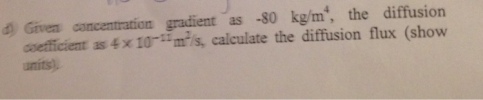 Given concentration gradient as -80 kg/M^4, the diffusion coefficient as 4 times 10^-11 m^2/s, calculate the diffusion flux (show units).
Calculate D, diffusion coefficient in m^2/s at the soecified temperature tions Determine the carburizing time necess...
 Calculate D, diffusion coefficient in m^2/s at the soecified
temperature
tions Determine the carburizing time necessary to achieve a carbon concentration of 0.47 wts at a position 2.1 mm into an iron-carbon alloy that initially contains 0.13 wt%C. The surface concentration is to be maintained at 1.1 wtC. and the treatment is to be conducted at 1180'C. Assume that Do -6,310ms and Q-113 kJ/mol. The table Tabulation of Error Function Values may be useful
Calculate D, diffusion coefficient in m^2/s at the soecified
temperature
tions Determine the carburizing time necessary to achieve a carbon concentration of 0.47 wts at a position 2.1 mm into an iron-carbon alloy that initially contains 0.13 wt%C. The surface concentration is to be maintained at 1.1 wtC. and the treatment is to be conducted at 1180'C. Assume that Do -6,310ms and Q-113 kJ/mol. The table Tabulation of Error Function Values may be useful
Diffusion Example 2: Which diffusion ean? The initial carbon concentration in an iron bar is 0.20%....
 Diffusion Example 2: Which diffusion ean? The initial carbon concentration in an iron bar is 0.20%. The surface concentration of the bar is maintained at 0.40% in a CO/CO2 environment. The bar is maintained at 1273K where the diffusion coefficient of carbon in iron is 3.0x107 cm2/s. How long will it take to obtain a carbon concentration of 0.24% at a depth of 0.01 cm beneath the surface of the iron bar?
The graph below shows the diffusion coefficient as a function of reciprocal temperature for several metals...
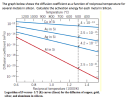 The graph below shows the diffusion coefficient as a function of reciprocal temperature for several metals in silicon. Calculate the activation energy for each metal in Silicon Temperature (C) Cu in' Si Au in Si Ag in Si 1200 1000 900 800 700 600 500 400 10-12 4 x 10-13 2.5 x 10⁻¹⁵ 4.2 x 10⁻¹⁷ 10-14 10-16 Al in Si a» 10-18 E 10-20 12.5-10-21 10-22 0.6 0.8 1.0 1.2 1.4 Reciprocal temperature (1000/K) Logarithm of D-versus-1/T (K) curves...
QUESTION 1 Which statement is not true about the concept of steady state diffusion as it...
 QUESTION 1 Which statement is not true about the concept of steady state diffusion as it applies to diffusion. Steady-state diffusion is the situation wherein the rate of diffusion into a given system is just equal to the rate of diffusion out There is no net accumulation or depletion of diffusing species the diffusion flux is independent of time None of the above All of the above QUESTION 2 What is the driving force for steady-state diffusion? Temperature Concentration gradient...
4. Draw InD vs. I/T curve where D is the diffusion coefficient and T is temperature....
 4. Draw InD vs. I/T curve where D is the diffusion coefficient and T is temperature. Show the slope and intercept. What do the slope and the intercept represent. (2p)
 UTVER VIS Concentration of Nitrogen (wt%): = 0.21 Position in mm= 7.2 Diffusion Coefficient for Nitrogen in Iron at 700°C -8.90E-10 Nitrogen in Iron Heat Treatment Time (hours): = 8 Carburizing Time (hrs): = 7 Steel Alloy Case Depth (mm): 4.8 Steel Alloy New Case Depth (mm) - 9.9 Activation Energy kJ/mol: = 103 Temperature for Problem 3 (Celsius) -809 . Data for Problem 4 Temperature in C: -595 Diffusivity (m2/s) = 5.62E-14 Temperature in C: -702 Diffusivity (m /s)...
 3) Calculate the thermal diffusion coefficient and diffusion length of heavy water in a CANDU reactor. Use Google to determine the moderator temperature/pressure/density in a CANDU reactor.
 2) Calculate the diffusion coefficient for Ni diffusing in Cu as the temperature approaches the melting temperature of Cu
 Given concentration gradient as -80 kg/M^4, the diffusion coefficient as 4 times 10^-11 m^2/s, calculate the diffusion flux (show units).
 Calculate D, diffusion coefficient in m^2/s at the soecified
temperature
tions Determine the carburizing time necessary to achieve a carbon concentration of 0.47 wts at a position 2.1 mm into an iron-carbon alloy that initially contains 0.13 wt%C. The surface concentration is to be maintained at 1.1 wtC. and the treatment is to be conducted at 1180'C. Assume that Do -6,310ms and Q-113 kJ/mol. The table Tabulation of Error Function Values may be useful
Calculate D, diffusion coefficient in m^2/s at the soecified
temperature
tions Determine the carburizing time necessary to achieve a carbon concentration of 0.47 wts at a position 2.1 mm into an iron-carbon alloy that initially contains 0.13 wt%C. The surface concentration is to be maintained at 1.1 wtC. and the treatment is to be conducted at 1180'C. Assume that Do -6,310ms and Q-113 kJ/mol. The table Tabulation of Error Function Values may be useful
 Diffusion Example 2: Which diffusion ean? The initial carbon concentration in an iron bar is 0.20%. The surface concentration of the bar is maintained at 0.40% in a CO/CO2 environment. The bar is maintained at 1273K where the diffusion coefficient of carbon in iron is 3.0x107 cm2/s. How long will it take to obtain a carbon concentration of 0.24% at a depth of 0.01 cm beneath the surface of the iron bar?
 The graph below shows the diffusion coefficient as a function of reciprocal temperature for several metals in silicon. Calculate the activation energy for each metal in Silicon Temperature (C) Cu in' Si Au in Si Ag in Si 1200 1000 900 800 700 600 500 400 10-12 4 x 10-13 2.5 x 10⁻¹⁵ 4.2 x 10⁻¹⁷ 10-14 10-16 Al in Si a» 10-18 E 10-20 12.5-10-21 10-22 0.6 0.8 1.0 1.2 1.4 Reciprocal temperature (1000/K) Logarithm of D-versus-1/T (K) curves...
 QUESTION 1 Which statement is not true about the concept of steady state diffusion as it applies to diffusion. Steady-state diffusion is the situation wherein the rate of diffusion into a given system is just equal to the rate of diffusion out There is no net accumulation or depletion of diffusing species the diffusion flux is independent of time None of the above All of the above QUESTION 2 What is the driving force for steady-state diffusion? Temperature Concentration gradient...
 4. Draw InD vs. I/T curve where D is the diffusion coefficient and T is temperature. Show the slope and intercept. What do the slope and the intercept represent. (2p)
Most questions answered within 3 hours.
-
Where is the error in this code sequence?
String s1 = "Hello";
String s2 = "ello";...
asked 10 months ago -
Financial data for Joel de Paris, Inc., for last year
follow:
Joel de Paris, Inc.
Balance...
asked 10 months ago -
Consider this reaction:
Al2(SO4)3 (aq)+ BaCl3
(aq) Al2Cl6 (aq)- +
3BaSO4(s) . What is the...
asked 10 months ago -
Suppose that Savneet is considering increasing her
recent random sample from 20 car rentals to 40...
asked 10 months ago -
Trucks arrive at an unloading terminal at an average rate of 120
per hour.
Trucks arrive...
asked 10 months ago -
Why are methanol and ethanol completely soluble in water while
octanol is not very little soluble....
asked 10 months ago -
A facilities manager at a university reads in a research report
that the mean amount of...
asked 10 months ago -
When the CuSO4 is rehydrated by adding water to the anhydrous
compound, is this an endothermic...
asked 10 months ago -
A ray of sunlight is passing from diamond into crown glass; the
angle of incidence is...
asked 10 months ago -
A block of mass 0.249 kg is placed on top of a light, vertical
spring of...
asked 10 months ago -
how do the kidneys compensate in the presences of acidosis
a) trigger hyperventilate
b) reserve acid...
asked 10 months ago -
Question 501 pts
The rental rate of capital to the firm increases. Which of the
following...
asked 10 months ago