4.The following questions refer to the skeletal C++ program shown below. a.Assume that static scoping is...
4.The following questions refer to the skeletal C++ program shown below.
a.Assume that static scoping is used. List all variables, along with the functions in which they are declared, that are visible at Line 1 in the program.
b. Repeat part (a), but list the variables along with the functions in which they are declared that are visible at Line 2.
c. Repeat part (a), but list the variables along with the functions in which they are declared that are visible at Line 3.
d. Repeat part (a), but list the variables along with the functions in which they are declared that are visible at Line 4.
e. Assume that dynamic scoping is used, and that main calls f2, which calls f1.(Assume that f2 calls f1 on Line 5.) List all variables, along with the functions in
which they are declared, that are visible at Line 2 in the program.
void f1();
void f2();
int b, c, d;
int main() {
int a, b, d;
... // Line 1
}
void f1() {
int d, e;
... //Line 2
if (...) {
int a, b;
... // Line 3
}
}
void f2() {
int a, c;
if (...) {
int b, c;
... // Line 4
}
... // Line 5
}
Here’s an example of the format that you should use for your answers:
b (global), d (declared in f1), e (declared in if block in f1)
Homework Answers


Add Answer to:
4.The following questions refer to the skeletal C++ program
shown below.
a.Assume that static scoping is...
Answer only The following questions refer to the skeletal C++ program shown below. void f10 void...
 Answer only
The following questions refer to the skeletal C++ program shown below. void f10 void £20 Part 8: (10 points) int a,c,di int main) int c,d eit void ri int b, e t) int a, b: 12( void 12( int b, d if (..) { int a, di / Line 1 (1) Assume that static scoping is used, indicate which version of each of the following variables will be visible at Line 1 by filling in each blank with...
Answer only
The following questions refer to the skeletal C++ program shown below. void f10 void £20 Part 8: (10 points) int a,c,di int main) int c,d eit void ri int b, e t) int a, b: 12( void 12( int b, d if (..) { int a, di / Line 1 (1) Assume that static scoping is used, indicate which version of each of the following variables will be visible at Line 1 by filling in each blank with...
programming languages in #f language QUESTION 4 Consider the following skeletal C program: void funi(void); /*...
 programming languages in #f language
QUESTION 4 Consider the following skeletal C program: void funi(void); /* prototype */ void fun2(void); /* prototype */ void fun3(void); /* prototype */ void main() { int a, b, c; void fun1(void) { int b, c, d; void fun2 (void) { int c, d, e; void fun3(void) { int d, e, f, Assuming that dynamic scoping is used, what variables are visible during execution of the last function called in following calling sequence: main calls...
programming languages in #f language
QUESTION 4 Consider the following skeletal C program: void funi(void); /* prototype */ void fun2(void); /* prototype */ void fun3(void); /* prototype */ void main() { int a, b, c; void fun1(void) { int b, c, d; void fun2 (void) { int c, d, e; void fun3(void) { int d, e, f, Assuming that dynamic scoping is used, what variables are visible during execution of the last function called in following calling sequence: main calls...
8. (10%) Consider the following JavaScript program: // The main program var x,y; function f10{ var...
 8. (10%) Consider the following JavaScript program: // The main program var x,y; function f10{ var y, z; function f20{ var x, Z, P; function f30{ var x, z, ; Assume that the execution of this program is in the following unit order: main calls f3, f3 calls f1, f1 calls 12. a) Assuming that static scoping is in effect, indicate which version of each of the following variables will be visible in f2 by filling in each blank with...
Given the following program in a C-like syntax, what does F1(m) return assuming static scoping and...
Given the following program in a C-like syntax, what does F1(m) return assuming static scoping and dynamic scoping? You can assume that expressions are evaluated from left to right. int m = 3; int F1(int i) { return (i + F2(m) + m); } int F2(int j) { j++; return (j * m); } int main() { int m = 5; F1(m); } Explain in details how you got the answers to earn full credit. Don't just write the answer....
Consider the following JavaScript skeletal program: //the main program var x: function sub1 () { var...
 Consider the following JavaScript skeletal program: //the main program var x: function sub1 () { var x: function sub2 () { } } function sub3 () { } Assume the execution of this program is in the following unit order: main calls sub1 sub1 calls sub2 sub2 calls sub3 a. Assuming static scoping, which declaration of x is the correct one for a reference to x in: i. sub1 ii. sub2 iii. sub3 b. Repeat part a, but assume dynamic...
(10pts). Consider the following: void fun1(void); void fun2(void); void fun3(void); void main() { Int a,b,c;...
(10pts). Consider the following: void fun1(void); void fun2(void); void fun3(void); void main() { Int a,b,c; … } void fun1(void){ Int b,c,d; … } void fun2(void){ Int c,d,e; … } void fun3(void){ Int d,e,f; … } Given the following calling sequences and assuming that dynamic scoping is used. What variables are visible during execution of the last function called? Include with each visible variable the name of the function in which it was...
3- (3 pts) Consider the following Pascal program skeleton program main var a, b, c: integer;...
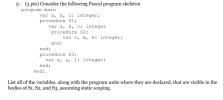 3- (3 pts) Consider the following Pascal program skeleton program main var a, b, c: integer; procedure Sl; var x, b, c: integer procedure S2; var n, m, k: integer; end; end; procedure S3; var x, a, l: integer; end; end; List all of the variables, along with the program units where they are declared, that are visible in the bodies of S1, S2, and S3, assuming static scoping.
Consider the following C++ program: #include <iostream> using namespace std; void f1(int); void f2(int); void f3(int);...
Consider the following C++ program: #include <iostream> using namespace std; void f1(int); void f2(int); void f3(int); int main() { f1(10); return 0; } void f1(int n) { f2(n + 5); } void f2(int n) { f3(n - 2); } void f3(int n) { cout << n << endl; // LINE 1 } Just before the program statement marked with the comment "LINE 1" is executed, how many stack frames will be on the program call stack?
Consider the following program, written in JavaScript-like syntax: // main program var x, y, z; function...
Consider the following program, written in JavaScript-like syntax: // main program var x, y, z; function sub1() { var a, y, z; . . . } function sub2() { var a, b, z; . . . } function sub3() { var a, x, w; . . . } Given the following calling sequences and assuming that dynamic scoping is used, what variables are visible during execution of the last subprogram activated? Include with each visible variable the name of the...
Show the stack with all activation record instances, including the dynamic chain, when execution...
Show the stack with all activation record instances, including the dynamic chain, when execution reaches position 1 in the following skeletal program. This programuses the deep-access method to implement dynamic scoping.void fun1(){float a;}void fun2(){int b, c;}void fun3(){float d;<--------1}void main(){char e, f, g;}The calling sequence for this program for execution to reach fun3 ismain calls fun2fun2 calls fun1fun1 calls fun1fun1 calls fun3
 Answer only
The following questions refer to the skeletal C++ program shown below. void f10 void £20 Part 8: (10 points) int a,c,di int main) int c,d eit void ri int b, e t) int a, b: 12( void 12( int b, d if (..) { int a, di / Line 1 (1) Assume that static scoping is used, indicate which version of each of the following variables will be visible at Line 1 by filling in each blank with...
Answer only
The following questions refer to the skeletal C++ program shown below. void f10 void £20 Part 8: (10 points) int a,c,di int main) int c,d eit void ri int b, e t) int a, b: 12( void 12( int b, d if (..) { int a, di / Line 1 (1) Assume that static scoping is used, indicate which version of each of the following variables will be visible at Line 1 by filling in each blank with...
 programming languages in #f language
QUESTION 4 Consider the following skeletal C program: void funi(void); /* prototype */ void fun2(void); /* prototype */ void fun3(void); /* prototype */ void main() { int a, b, c; void fun1(void) { int b, c, d; void fun2 (void) { int c, d, e; void fun3(void) { int d, e, f, Assuming that dynamic scoping is used, what variables are visible during execution of the last function called in following calling sequence: main calls...
programming languages in #f language
QUESTION 4 Consider the following skeletal C program: void funi(void); /* prototype */ void fun2(void); /* prototype */ void fun3(void); /* prototype */ void main() { int a, b, c; void fun1(void) { int b, c, d; void fun2 (void) { int c, d, e; void fun3(void) { int d, e, f, Assuming that dynamic scoping is used, what variables are visible during execution of the last function called in following calling sequence: main calls...
 8. (10%) Consider the following JavaScript program: // The main program var x,y; function f10{ var y, z; function f20{ var x, Z, P; function f30{ var x, z, ; Assume that the execution of this program is in the following unit order: main calls f3, f3 calls f1, f1 calls 12. a) Assuming that static scoping is in effect, indicate which version of each of the following variables will be visible in f2 by filling in each blank with...
 Consider the following JavaScript skeletal program: //the main program var x: function sub1 () { var x: function sub2 () { } } function sub3 () { } Assume the execution of this program is in the following unit order: main calls sub1 sub1 calls sub2 sub2 calls sub3 a. Assuming static scoping, which declaration of x is the correct one for a reference to x in: i. sub1 ii. sub2 iii. sub3 b. Repeat part a, but assume dynamic...
 3- (3 pts) Consider the following Pascal program skeleton program main var a, b, c: integer; procedure Sl; var x, b, c: integer procedure S2; var n, m, k: integer; end; end; procedure S3; var x, a, l: integer; end; end; List all of the variables, along with the program units where they are declared, that are visible in the bodies of S1, S2, and S3, assuming static scoping.
Most questions answered within 3 hours.
-
Where is the error in this code sequence?
String s1 = "Hello";
String s2 = "ello";...
asked 11 months ago -
Financial data for Joel de Paris, Inc., for last year
follow:
Joel de Paris, Inc.
Balance...
asked 11 months ago -
Consider this reaction:
Al2(SO4)3 (aq)+ BaCl3
(aq) Al2Cl6 (aq)- +
3BaSO4(s) . What is the...
asked 11 months ago -
Suppose that Savneet is considering increasing her
recent random sample from 20 car rentals to 40...
asked 11 months ago -
Trucks arrive at an unloading terminal at an average rate of 120
per hour.
Trucks arrive...
asked 11 months ago -
Why are methanol and ethanol completely soluble in water while
octanol is not very little soluble....
asked 11 months ago -
A facilities manager at a university reads in a research report
that the mean amount of...
asked 11 months ago -
When the CuSO4 is rehydrated by adding water to the anhydrous
compound, is this an endothermic...
asked 11 months ago -
A ray of sunlight is passing from diamond into crown glass; the
angle of incidence is...
asked 11 months ago -
A block of mass 0.249 kg is placed on top of a light, vertical
spring of...
asked 11 months ago -
how do the kidneys compensate in the presences of acidosis
a) trigger hyperventilate
b) reserve acid...
asked 11 months ago -
Question 501 pts
The rental rate of capital to the firm increases. Which of the
following...
asked 11 months ago