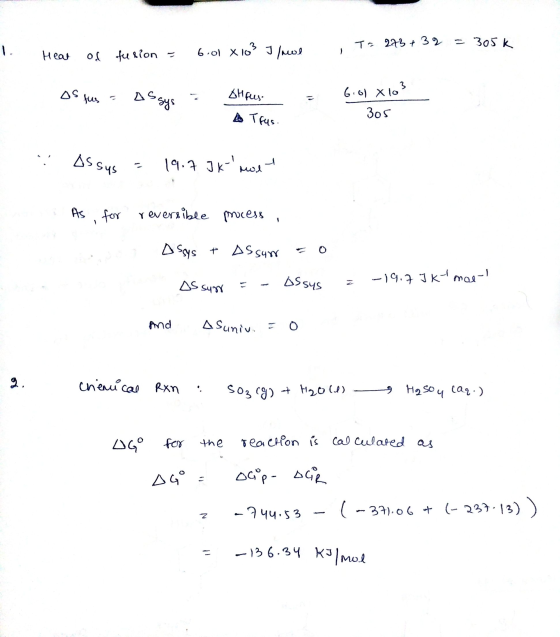
#1)Suppose a small decorative piece of ice (system) at a temperature of 0°C and weighing 538...
#1)Suppose a small decorative piece of ice (system) at a
temperature of 0°C and weighing 538 g is placed on a granite
tabletop (surroundings) at 32 °C. Determine ∆Ssys,
∆Ssurr and ∆Suniv (in J/K) associated for the
reversible melting of this piece of ice.
Assume the temperature of the tabletop does not change and that the
final temperature of the water is 0 °C. To solve this problem you
are given the molar heat of fusion of ice is 6.01 kJ
mol-1.
∆Ssys =
∆Ssurr =
∆Suniv =
#2)Determine ∆rG° (in kJ mol-1) for the following reaction at 298 K,
SO3(g) + H2O(l) ----> H2SO4(aq)
Given that ∆fG° for the species are,
SO3(g) = -371.06 kJ mol-1
H2O(l) = -237.13 kJ mol-1
H2SO4(aq) = -744.53 kJ mol-1
Homework Answers
A thermodynamically irreversible process is always accompanied by an increase of entropy of the system and its surrounding taken together while in a thermodynamically reversible process, the entropy of the system and its surrounding taken together remains unaltered. Thus we can write
∆Ssys + ∆Ssurr = 0
Add Answer to:
#1)Suppose a small decorative piece of ice (system) at a
temperature of 0°C and weighing 538...
7. (20 pts) The production of sulfuric acid, a component of acid rain occurs according to...
7. (20 pts) The production of sulfuric acid, a component of acid rain occurs according to SO3(g) + H2O(l) → H2SO4(aq); ∆r HƟ = -227.72 kJ/mol a) Using the thermodynamic data given below state whether this reaction is spontaneous at 25 oC. Explain your answer. Substance ∆f GƟ (kJ/mol) H2SO4(aq) -744.53 H2O(l) -237.13 SO3(g) -371.06 b) Calculate the equilibrium constant at 25 oC. c) Assuming the enthalpy change is independent...
Two 20.0 g ice cubes at −14.0 ∘C are placed into 235 g of water at...
Two 20.0 g ice cubes at −14.0 ∘C are placed into 235 g of water at 25.0 ∘C. Assuming no energy is transferred to or from the surroundings, calculate the final temperature, Tf, of the water after all the ice melts. heat capacity of H2O(s) 37.7 J/(mol⋅K) heat capacity of H2O(l) 75.3 J/(mol⋅K) enthalpy of fusion of H2O. 6.01 kJ/mol
Two 20.0 g ice cubes at −17.0 ∘C−17.0 ∘C are placed into 265 g265 g of...
Two 20.0 g ice cubes at −17.0 ∘C−17.0 ∘C are placed into 265 g265 g of water at 25.0 ∘C.25.0 ∘C. Assuming no energy is transferred to or from the surroundings, calculate the final temperature, ?f,Tf, of the water after all the ice melts. Heat Capacity of H2O(s) 37.7 J/(mol K) Heat Capacity of H2O (l) 75.3 J/(mol K) Enthalpy of Fusion of H2O 6.01 kJ/mol
You have a block of ice at a temperature of -100°C. This block of ice is...
You have a block of ice at a temperature of -100°C. This block of ice is made from 180g H2O. The block of ice will be heated continually until it becomes super-heated steam at a temperature of 200°C Cice = 2.03 J/g-K ΔHfus=6.01 kJ/mol Cwater = 4.18 J/g-K Csteam = 1.84 J/g-K ΔHvap=40.67 kJ/mol What is the enthalpy change raising the temperature of 180 g of ice at −100 °C to 0°C? What is the enthalpy change upon melting 180...
Calculate the change in entropy that occurs when 18.02 g of ice at –17.5°C is placed...
Calculate the change in entropy that occurs when 18.02 g of ice at –17.5°C is placed in 90.08 g of water at 100.0°C in a perfectly insulated vessel. Assume that the molar heat capacities for H2O(s) and H2O(l) are 37.5 J K^-1 mol^-1 and 75.3 J K^-1 mol^-1, respectively, and the molar enthalpy of fusion for ice is 6.01 kJ/mol. Change in entropy = ______J/K
Two 20.0 g ice cubes at -12.0 °C are placed into 215 g of water at...
 Two 20.0 g ice cubes at -12.0 °C are placed into 215 g of water at 25.0 °C. Assuming no energy is transferred to or from the surroundings, calculate the final temperature, T, of the water after all the ice melts. heat capacity of H2O(s) heat capacity of H2O(1) enthalpy of fusion of H,O 37.7 J/(mol-K) 75.3 J/(mol-K) 6.01 kJ/mol Ti =
Calculate the enthalpy change upon converting 1.00 mol of ice at -25 °C to steam at 125 °C under a constant pressure of 1 atm
 Calculate the enthalpy change upon converting 1.00 mol of ice at -25 °C to steam at 125 °C under a constant pressure of 1 atm. The specific heats of ice, liquid water, and steam are 2.03, 4.18, and 1.84 J/g-K, respectively. For H2O, ΔHfus = 6.01 kJ/mol and ΔHvap=40.67 kJ/mol.
A 100 g piece of ice at initial temperature 0 C is added to 1 L...
A 100 g piece of ice at initial temperature 0 C is added to 1 L water at initial temperature 100 C. What is the final temperature of the system? Please show all steps and work . Thank you very much for help!
only worth 1 point. 1. (6) 15.0 g of ice cubes at 0.0°C are combined with...
 only worth 1 point. 1. (6) 15.0 g of ice cubes at 0.0°C are combined with 150.g of liquid water at 70.0°C in a coffee cup calorimeter. Calculate the final temperature reached, assuming no heat loss or gain from the calorimeter. (Data: specific heat capacity of H2O(l). C4.18 1/8 'C) H2O(s) → H2O(1) AH = 6.02 kJ/mol) 2. (6) Calculate A s for the reaction: 5C(s) + 6H2(g) → CsHuz10 Use the following reactions and given AH's. CsHua(l) + 802()...
1 What is the equilibrium constant for a reaction at temperature 89.1 °C if the equilibrium...
1 What is the equilibrium constant for a reaction at temperature 89.1 °C if the equilibrium constant at 22.6 °C is 49.93? For this reaction, ΔrH = -21.1 kJ mol-1 . 2 What is the ΔrG° for the following reaction (in kJ mol-1)? C6H12O6(s, glucose) + 6 O2 (g) ⇌6 CO2 (g)+ 6 H2O (l) 3 What is the ΔrG° for the following reaction (in kJ mol-1)? 2 NO2 (g) ⇌N2O4 (g) 4 What is the ΔrG for the following...
 Two 20.0 g ice cubes at -12.0 °C are placed into 215 g of water at 25.0 °C. Assuming no energy is transferred to or from the surroundings, calculate the final temperature, T, of the water after all the ice melts. heat capacity of H2O(s) heat capacity of H2O(1) enthalpy of fusion of H,O 37.7 J/(mol-K) 75.3 J/(mol-K) 6.01 kJ/mol Ti =
 only worth 1 point. 1. (6) 15.0 g of ice cubes at 0.0°C are combined with 150.g of liquid water at 70.0°C in a coffee cup calorimeter. Calculate the final temperature reached, assuming no heat loss or gain from the calorimeter. (Data: specific heat capacity of H2O(l). C4.18 1/8 'C) H2O(s) → H2O(1) AH = 6.02 kJ/mol) 2. (6) Calculate A s for the reaction: 5C(s) + 6H2(g) → CsHuz10 Use the following reactions and given AH's. CsHua(l) + 802()...
Most questions answered within 3 hours.
-
Where is the error in this code sequence?
String s1 = "Hello";
String s2 = "ello";...
asked 11 months ago -
Financial data for Joel de Paris, Inc., for last year
follow:
Joel de Paris, Inc.
Balance...
asked 11 months ago -
Consider this reaction:
Al2(SO4)3 (aq)+ BaCl3
(aq) Al2Cl6 (aq)- +
3BaSO4(s) . What is the...
asked 11 months ago -
Suppose that Savneet is considering increasing her
recent random sample from 20 car rentals to 40...
asked 11 months ago -
Trucks arrive at an unloading terminal at an average rate of 120
per hour.
Trucks arrive...
asked 11 months ago -
Why are methanol and ethanol completely soluble in water while
octanol is not very little soluble....
asked 11 months ago -
A facilities manager at a university reads in a research report
that the mean amount of...
asked 11 months ago -
When the CuSO4 is rehydrated by adding water to the anhydrous
compound, is this an endothermic...
asked 11 months ago -
A ray of sunlight is passing from diamond into crown glass; the
angle of incidence is...
asked 11 months ago -
A block of mass 0.249 kg is placed on top of a light, vertical
spring of...
asked 11 months ago -
how do the kidneys compensate in the presences of acidosis
a) trigger hyperventilate
b) reserve acid...
asked 11 months ago -
Question 501 pts
The rental rate of capital to the firm increases. Which of the
following...
asked 11 months ago