P=100 TC= 2q+q^2 1) Find q* 2) Find ATC, MC 3) Plot MR, ATC, MC, d...
P=100
TC= 2q+q^2
1) Find q*
2) Find ATC, MC
3) Plot MR, ATC, MC, d and show profit
4) Based on profit what do you expect to happen as a result?
Homework Answers
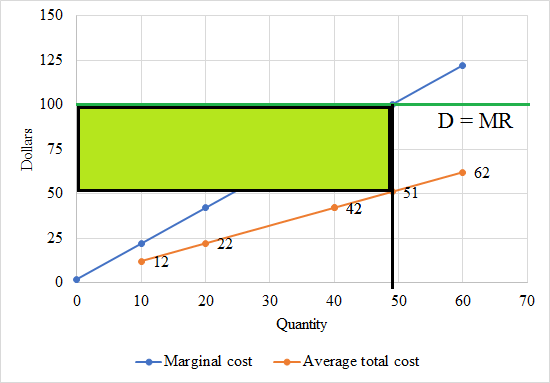
1) Use P = MC. Here MC = 2 + 2q. Then we have 100 = 2 + 2q or q = 98/2 = 49. Hence q* = 49
2) ATC = C/q = 2 + q = $51. MC = 2 + 2*q = 100
3) Graph plot is provided below. Profit is shown as green shaded region
4) We expect new firms entering the industry in the long run due to positive economic profits in short run. This would drive down the price and it will reach the minimum of ATC which is $2.
Add Answer to:
P=100
TC= 2q+q^2
1) Find q*
2) Find ATC, MC
3) Plot MR, ATC, MC, d...
P = 225 - q TC = 5q MC = MR MC = 5 MR =...
 P = 225 - q
TC = 5q
MC = MR
MC = 5
MR = 225 - 2q
5 = 225 - 2q
2q = 225 - 5
q = 220/2
= 110
P = 225 - 110
= 115
Duopoly Continuing with our latinum market example from last week, imagine that the government has noted the extreme restriction in latinum supplied and wishes to remedy the situation. While regulators are not willing to completely reopen the market, they...
P = 225 - q
TC = 5q
MC = MR
MC = 5
MR = 225 - 2q
5 = 225 - 2q
2q = 225 - 5
q = 220/2
= 110
P = 225 - 110
= 115
Duopoly Continuing with our latinum market example from last week, imagine that the government has noted the extreme restriction in latinum supplied and wishes to remedy the situation. While regulators are not willing to completely reopen the market, they...
P ($/pound) Q (pound) TR ($) MR ($) TC ($) MC ($) ATC ($/pound) 100 0...
P ($/pound) Q (pound) TR ($) MR ($) TC ($) MC ($) ATC ($/pound) 100 0 --- 0 --- --- 90 1 30 80 2 60 70 3 90 60 4 120 50 5 150 40 6 180 30 7 210 20 8 240 10 9 270 0 10 300 a. Complete the chart.
1. Complete the table 2 . Plot ATC, AVC, and MC in one diagram. 3 ....
1. Complete the table 2 . Plot ATC, AVC, and MC in one diagram. 3 . What is the shutdown price? 4. At a price of $18.8 how much should the firm produce to maximize profit? 5. At a price of $18.8 calculate its profit. please show me how you got the result not only the answer. thank you Q TFC TVC TC AVC ATC MC 0 30 NA NA NA 1 50 2 66 3 80 4 90 5...
Monopoly: Assume: P = 16 – 2Q TC = 3Q^2 + 4Q + 3 Find: P,Q,...
Monopoly: Assume: P = 16 – 2Q TC = 3Q^2 + 4Q + 3 Find: P,Q, TR,TC, profit, and elasticity at profit max. Please show all your work
Fill in the Table for a monopoly. Q P TR TC Profit MR MC 10 $20...
Fill in the Table for a monopoly. Q P TR TC Profit MR MC 10 $20 $150 11 19 155 12 18 161 13 17 170 14 16 185 39 15 15 210 What is the highest profit possible? What is the profit maximizing level of output? What is the profit maximizing price? Draw the graph for a monopoly below, find the profit maximizing level of output Q*, the profit maximizing price P*, the average total cost ATC*, the profit...
Consider a competitive rm with total costs given by TC(q) = 100 + 10q + q^2,...
Consider a competitive rm with total costs given by TC(q) = 100 + 10q + q^2, The firm faces a market price p = 50. (a) Write expressions for total revenue TR and marginal revenue MR as functions of output q. (b) Write expressions for average total cost ATC, average variable cost AVC, and marginal cost MC as functions of output q. (c) For what value of output is ATC minimized? (d) Find the profit maximizing level of output q...
Consider a competitive firm with total costs given by TC(q) = 100 + 10q + q...
Consider a competitive firm with total costs given by TC(q) = 100 + 10q + q 2 The firm faces a market price p = 50. (d) Find the profit-maximizing level of output q^*. At this level of output, what are TR, TC, ATC, and π? (e) Graph the ATC, AVC, MC, and MR curves in a single graph, and indicate the profit-maximizing level of output. If there are profits, shade the region corresponding to profit and label it.
MR, MC, and ATC $12.00 MC $10.00 $8.00 $6.00 $4.00 ATC ATC = $2.75 $2.00 MR...
 MR, MC, and ATC $12.00 MC $10.00 $8.00 $6.00 $4.00 ATC ATC = $2.75 $2.00 MR P = $1.50 $0.00 0 1 120 20 40 Average Total Cost (ATC) 60 - Marginal Cost (MC) 80 100 R Marginal Revenue (MR) Question 2 of Quiz 4: If the firm maximizes the profit, calculate the profit of the perfectly competitive firm when the price is $1.5, show your calculation. Is that equal to the size of the red rectangle?
Labor TVC TC MC AFC AVC ATC 25 50 75 100 25 125 (a) Complete...
 Labor TVC TC MC AFC AVC ATC 25 50 75 100 25 125 (a) Complete the blank columns (5 points). Please create a table like mine and fill it. (b) Assume the price of this product equals $10. What's the profit-maximizing output (q)? (3 points). Note: managers maximize profits by setting MR=MC and under perfectly competitive markets, MR=Price. Thus, maximize profit by producing a where P=MC.(2 points) (c) What is the profit? (3 points) TOTAL COST (TC) - the...
TR! MR FC vel TC MC ATC Profit S-6 $25 21 5 4 3 2 $25...
 TR! MR FC vel TC MC ATC Profit S-6 $25 21 5 4 3 2 $25 $20 $153 $10 41 S33 Complete the table above, using the given information. a. Use the demand and supply schedules to plot both curves on a well-labeled graph. b. Now assume a price floor of $20 and indicate this on the graph. C. Calculate the value of the new consumer surplus, the value of the new producer surplus, and the value of the new...
 P = 225 - q
TC = 5q
MC = MR
MC = 5
MR = 225 - 2q
5 = 225 - 2q
2q = 225 - 5
q = 220/2
= 110
P = 225 - 110
= 115
Duopoly Continuing with our latinum market example from last week, imagine that the government has noted the extreme restriction in latinum supplied and wishes to remedy the situation. While regulators are not willing to completely reopen the market, they...
P = 225 - q
TC = 5q
MC = MR
MC = 5
MR = 225 - 2q
5 = 225 - 2q
2q = 225 - 5
q = 220/2
= 110
P = 225 - 110
= 115
Duopoly Continuing with our latinum market example from last week, imagine that the government has noted the extreme restriction in latinum supplied and wishes to remedy the situation. While regulators are not willing to completely reopen the market, they...
 MR, MC, and ATC $12.00 MC $10.00 $8.00 $6.00 $4.00 ATC ATC = $2.75 $2.00 MR P = $1.50 $0.00 0 1 120 20 40 Average Total Cost (ATC) 60 - Marginal Cost (MC) 80 100 R Marginal Revenue (MR) Question 2 of Quiz 4: If the firm maximizes the profit, calculate the profit of the perfectly competitive firm when the price is $1.5, show your calculation. Is that equal to the size of the red rectangle?
 Labor TVC TC MC AFC AVC ATC 25 50 75 100 25 125 (a) Complete the blank columns (5 points). Please create a table like mine and fill it. (b) Assume the price of this product equals $10. What's the profit-maximizing output (q)? (3 points). Note: managers maximize profits by setting MR=MC and under perfectly competitive markets, MR=Price. Thus, maximize profit by producing a where P=MC.(2 points) (c) What is the profit? (3 points) TOTAL COST (TC) - the...
 TR! MR FC vel TC MC ATC Profit S-6 $25 21 5 4 3 2 $25 $20 $153 $10 41 S33 Complete the table above, using the given information. a. Use the demand and supply schedules to plot both curves on a well-labeled graph. b. Now assume a price floor of $20 and indicate this on the graph. C. Calculate the value of the new consumer surplus, the value of the new producer surplus, and the value of the new...
Most questions answered within 3 hours.
-
Where is the error in this code sequence?
String s1 = "Hello";
String s2 = "ello";...
asked 10 months ago -
Financial data for Joel de Paris, Inc., for last year
follow:
Joel de Paris, Inc.
Balance...
asked 10 months ago -
Consider this reaction:
Al2(SO4)3 (aq)+ BaCl3
(aq) Al2Cl6 (aq)- +
3BaSO4(s) . What is the...
asked 10 months ago -
Suppose that Savneet is considering increasing her
recent random sample from 20 car rentals to 40...
asked 10 months ago -
Trucks arrive at an unloading terminal at an average rate of 120
per hour.
Trucks arrive...
asked 10 months ago -
Why are methanol and ethanol completely soluble in water while
octanol is not very little soluble....
asked 10 months ago -
A facilities manager at a university reads in a research report
that the mean amount of...
asked 10 months ago -
When the CuSO4 is rehydrated by adding water to the anhydrous
compound, is this an endothermic...
asked 10 months ago -
A ray of sunlight is passing from diamond into crown glass; the
angle of incidence is...
asked 10 months ago -
A block of mass 0.249 kg is placed on top of a light, vertical
spring of...
asked 10 months ago -
how do the kidneys compensate in the presences of acidosis
a) trigger hyperventilate
b) reserve acid...
asked 10 months ago -
Question 501 pts
The rental rate of capital to the firm increases. Which of the
following...
asked 10 months ago