A robot cheetah can jump over obstacles. Suppose the launch speed is v0 = 3.3 m/s,...
A robot cheetah can jump over obstacles. Suppose the launch speed is v0 = 3.3 m/s, and the launch angle is θ = 42.3 degrees above horizontal.
a)What is the maximum height h in terms of v0, θ, and g (9.80 m/s2)?
b)What is the maximum height in meters?
c) Given the same launch speed, what launch angle, in degrees, would yield a maximum height that is 58.1% greater than that calculated in part (b)?
Homework Answers


Add Answer to:
A robot cheetah can jump over obstacles. Suppose the launch
speed is v0 = 3.3 m/s,...
A rocket is fired at an initial speed v0 = 141.0 m/s from ground level, at...
A rocket is fired at an initial speed v0 = 141.0 m/s from ground level, at an angle θ = 33 degrees above the horizontal. Ignore air resistance. The magnitude of the gravitational acceleration is 9.8 m/s2. Choose the RIGHT as positive x-direction. Choose UPWARD as psotitive y-direction. Keep 2 decimal places in all answers (a) Find v0x, the x component of the initial velocity (in m/s) (b) Find v0y, the y component of the initial velocity (in m/s) (c)...
A spring-gun projects a small rock from the ground with speed v0 at an angle ?0...
 A spring-gun projects a small rock from the ground with speed
v0 at an angle ?0 above the ground. You have been
asked to determine v0. From the way the spring-gun is
constructed, you know that to a good approximation v0 is
independent of the launch angle. You go to a level, open field,
select a launch angle, and measure the horizontal distance the rock
travels. You use g = 9.80 m/s2 and ignore the small height
of the end...
A spring-gun projects a small rock from the ground with speed
v0 at an angle ?0 above the ground. You have been
asked to determine v0. From the way the spring-gun is
constructed, you know that to a good approximation v0 is
independent of the launch angle. You go to a level, open field,
select a launch angle, and measure the horizontal distance the rock
travels. You use g = 9.80 m/s2 and ignore the small height
of the end...
An object is launched with a speed v0 = 80.0 m/s and with an angle α0...
An object is launched with a speed v0 = 80.0 m/s and with an angle α0 = 60º with respect to the flat surface from which it was launched at a place where g = 9.80 m/s^2. a) Calculate the position (x, y) of the object when t = 4.00s. b) Calculate the magnitude and direction of its velocity when t = 4.00s. c) Determine the time at which the object reaches its maximum height and the value of said...
A kid always throws a ball with the same speed, V0 = 22 m/s, and witht...
A kid always throws a ball with the same speed, V0 = 22 m/s, and witht he same angle above the horizontal, θ = 15°. Hitting a squirel is then only a matter of precise timing! As Squirells are intelligent and difficult to hit, they are prone to jumping at random moments to avoid being hit. Ift he standoff begins at t = 0 s, and anticipating that the squirel will jump at tj = 3.0 s, determine the interval...
A secret agent skis off a slope inclined at θ = 25.6 degrees below horizontal at a speed of v0 = 18.7 m/s
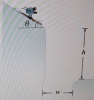 A secret agent skis off a slope inclined at θ = 25.6 degrees below horizontal at a speed of v0 = 18.7 m/s. He must clear a gorge, and the slope on the other side of the gorge is h=11.7 m below the edge of the upper slope.What is the maximum width,w, of the gorge (in meters) so that the agent clears it?
A secret agent skis off a slope inclined at θ = 32.9 degrees below horizontal at a speed of v0 = 14.4 m/s.
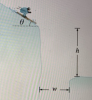 A secret agent skis off a slope inclined at θ = 32.9 degrees below horizontal at a speed of v0 = 14.4 m/s. He must clear a gorge, and the slope on the other side of the gorge is h = 11.8 m below the edge of the upper slope. What is the maximum width, w of the gorge (in meters) so that the agent clears it?
A ski jumper leaves a ski jump at a speed of 24 m/s at an angle...
A ski jumper leaves a ski jump at a speed of 24 m/s at an angle of 30 degrees. She ultimately lands 20 meters below where she left the jump. What is her speed when she hits the ground?
A rock thrown with speed 6.00 m/s and launch angle 30.0 ∘ (above the horizontal) travels...
A rock thrown with speed 6.00 m/s and launch angle 30.0 ∘ (above the horizontal) travels a horizontal distance of d = 16.5 m before hitting the ground. From what height was the rock thrown? Use the value g = 9.800 m/s2 for the free-fall acceleration. Find the height yi from which the rock was launched.
A rock thrown with speed 9.00 m/s and launch angle 30.0 ∘ (above the horizontal) travels...
A rock thrown with speed 9.00 m/s and launch angle 30.0 ∘ (above the horizontal) travels a horizontal distance of d = 20.0 m before hitting the ground. From what height was the rock thrown? Use the value g = 9.800 m/s2 for the free-fall acceleration
You launch a projectile from level ground at a speed of 25.0 m/s and an angle...
You launch a projectile from level ground at a speed of 25.0 m/s and an angle of 36.9∘ above the horizontal. a) How long after it is launched does the projectile reach its maximum height above the ground? b) What is the maximum height of the projectile? c) How long after the projectile is launched does it return to ground level? d) How far from its launch point does the projectile land?
 A spring-gun projects a small rock from the ground with speed
v0 at an angle ?0 above the ground. You have been
asked to determine v0. From the way the spring-gun is
constructed, you know that to a good approximation v0 is
independent of the launch angle. You go to a level, open field,
select a launch angle, and measure the horizontal distance the rock
travels. You use g = 9.80 m/s2 and ignore the small height
of the end...
A spring-gun projects a small rock from the ground with speed
v0 at an angle ?0 above the ground. You have been
asked to determine v0. From the way the spring-gun is
constructed, you know that to a good approximation v0 is
independent of the launch angle. You go to a level, open field,
select a launch angle, and measure the horizontal distance the rock
travels. You use g = 9.80 m/s2 and ignore the small height
of the end...
Most questions answered within 3 hours.
-
Where is the error in this code sequence?
String s1 = "Hello";
String s2 = "ello";...
asked 10 months ago -
Financial data for Joel de Paris, Inc., for last year
follow:
Joel de Paris, Inc.
Balance...
asked 10 months ago -
Consider this reaction:
Al2(SO4)3 (aq)+ BaCl3
(aq) Al2Cl6 (aq)- +
3BaSO4(s) . What is the...
asked 10 months ago -
Suppose that Savneet is considering increasing her
recent random sample from 20 car rentals to 40...
asked 10 months ago -
Trucks arrive at an unloading terminal at an average rate of 120
per hour.
Trucks arrive...
asked 10 months ago -
Why are methanol and ethanol completely soluble in water while
octanol is not very little soluble....
asked 10 months ago -
A facilities manager at a university reads in a research report
that the mean amount of...
asked 10 months ago -
When the CuSO4 is rehydrated by adding water to the anhydrous
compound, is this an endothermic...
asked 10 months ago -
A ray of sunlight is passing from diamond into crown glass; the
angle of incidence is...
asked 10 months ago -
A block of mass 0.249 kg is placed on top of a light, vertical
spring of...
asked 10 months ago -
how do the kidneys compensate in the presences of acidosis
a) trigger hyperventilate
b) reserve acid...
asked 10 months ago -
Question 501 pts
The rental rate of capital to the firm increases. Which of the
following...
asked 10 months ago