Four roommates are planning to spend the weekend in their dorm room watching old movies, and...
Four roommates are planning to spend the weekend in their dorm room watching old movies, and they are debating how many to watch. Here is their willingness to pay for each film:
|
Willingness to Pay |
||||
|---|---|---|---|---|
|
(Dollars) |
||||
|
Felix |
Larry |
Raphael |
Alex |
|
| First film | 7 | 5 | 3 | 2 |
| Second film | 6 | 4 | 2 | 1 |
| Third film | 5 | 3 | 1 | 0 |
| Fourth film | 4 | 2 | 0 | 0 |
| Fifth film | 3 | 1 | 0 | 0 |
Within the dorm room, the showing of a movie a public good.
If it costs $8 to rent a movie, the roommates should rent
movies in order to maximize the total surplus.
Suppose the roommates choose to rent the optimal number of movies you just indicated and then split the cost of renting equally.
This means that each roommate will pay
.
Complete the following table with each roommate's total willingness to pay for this many movies and the surplus each person obtains from watching the movies.
|
Roommate |
Total Willingness to Pay |
Consumer Surplus |
|---|---|---|
|
(Dollars) |
(Dollars) |
|
| Felix | ||
| Larry | ||
| Raphael | ||
| Alex |
In order to split the cost in a way that ensures that everyone benefits, the cost could be divided up based on the benefits each roommate receives. The practical problem with this solution is that each roommate has an incentive to the value of the movies to him. Suppose they agree in advance to choose the efficient number and to split the cost of the movies equally. True or False: When Felix is asked his willingness to pay, he will have an incentive to tell the truth. True False |
Homework Answers
Within the dorm room showing a movie is a public good.
Cost of renting a movie - $8
For the first film total willingness to pay is- $7+$5+$3+$2= $17 which is greater than renting this movie which is $8
For the second film total willingness to pay is= $6+$4+$2+$1= $13 which is greater than the cost of renting this movie which is $8
For the third film total willingness to pay is= $5+$3+$1+$0= $9 which is greater than the cost of renting this movie which is $8
For the fourth film total willingness to pay is= $4+$2+$0+$0= $6 which is less than the cost of renting this movie which is $8
For the fourth film total willingness to pay is= $3+$1+$0+$0= $4 which is less than the cost of renting this movie which is $8
So we can conclude that the roommates should rent three films as for the other two movies willingness to pay for the movie is less than the cost of renting the movie.
Now each movie costs $8. So renting 3 movies will cost $8*3= $24
Now if all the four roommates split the cost of renting the movies equally then each roommate will pay
$24/ 4 = $6
Now for Felix
Total willingness to pay for the three movies are = $7+$6+$5= $18
He will pay $6 for renting 3 movies
So consumer surplus will be = willingness to pay- cost of renting movies = $18-$6 = $12
For Larry
Total willingness to pay = $5+$4+$3 = $12
He will pay $6 to rent these movies
So consumer surplus = $12 - $ 6 = $6
For Raphael
Total willingness to pay for three movies = $3+ $2 +$1= $6
He will pay $ 6 to rent these movies
So consumer surplus is = $6 - $6 = 0
For Alex
Total willingness to pay for three movies
= $2+$1+$0= $3
He will pay $6 to rent these movies
So consumer surplus is = $3- $6 = -$3
As the roommates split the cost of the movies equally Felix has an incentive, to tell the truth about his willingness to pay because his cost per movie is $6/3 = $2 which is less than his willingness ness to pay for each of three movies.
That is $7 > $2
$6 > $2
$5> $2
So the statement is true.
Add Answer to:
Four roommates are planning to spend the weekend in their dorm
room watching old movies, and...
Four roommates are planning to spend the weekend in their dorm room watching old movies, and...
 Four roommates are planning to spend the weekend in their dorm room watching old movies, and they are debating how many to watch. Here is their willingness to pay for each film: Willingness to Pay (Dollars) Paolo Van Carlos Felix First film 10 9 6 Second film 97 42 Third film Fourth film Fifth film t》 Within the dorm room, the showing of a moviea public good If it costs $8 to rent a movie, the roommates should rent movies...
Four roommates are planning to spend the weekend in their dorm room watching old movies, and they are debating how many...
Four roommates are planning to spend the weekend in their dorm room watching old movies, and they are debating how many to watch. Here is their willingness to pay for each film: Willingness to Pay (Dollars) Eric Kenji Paolo Van First film 10 9 8 3 Second film 8 7 6 2 Third film 6 5 4 1 Fourth film 4 3 2 0 Fifth film 2 1 0 0 Within the dorm room, the showing of a movie (...
3. Problems 11-5 Four roommates are planning to spend the weekend in their dorm room watching...
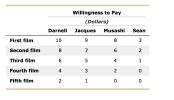
 3. Problems 11-5 Four roommates are planning to spend the weekend in their dorm room watching old movies, and they are debating how many to watch. Here is their willingness to pay for each film: Willingness to Pay (Dollars) Andrew Darnell Jacques Musashi 6 First film Second film Third film Fourth film Fifth film Within the dorm room, the showing of a movie a public good. If it costs $8 to rent a movie, the roommates should rent 3 movies...
5. Problems and Applications Q5 Four roommates are planning to spend the weekend in their dorm room watching o...
5. Problems and Applications Q5 Four roommates are planning to spend the weekend in their dorm room watching old movies, and they are debating how many to watch. Here is their willingness to pay for each film: Willingness to Pay (Dollars) Kevin Rajiv Yakov Charles First film 10 9 6 3 Second film 9 7 4 2 Third film 8 5 2 1 Fourth film 7 3 0 0 Fifth film 6 1 0 0 Within the dorm room, the...
Four roommates are planning to spend the weekend in their dorm room watching old movies, and they are debating how man...
 Four
roommates are planning to spend the weekend in their dorm room
watching old movies, and they are debating how many to watch. Here
is their willingness to pay for each film:
Within the dorm room, the showing of a movie (is not or
is) a public good.
If it costs $12 to rent a movie, the roommates should rentmovies
in order to maximize the total surplus.
Suppose the roommates choose to rent the optimal number of
movies you just...
Four
roommates are planning to spend the weekend in their dorm room
watching old movies, and they are debating how many to watch. Here
is their willingness to pay for each film:
Within the dorm room, the showing of a movie (is not or
is) a public good.
If it costs $12 to rent a movie, the roommates should rentmovies
in order to maximize the total surplus.
Suppose the roommates choose to rent the optimal number of
movies you just...
5. Problems and Applications Q5 Four roommates are planning to spend the weekend in their dorm...
5. Problems and Applications Q5 Four roommates are planning to spend the weekend in their dorm room watching old movies, and they are debating how many to watch. Here is their willingness to pay for each film: Willingness to Pay (Dollars) Andrew Darnell Jacques Musashi First film 10 9 6 3 Second film 9 7 4 2 Third film 8 5 2 1 Fourth film 7 3 0 0 Fifth film 6 1 0 0 Within the dorm room, the...
Public Goods: Four roommates are planning to spend the weekend in their dorm room watching pay...
 Public Goods: Four roommates are planning to spend the weekend
in their dorm room watching pay per view movies, and they are
debating how many to watch. The following gives their willingness
to pay (marginal benefit) for each film: Ang Greta Shonda J.J.
First film $8 $5 $4 $2 Second film $6 $4 $2 $1 Third film $5 $3 $1
$0 Fourth film $1 $2 $0 $0 Fifth film $0 $1 $0 $0 Anyone in the
room is able to...
Public Goods: Four roommates are planning to spend the weekend
in their dorm room watching pay per view movies, and they are
debating how many to watch. The following gives their willingness
to pay (marginal benefit) for each film: Ang Greta Shonda J.J.
First film $8 $5 $4 $2 Second film $6 $4 $2 $1 Third film $5 $3 $1
$0 Fourth film $1 $2 $0 $0 Fifth film $0 $1 $0 $0 Anyone in the
room is able to...
Four roommates are planning to spend the weekend in their dorm room watching old movies, and they are debating how many to watch
Four roommates are planning to spend the weekend in their dorm room watching old movies, and they are debating how many to watch. Here is their willingness to pay for each film: Orson Alfred Woody Ingmar Frist film 7 5 3 2 Second film 6 4 2 1 Third film 5 3 1 0 Fourth film 4 2 0 0 Fifth film 3 1 0 0 b. If it costs $8 to rent a video, how many videos should the...
8. Problems and Applications Q8 Five roommates are planning to spend the weekend in their dorm...
 8. Problems and Applications Q8 Five roommates are planning to spend the weekend in their dorm room watching movies, and they are debating how many movies to watch. Here is their willingness to pay: Willingness to Pay (Dollars) Shen Antonio Dmitri Manuel Jake First film 14 10 8 2 Second film 12 8 4 2 0 Third film 10 2 0 0 Fourth film 6 2 0 0 0 Fifth film 2 0 0 0 0 Buying a DVD costs...
On page 180 of the text there is a very simple personal example of three roommates...
 On page 180 of the text there is a very simple personal
example of three roommates who set up cost allocation. The
allocation was for rent, TV, internet and groceries. The the cost
allocation system was using the three roommates as equals so the
cost allocation was the total cost divided by three. That method
worked our for a short period of time then each roommate found
specific reasons why that cost allocation system did not work
"fairly". One example...
On page 180 of the text there is a very simple personal
example of three roommates who set up cost allocation. The
allocation was for rent, TV, internet and groceries. The the cost
allocation system was using the three roommates as equals so the
cost allocation was the total cost divided by three. That method
worked our for a short period of time then each roommate found
specific reasons why that cost allocation system did not work
"fairly". One example...
 Four roommates are planning to spend the weekend in their dorm room watching old movies, and they are debating how many to watch. Here is their willingness to pay for each film: Willingness to Pay (Dollars) Paolo Van Carlos Felix First film 10 9 6 Second film 97 42 Third film Fourth film Fifth film t》 Within the dorm room, the showing of a moviea public good If it costs $8 to rent a movie, the roommates should rent movies...
 3. Problems 11-5 Four roommates are planning to spend the weekend in their dorm room watching old movies, and they are debating how many to watch. Here is their willingness to pay for each film: Willingness to Pay (Dollars) Andrew Darnell Jacques Musashi 6 First film Second film Third film Fourth film Fifth film Within the dorm room, the showing of a movie a public good. If it costs $8 to rent a movie, the roommates should rent 3 movies...
 Four
roommates are planning to spend the weekend in their dorm room
watching old movies, and they are debating how many to watch. Here
is their willingness to pay for each film:
Within the dorm room, the showing of a movie (is not or
is) a public good.
If it costs $12 to rent a movie, the roommates should rentmovies
in order to maximize the total surplus.
Suppose the roommates choose to rent the optimal number of
movies you just...
Four
roommates are planning to spend the weekend in their dorm room
watching old movies, and they are debating how many to watch. Here
is their willingness to pay for each film:
Within the dorm room, the showing of a movie (is not or
is) a public good.
If it costs $12 to rent a movie, the roommates should rentmovies
in order to maximize the total surplus.
Suppose the roommates choose to rent the optimal number of
movies you just...
 Public Goods: Four roommates are planning to spend the weekend
in their dorm room watching pay per view movies, and they are
debating how many to watch. The following gives their willingness
to pay (marginal benefit) for each film: Ang Greta Shonda J.J.
First film $8 $5 $4 $2 Second film $6 $4 $2 $1 Third film $5 $3 $1
$0 Fourth film $1 $2 $0 $0 Fifth film $0 $1 $0 $0 Anyone in the
room is able to...
Public Goods: Four roommates are planning to spend the weekend
in their dorm room watching pay per view movies, and they are
debating how many to watch. The following gives their willingness
to pay (marginal benefit) for each film: Ang Greta Shonda J.J.
First film $8 $5 $4 $2 Second film $6 $4 $2 $1 Third film $5 $3 $1
$0 Fourth film $1 $2 $0 $0 Fifth film $0 $1 $0 $0 Anyone in the
room is able to...
 8. Problems and Applications Q8 Five roommates are planning to spend the weekend in their dorm room watching movies, and they are debating how many movies to watch. Here is their willingness to pay: Willingness to Pay (Dollars) Shen Antonio Dmitri Manuel Jake First film 14 10 8 2 Second film 12 8 4 2 0 Third film 10 2 0 0 Fourth film 6 2 0 0 0 Fifth film 2 0 0 0 0 Buying a DVD costs...
 On page 180 of the text there is a very simple personal
example of three roommates who set up cost allocation. The
allocation was for rent, TV, internet and groceries. The the cost
allocation system was using the three roommates as equals so the
cost allocation was the total cost divided by three. That method
worked our for a short period of time then each roommate found
specific reasons why that cost allocation system did not work
"fairly". One example...
On page 180 of the text there is a very simple personal
example of three roommates who set up cost allocation. The
allocation was for rent, TV, internet and groceries. The the cost
allocation system was using the three roommates as equals so the
cost allocation was the total cost divided by three. That method
worked our for a short period of time then each roommate found
specific reasons why that cost allocation system did not work
"fairly". One example...
Most questions answered within 3 hours.
-
Where is the error in this code sequence?
String s1 = "Hello";
String s2 = "ello";...
asked 10 months ago -
Financial data for Joel de Paris, Inc., for last year
follow:
Joel de Paris, Inc.
Balance...
asked 10 months ago -
Consider this reaction:
Al2(SO4)3 (aq)+ BaCl3
(aq) Al2Cl6 (aq)- +
3BaSO4(s) . What is the...
asked 10 months ago -
Suppose that Savneet is considering increasing her
recent random sample from 20 car rentals to 40...
asked 10 months ago -
Trucks arrive at an unloading terminal at an average rate of 120
per hour.
Trucks arrive...
asked 10 months ago -
Why are methanol and ethanol completely soluble in water while
octanol is not very little soluble....
asked 10 months ago -
A facilities manager at a university reads in a research report
that the mean amount of...
asked 10 months ago -
When the CuSO4 is rehydrated by adding water to the anhydrous
compound, is this an endothermic...
asked 10 months ago -
A ray of sunlight is passing from diamond into crown glass; the
angle of incidence is...
asked 10 months ago -
A block of mass 0.249 kg is placed on top of a light, vertical
spring of...
asked 10 months ago -
how do the kidneys compensate in the presences of acidosis
a) trigger hyperventilate
b) reserve acid...
asked 10 months ago -
Question 501 pts
The rental rate of capital to the firm increases. Which of the
following...
asked 10 months ago