I have to do lab report and I'm stuck with the discussion only. If someone can...
I have to do lab report and I'm stuck with the discussion only. If someone can help to write it it will be very nice.
EXPERIMENT 3
THE DETERMINATION OF HYDROGEN PEROXIDE BY IODOMETRIC TITRATION
___________________________________________________________
LEARNING AIMS
- To improve titration technique
- To determine the concentration of a hydrogen peroxide solution
LEARNING OUTCOMES
- To evaluate the use of titrimetric analysis
- To manipulate common volumetric apparatus
- To carry out standard calculations involving concentrations and moles
DIRECTED READING
Vogel’s Textbook of Quantitative Chemical Analysis 6PthP Ed; Mendham et al (2000) Prentice Hall, ISBN: 0582226287; Chapter 10, pp: 312 – 314, 428 – 436
INTRODUCTION
Peroxides occur in a wide variety of situations: organic peroxides, having the general formula ROOR, where R is an organic group, are often used to start polymerization reactions, such as the ones needed to make commonly occurring polymers like polystyrene and polythene.
Hydrogen peroxide, HB2BOB2B is readily available in supermarkets and pharmacies since it is a principal component in bleaches for hair and most recently and controversially it was one of the components used to make the bombs which exploded in London on 7PthP July 2005.
Peroxides are also thought to contribute to aging of skin and they are also a source of free radicals thought to be partly responsible for some cancers.
In this experiment you will use a titrimetric method to determine the amount of hydrogen peroxide in a given solution. Hydrogen peroxide can act as both an oxidizing agent and a reducing agent depending upon the conditions of the reaction. In this experiment hydrogen peroxide will oxidize the iodide ion, IP-P, obtained from potassium iodide to iodine, IB2B. The iodine produced reacts with sodium thiosulphate and the amount of thiosulphate required can be used to calculate the amount of iodine present and hence the amount of hydrogen peroxide in the solution.
THEORY
Titrimetry, or titrimetric analysis, is an example of a so-called classical method of analysis. Titrimetry is a convenient method of getting very small amounts of chemicals in to a reaction because the method involves the use of dilute solutions of reactants.
Hydrogen peroxide reacts with potassium iodide according to the reaction given below:
HB2BOB2B + 2HP+P + 2IP-P = IB2B + 2HB2BO (equation 1)
Equation 1 shows that 1 mole of hydrogen peroxide gives 1 mole of IB2B.
Note: we have omitted the potassium ion, KP+P, from this reaction since it would occur on both sides of the equation and so it does not take part in the reaction.
The iodine produced reacts with sodium thiosulphate, NaB2BSB2BOB3B as shown in equation 2 below:
IB2B + 2S2O32- à 2IP- + S4O6B2- (equation 2)
Equation 2 shows that 1 mole of iodine reacts exactly with 2 moles of thiosulphate.
Combining equations 1 and 2:
1 mole HB2BOB2B gives 1 mole iodine AND 1 mole iodine reacts with 2 moles thiosulphate.
This shows that 1 mole HB2BOB2B is equivalent to 2 moles thiosulphate.
This means that if we know how much (the number of moles) thiosulphate we need to react with the iodine we can calculate how much hydrogen peroxide was in the solution we started with.
EXPERIMENTAL
In this experiment you will use titrimetric analysis to determine the concentration of hydrogen peroxide in a solution. The titration is relatively easy to follow because the iodine produced by reaction of hydrogen peroxide with iodide is iodine, which is purple in colour. Addition of thiosulphate solution gives a colourless solution when all of the iodine has reacted (the end point). You can make the end point even sharper by adding a few drops of starch solution when the colour of the solution is pale yellow. The starch changes the colour of the solution to black but the solution will become colourless at the end point.
The experiment is quite short and so you have plenty of opportunity to repeat the titrations until you get consistent results.
You have already carried out an acid-base titration and so you should know that “consistent results” means that the volumes required to completely decolourise the iodine produced should be consistent to ± 0.1 cmP3P.
You are provided with a solution of hydrogen peroxide and a solution of sodium thiosulphate as well as 1.25 mol dm-3 sulphuric acid and solid potassium iodide.
Throughout your experiment, note any colours that are observed in your lab book.
- Note the concentration of the sodium thiosulphate solution supplied.
|
0.1 m |
- Measure out 10 cmP3 of 1.25 mol dm-3 sulphuric acid using a measuring cylinder and place it in a 250 cmP3P conical flask.
- Add about 1 g of potassium iodide. There is NO NEED TO WEIGH THIS ACCURATELY so just use a top pan balance. Swirl the flask in order to dissolve the potassium iodide in the sulphuric acid.
|
1* -1.00g /2*- 1.11g /3*- 1.5g |
- When the potassium iodide has all dissolved use pipette and measure out 25.00 cmP3P of the hydrogen peroxide solution.
- Gradually add the hydrogen peroxide solution to the acidified potassium iodide solution with constant swirling.
- Use a cork, rubber bung or parafilm to close the top of the conical flask and allow the mixture to stand for 15 minutes. The solution should become dark orange/brown because of the presence of iodine in solution.
- Pour sodium thiosulphate into a burette. Run some of this solution through the burette to remove any bubbles below the tap.
- Record the reading on the burette to the nearest 0.05 cm3 (NOTE: you will have to estimate the second decimal place). THERE IS NO NEED TO GET THE VOLUME TO EXACTLY 0.00 ON THE BURETTE.
|
1*- 3.20/ 2*- 3.00/ 3*- 3.10 |
- Titrate the iodine solution in the conical flask with the sodium thiosulphate in the burette. You can add the thiosulphate fairly quickly in the early stages but you will need to add the thiosulphate more slowly as the colour of the iodine get more and more yellow.
- When the iodine solution becomes straw coloured (pale yellow) add a few drops of starch solution. The iodine solution should now be much darker – almost black.
- Continue adding the thiosulphate solution until the iodine solution becomes colourless.
- Record the reading on the burette again to the nearest 0.05 cmP3.P
- The volume of thiosulphate required to react with the iodine solution is the difference between the final reading and the initial reading.
- Repeat steps 2 – 13 until you get THREE consistent results (i.e. where the volume used agrees to ± 0.1 cmP3P.
|
1 |
2 |
3 |
4 |
|
|
Initial volume (cm3) |
3.20 |
3.00 |
3.10 |
|
|
Final volume (cm3) |
27.10 |
26.80 |
27.00 |
|
|
\volume used (cmP3P) |
23.90 |
23.80 |
23.90 |
Calculate the concentration of hydrogen peroxide in the solution provided.
EVALUATION OF RESULTS
If the concentration of the sodium thiosulphate provided is C and the volume of this solution required to react with all of the iodine is V:
From equations 1 and 2:
No. of moles of hydrogen peroxide = 0.5 x no. moles thiosulphate = 0.5 x
But we started with 25.00 cmP3 of hydrogen peroxide solution of concentration, Z (the value we are trying to determine)
No. moles of hydrogen peroxide = half of the no. of moles of thiosulphate used.
Thus we can balance the following equation if we know the concentration of sodium thiosulphate used (C) and the volume of sodium thiosulphate used in the titre (V):
So as you know the concentration and volume of thiosulphate solution, you can now determine the concentration of hydrogen peroxide.
QUESTIONS
1. Calculate a value for the concentration of the hydrogen peroxide solution for each of your titrations.
2. Calculate the mean, standard deviation and relative standard deviation for your data.
3. Comment on your results.
Homework Answers
-
H2O2(aq) + 2H+(aq) + 2I-(aq) ===> I2 + 2H2O
This equation shows that 1 mole of hydrogen peroxide gives 1 mole of I2.
The iodine produced reacts with sodium thiosulphate, Na2S2O3 as shown in equation below:
I2 + 2S2O32- (aq) ==> 2I- (aq) + S4O62- (aq)
This Equation shows that 1 mole of iodine reacts exactly with 2 moles of thiosulphate.
Combining equations :
1 mole H2O2 gives 1 mole iodine and 1 mole iodine reacts with 2 moles thiosulphate.
1 mole H2O2 = 2 moles thiosulphate.
Concentration of the sodium thiosulphate solution = 0.1 M
25.00 cm3 of the hydrogen peroxide solution.
#1 : Volume consumed : 23.90 mL
moles of thiosulphate consumed : 0.0239 L * 0.1 mol/L = 0.00239 moles
thus moles of hydrogen peroxide in 25 mL solution = 0.001195 moles
thus, Concentration of H2O2 solution : 0.001195 mole/ 0.025 L = 0.0478 M
#2 : Volume consumed : 23.80 mL
moles of thiosulphate consumed : 0.0238 L * 0.1 mol/L = 0.00238 moles
thus moles of hydrogen peroxide in 25 mL solution = 0.00119 moles
thus, Concentration of H2O2 solution : 0.00119 mole/ 0.025 L = 0.0476 M
#3 : Volume consumed : 23.90 mL
moles of thiosulphate consumed : 0.00264 L * 0.1 mol/L = 0.00239 moles
thus moles of hydrogen peroxide in 25 mL solution = 0.001195 moles
thus, Concentration of H2O2 solution : 0.001195 mole/ 0.025 L = 0.0478 M
-
mean, standard deviation and relative standard deviation :
| Count, N: | 3 |
| Sum, Σx: | 0.1432 |
| Mean, x̄: | 0.0477 |
| Variance, s2: | 1.33E-8 |
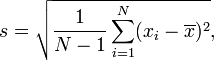
Standard Deviation, s: 0.000115
The relative standard deviation formula is:
100 * s / |x̄|
Where:
s = the sample standard deviation
x̄ = sample mean
% RSD = 100 * (0.000115 / 0.0477) = 0.24 %
Add Answer to:
I have to do lab report and I'm stuck with the
discussion only. If someone can...
I need to: DETERMINE THE CONCENTRATION OF HYDROGEN PEROXIDE IN THE SOLUTION how ?? THEORY Titrimetry,...
I need to: DETERMINE THE CONCENTRATION OF HYDROGEN PEROXIDE IN THE SOLUTION how ?? THEORY Titrimetry, or titrimetric analysis, is an example of a so-called classical method of analysis. Titrimetry is a convenient method of getting very small amounts of chemicals in to a reaction because the method involves the use of dilute solutions of reactants. Hydrogen peroxide reacts with potassium iodide according to the reaction given below: HB2BOB2B + 2HP+P + 2IP-P = IB2B + 2HB2BO (equation...
I need to determine the concentration of hydrogen peroxide in a solution using titrimetric analysis 25...
I need to determine the concentration of hydrogen peroxide in a solution using titrimetric analysis 25 cm3 of the hydrogen peroxide solution was used the concentration of sodium thiosulphate is 0.1046M (used in the burette) the overall volume used was 26.4 cm3
do # 2 first photo Calculate the ongar UUM Calculate the average concentration of the original...
 do # 2
first photo
Calculate the ongar UUM Calculate the average concentration of the original Cu4+ solution Pre-Laboratory Questions 1. Define the term titration. From the chemical equations provided in the introduction, write the overall balanced stoichiometric equation for the volumetric analysis of Cu2+. A 25.00 mL sample of a Cuct solution requires 35.45 mL of 0.2000 M Na S,O2 solution to reach the end point. Calculate the molar concentration of Cuct in the sample. the amount of metallic...
do # 2
first photo
Calculate the ongar UUM Calculate the average concentration of the original Cu4+ solution Pre-Laboratory Questions 1. Define the term titration. From the chemical equations provided in the introduction, write the overall balanced stoichiometric equation for the volumetric analysis of Cu2+. A 25.00 mL sample of a Cuct solution requires 35.45 mL of 0.2000 M Na S,O2 solution to reach the end point. Calculate the molar concentration of Cuct in the sample. the amount of metallic...
DATA SHEET Overall Stoichiometric Equations 1. Results and Observations 2. Unknown No.:l Concentration of standard Na2S&O3...
 DATA SHEET Overall Stoichiometric Equations 1. Results and Observations 2. Unknown No.:l Concentration of standard Na2S&O3 solution, M 0.020(0 Trial 3 Trial 2 Trial 1 13.22 33.97 o.0.20 1311 Initial burette reading, mL 13.09 Final burette reading, mL (0.21 Volume of NAS2O3 used, mL Amount of NA2S2O3 used, mol Amount of Cu2 in unknown sample, mol L0.00 10. 00 10.00 Volume of original Cu solution used, mL in original solution, M Concentration of Cu Average Concentration of Cu2, M Procedure...
CHEM LAB hello can someone help me come up with a procedure for this lab it...
 CHEM LAB
hello can someone help me come up with a procedure for this
lab
it is an standarization of acid and base solution
• Each student will receive approximately 100 mL of an unknown HCl. The approximate concentration of HCl will be 0.1 M or 1.0 M. There will be a common container with NaOH. The approximate concentration of NaOH will be 0.1 M or 1.0 M. You will be given the approximate concentrations of NaOH and HCl on...
CHEM LAB
hello can someone help me come up with a procedure for this
lab
it is an standarization of acid and base solution
• Each student will receive approximately 100 mL of an unknown HCl. The approximate concentration of HCl will be 0.1 M or 1.0 M. There will be a common container with NaOH. The approximate concentration of NaOH will be 0.1 M or 1.0 M. You will be given the approximate concentrations of NaOH and HCl on...
Hello there! I'm currently stuck on this next part od my lab. I'm struggling with the...
 Hello there! I'm currently stuck on this next part od my lab. I'm
struggling with the equations. Pleaae help! Thank you.
this is the concentrate of NaOH
DATA - PART 1 Write the balanced chemical equation for the reaction of HC with NaOH in the space below. NaOH + HCI - NACIT H2O Trial 4 In the table below, and asterisk (*) means e calculated quantity Trial Trial 2 Trial 3 Volume of HCl(aq) used (mL) (Diluted Toilet 10.00i 10.00ml...
Hello there! I'm currently stuck on this next part od my lab. I'm
struggling with the equations. Pleaae help! Thank you.
this is the concentrate of NaOH
DATA - PART 1 Write the balanced chemical equation for the reaction of HC with NaOH in the space below. NaOH + HCI - NACIT H2O Trial 4 In the table below, and asterisk (*) means e calculated quantity Trial Trial 2 Trial 3 Volume of HCl(aq) used (mL) (Diluted Toilet 10.00i 10.00ml...
doing experiment about standardization of 0.0025M sodium thiosulphate solution, can someone tell me how this formula...
 doing experiment about standardization of 0.0025M
sodium thiosulphate solution,
can someone tell me how this formula (calculating exact conc of
Na2S2o3) (at the bottom) comes ?
Data: (10 marks) Part 1: Standardization of 0.0025M sodium thiosulphate solution No. of drops of 0.0025 M sodium thiosulphate solution Solution Trial 1 Trial 2 Trial 3 Average 1 mL of potassium iodate solution + 0.2 mL 3 M HCI + 1 mL D.I. water + 3 drops of starch 2) 22 121.67 N...
doing experiment about standardization of 0.0025M
sodium thiosulphate solution,
can someone tell me how this formula (calculating exact conc of
Na2S2o3) (at the bottom) comes ?
Data: (10 marks) Part 1: Standardization of 0.0025M sodium thiosulphate solution No. of drops of 0.0025 M sodium thiosulphate solution Solution Trial 1 Trial 2 Trial 3 Average 1 mL of potassium iodate solution + 0.2 mL 3 M HCI + 1 mL D.I. water + 3 drops of starch 2) 22 121.67 N...
Titration of Vinegar Lab Report 1 /25 pts) Name: Part 1: Data and Calculations mass KHC.H.O-...
 Titration of Vinegar Lab Report 1 /25 pts) Name: Part 1: Data and Calculations mass KHC.H.O- 4.0744 g Molecular Weight potassium hydrogen phthalate KHCHO. - [1 pt) #moles KHP = 10.5 pts) Volume of solution = 250 ml_ L10.5 pts] Concentration of KHP = Mop = _M (1 pt) Volume of KHP Solution to be titrated mL = [1 pt) # mols of KHP to be titrated [Moe XVw] = [1 pt) Rough Trial Trial 1 Trial 2 9.9 0.0...
1. You have a stock solution of 35 % hydrogen peroxide. You need to make several...
 1. You have a stock solution of 35 % hydrogen peroxide. You need to make several dilutions for a reaction. Calculate how much volume of the stock hydrogen peroxide you need to make 50 mL of 10 % hydrogen peroxide. 2. Using the equation of the line from the graph below, calculate the concentration of hydrogen peroxide if 820 mL of foam is produced from the reaction with potassium iodide. Foam Production vs. Concentration H2O2 1500 y 49.534x R-0.9677 1000...
Hello. I was trying to do the question but i think my direction is wrong. Can you help me to solve it please. a) T...
 Hello. I was trying to do the question but i think my direction is
wrong. Can you help me to solve it please.
a) Titration of Borax Pipette accurately 10.0 cm of the mixed solution into a 200 or 250 cm conical flask and then add a few drops of methyl red (colour change for this indicator is from red in acid to yellow in basic solution) or screened methyl red indicator. Place this flask on a white, glazed plate...
Hello. I was trying to do the question but i think my direction is
wrong. Can you help me to solve it please.
a) Titration of Borax Pipette accurately 10.0 cm of the mixed solution into a 200 or 250 cm conical flask and then add a few drops of methyl red (colour change for this indicator is from red in acid to yellow in basic solution) or screened methyl red indicator. Place this flask on a white, glazed plate...
 do # 2
first photo
Calculate the ongar UUM Calculate the average concentration of the original Cu4+ solution Pre-Laboratory Questions 1. Define the term titration. From the chemical equations provided in the introduction, write the overall balanced stoichiometric equation for the volumetric analysis of Cu2+. A 25.00 mL sample of a Cuct solution requires 35.45 mL of 0.2000 M Na S,O2 solution to reach the end point. Calculate the molar concentration of Cuct in the sample. the amount of metallic...
do # 2
first photo
Calculate the ongar UUM Calculate the average concentration of the original Cu4+ solution Pre-Laboratory Questions 1. Define the term titration. From the chemical equations provided in the introduction, write the overall balanced stoichiometric equation for the volumetric analysis of Cu2+. A 25.00 mL sample of a Cuct solution requires 35.45 mL of 0.2000 M Na S,O2 solution to reach the end point. Calculate the molar concentration of Cuct in the sample. the amount of metallic...
 DATA SHEET Overall Stoichiometric Equations 1. Results and Observations 2. Unknown No.:l Concentration of standard Na2S&O3 solution, M 0.020(0 Trial 3 Trial 2 Trial 1 13.22 33.97 o.0.20 1311 Initial burette reading, mL 13.09 Final burette reading, mL (0.21 Volume of NAS2O3 used, mL Amount of NA2S2O3 used, mol Amount of Cu2 in unknown sample, mol L0.00 10. 00 10.00 Volume of original Cu solution used, mL in original solution, M Concentration of Cu Average Concentration of Cu2, M Procedure...
 CHEM LAB
hello can someone help me come up with a procedure for this
lab
it is an standarization of acid and base solution
• Each student will receive approximately 100 mL of an unknown HCl. The approximate concentration of HCl will be 0.1 M or 1.0 M. There will be a common container with NaOH. The approximate concentration of NaOH will be 0.1 M or 1.0 M. You will be given the approximate concentrations of NaOH and HCl on...
CHEM LAB
hello can someone help me come up with a procedure for this
lab
it is an standarization of acid and base solution
• Each student will receive approximately 100 mL of an unknown HCl. The approximate concentration of HCl will be 0.1 M or 1.0 M. There will be a common container with NaOH. The approximate concentration of NaOH will be 0.1 M or 1.0 M. You will be given the approximate concentrations of NaOH and HCl on...
 Hello there! I'm currently stuck on this next part od my lab. I'm
struggling with the equations. Pleaae help! Thank you.
this is the concentrate of NaOH
DATA - PART 1 Write the balanced chemical equation for the reaction of HC with NaOH in the space below. NaOH + HCI - NACIT H2O Trial 4 In the table below, and asterisk (*) means e calculated quantity Trial Trial 2 Trial 3 Volume of HCl(aq) used (mL) (Diluted Toilet 10.00i 10.00ml...
Hello there! I'm currently stuck on this next part od my lab. I'm
struggling with the equations. Pleaae help! Thank you.
this is the concentrate of NaOH
DATA - PART 1 Write the balanced chemical equation for the reaction of HC with NaOH in the space below. NaOH + HCI - NACIT H2O Trial 4 In the table below, and asterisk (*) means e calculated quantity Trial Trial 2 Trial 3 Volume of HCl(aq) used (mL) (Diluted Toilet 10.00i 10.00ml...
 doing experiment about standardization of 0.0025M
sodium thiosulphate solution,
can someone tell me how this formula (calculating exact conc of
Na2S2o3) (at the bottom) comes ?
Data: (10 marks) Part 1: Standardization of 0.0025M sodium thiosulphate solution No. of drops of 0.0025 M sodium thiosulphate solution Solution Trial 1 Trial 2 Trial 3 Average 1 mL of potassium iodate solution + 0.2 mL 3 M HCI + 1 mL D.I. water + 3 drops of starch 2) 22 121.67 N...
doing experiment about standardization of 0.0025M
sodium thiosulphate solution,
can someone tell me how this formula (calculating exact conc of
Na2S2o3) (at the bottom) comes ?
Data: (10 marks) Part 1: Standardization of 0.0025M sodium thiosulphate solution No. of drops of 0.0025 M sodium thiosulphate solution Solution Trial 1 Trial 2 Trial 3 Average 1 mL of potassium iodate solution + 0.2 mL 3 M HCI + 1 mL D.I. water + 3 drops of starch 2) 22 121.67 N...
 Titration of Vinegar Lab Report 1 /25 pts) Name: Part 1: Data and Calculations mass KHC.H.O- 4.0744 g Molecular Weight potassium hydrogen phthalate KHCHO. - [1 pt) #moles KHP = 10.5 pts) Volume of solution = 250 ml_ L10.5 pts] Concentration of KHP = Mop = _M (1 pt) Volume of KHP Solution to be titrated mL = [1 pt) # mols of KHP to be titrated [Moe XVw] = [1 pt) Rough Trial Trial 1 Trial 2 9.9 0.0...
 1. You have a stock solution of 35 % hydrogen peroxide. You need to make several dilutions for a reaction. Calculate how much volume of the stock hydrogen peroxide you need to make 50 mL of 10 % hydrogen peroxide. 2. Using the equation of the line from the graph below, calculate the concentration of hydrogen peroxide if 820 mL of foam is produced from the reaction with potassium iodide. Foam Production vs. Concentration H2O2 1500 y 49.534x R-0.9677 1000...
 Hello. I was trying to do the question but i think my direction is
wrong. Can you help me to solve it please.
a) Titration of Borax Pipette accurately 10.0 cm of the mixed solution into a 200 or 250 cm conical flask and then add a few drops of methyl red (colour change for this indicator is from red in acid to yellow in basic solution) or screened methyl red indicator. Place this flask on a white, glazed plate...
Hello. I was trying to do the question but i think my direction is
wrong. Can you help me to solve it please.
a) Titration of Borax Pipette accurately 10.0 cm of the mixed solution into a 200 or 250 cm conical flask and then add a few drops of methyl red (colour change for this indicator is from red in acid to yellow in basic solution) or screened methyl red indicator. Place this flask on a white, glazed plate...
Most questions answered within 3 hours.
-
Where is the error in this code sequence?
String s1 = "Hello";
String s2 = "ello";...
asked 10 months ago -
Financial data for Joel de Paris, Inc., for last year
follow:
Joel de Paris, Inc.
Balance...
asked 10 months ago -
Consider this reaction:
Al2(SO4)3 (aq)+ BaCl3
(aq) Al2Cl6 (aq)- +
3BaSO4(s) . What is the...
asked 10 months ago -
Suppose that Savneet is considering increasing her
recent random sample from 20 car rentals to 40...
asked 10 months ago -
Trucks arrive at an unloading terminal at an average rate of 120
per hour.
Trucks arrive...
asked 10 months ago -
Why are methanol and ethanol completely soluble in water while
octanol is not very little soluble....
asked 10 months ago -
A facilities manager at a university reads in a research report
that the mean amount of...
asked 10 months ago -
When the CuSO4 is rehydrated by adding water to the anhydrous
compound, is this an endothermic...
asked 10 months ago -
A ray of sunlight is passing from diamond into crown glass; the
angle of incidence is...
asked 10 months ago -
A block of mass 0.249 kg is placed on top of a light, vertical
spring of...
asked 10 months ago -
how do the kidneys compensate in the presences of acidosis
a) trigger hyperventilate
b) reserve acid...
asked 10 months ago -
Question 501 pts
The rental rate of capital to the firm increases. Which of the
following...
asked 10 months ago