The value of $1 invested in the large-company stock in the year of 1925 grew to...
The value of $1 invested in the large-company stock in the year of 1925 grew to $3,320 in the year of 2017 over 92 years. Compute the time weighted compounding rate of return.
Homework Answers
time weighted compounding rate of return
=((3320/1)^(1/92))-1
=9.21%
the above is answer..
Add Answer to:
The value of $1 invested in the large-company stock in the year
of 1925 grew to...
Suppose that $25,000 from a retirement account is invested in a large cap stock fund. After...
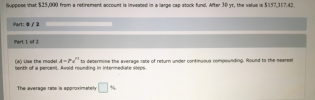 Suppose that $25,000 from a retirement account is invested in a large cap stock fund. After 30 yr, the value is $157,317.42. Part: 0/2 Part 1 of 2 (a) Use the model A=Pe to determine the average rate of return under continuous compounding. Round to the nearest tenth of a percent. Avoid rounding in intermediate steps. The average rate is approximately %.
You invested $10,000 one year ago in a stock, and the value of the stock is...
 You invested $10,000 one year ago in a stock, and the value of the stock is now $11,000. If the inflation rate during this time was 2.7%, what was your real rate of return? (Answers based off of Fisher Equation). Multiple Choice O 12.7% O 7.1% O -7.3% O 10%
Using Excel to calculate the following: 1. The future value of $3 invested every day, 360...
 Using Excel to calculate the following: 1. The future value of $3 invested every day, 360 days per year, for 50 years at 8% interest. Hint: Interest is compounding daily. 2. The future value of $1,080 ($3 x 360) invested annually for 50 years at 8% interest. 3. The payment for a mortgage with a principal amount of $150,000, an interest rate of 5%, fully amortized over 30 years. 4. The price today of 15 year bond that has a...
You own a portfolio that has 60% invested in Stock X and 40% invested in Stock...
 You own a portfolio that has 60% invested in Stock X and 40% invested in Stock Y. Assume the expected returns on these stocks are 13% and 18%, respectively. What is the expected return on the portfolio? A portfolio has a beta of 0.6. The risk-free rate is 2% and the expected return on the market is 12%. What is the expected return on the portfolio? A bond has a $1,000 par value, 10 years to maturity, a 5% coupon...
you recently invested $18,000 of your savings in a security issued by a large company. the...
 you recently invested $18,000 of your savings in a security
issued by a large company. the security agreement pays you 6
percent per year and has a maturity three years from the day you
purchased it. what is the total cash flow you expect to receive
from this investment over the next three years
숄 https://n eek One: Chapters 1 & 26 Help Save & Exit Submit You recently invested $18.000 of your savings in a security issued by a...
you recently invested $18,000 of your savings in a security
issued by a large company. the security agreement pays you 6
percent per year and has a maturity three years from the day you
purchased it. what is the total cash flow you expect to receive
from this investment over the next three years
숄 https://n eek One: Chapters 1 & 26 Help Save & Exit Submit You recently invested $18.000 of your savings in a security issued by a...
Last year you invested in a stock with a beta equal to 0.76. The risk-free rate...
Last year you invested in a stock with a beta equal to 0.76. The risk-free rate was 0.016 and the expected return of the market was 0.19. After holding the stock for the year you find that the market did return what was expected. However, the stock you invested in returned 0.16. By how much did the stock over-perform (under-perform) for the year? Answer as a percentage to two decimals
Your grandfather invested $1,000 in a stock 37 years ago. Currently the value of his account...
Your grandfather invested $1,000 in a stock 37 years ago. Currently the value of his account is $320,000. What is his geometric return over this period?
Arthur buys $1,500 worth of stock. Six months later, the value of the stock has risen...
Arthur buys $1,500 worth of stock. Six months later, the value of the stock has risen to $1,700 and Arthur buys another $1,000 worth of stock. After another eight months, Arthur's holdings are worth $2,300 and he sells off $800 of them. Ten months later, Arthur finds that his stock has a value of $1,600. (a) Compute the annual time-weighted yield rate of the stock over the two-year period. (Round your answer to two decimal places.) (b) Compute the annual...
Question 1 (1 point) Calculate the future value (FV) of: $1,250 today invested in a financial...
 Question 1 (1 point) Calculate the future value (FV) of: $1,250 today invested in a financial tool with a rate of return of 8% that compounds once a year for 5 years. $1,858.89 $1,353.25 $1,836.66 $1,350.00 Question 2 (1 point) Calculate the future value (FV) of: $500 today invested in a financial tool with a rate of return of 12% that compounds 12 times a year for 8 years. 20 PWPXO
Tom O'Brien has a 2-stock portfolio with a total value of $100,000 $47.500 is invested in Stock A with a beta...
 Tom O'Brien has a 2-stock portfolio with a total value of $100,000 $47.500 is invested in Stock A with a beta of 0.75 and the remainder is invested in Stock B with a beta of 1.42. What is his portfolio's beta? Do not round your intermediate calculations. Round your final answer to 2 decimal places. a. 1.06 O b. 1.05 . c. 1.09 • O d. 1.10 OOO oooo.. o. Click here to read the eBook: The Relationship Between Risk...
 Suppose that $25,000 from a retirement account is invested in a large cap stock fund. After 30 yr, the value is $157,317.42. Part: 0/2 Part 1 of 2 (a) Use the model A=Pe to determine the average rate of return under continuous compounding. Round to the nearest tenth of a percent. Avoid rounding in intermediate steps. The average rate is approximately %.
 You invested $10,000 one year ago in a stock, and the value of the stock is now $11,000. If the inflation rate during this time was 2.7%, what was your real rate of return? (Answers based off of Fisher Equation). Multiple Choice O 12.7% O 7.1% O -7.3% O 10%
 Using Excel to calculate the following: 1. The future value of $3 invested every day, 360 days per year, for 50 years at 8% interest. Hint: Interest is compounding daily. 2. The future value of $1,080 ($3 x 360) invested annually for 50 years at 8% interest. 3. The payment for a mortgage with a principal amount of $150,000, an interest rate of 5%, fully amortized over 30 years. 4. The price today of 15 year bond that has a...
 You own a portfolio that has 60% invested in Stock X and 40% invested in Stock Y. Assume the expected returns on these stocks are 13% and 18%, respectively. What is the expected return on the portfolio? A portfolio has a beta of 0.6. The risk-free rate is 2% and the expected return on the market is 12%. What is the expected return on the portfolio? A bond has a $1,000 par value, 10 years to maturity, a 5% coupon...
 you recently invested $18,000 of your savings in a security
issued by a large company. the security agreement pays you 6
percent per year and has a maturity three years from the day you
purchased it. what is the total cash flow you expect to receive
from this investment over the next three years
숄 https://n eek One: Chapters 1 & 26 Help Save & Exit Submit You recently invested $18.000 of your savings in a security issued by a...
you recently invested $18,000 of your savings in a security
issued by a large company. the security agreement pays you 6
percent per year and has a maturity three years from the day you
purchased it. what is the total cash flow you expect to receive
from this investment over the next three years
숄 https://n eek One: Chapters 1 & 26 Help Save & Exit Submit You recently invested $18.000 of your savings in a security issued by a...
 Question 1 (1 point) Calculate the future value (FV) of: $1,250 today invested in a financial tool with a rate of return of 8% that compounds once a year for 5 years. $1,858.89 $1,353.25 $1,836.66 $1,350.00 Question 2 (1 point) Calculate the future value (FV) of: $500 today invested in a financial tool with a rate of return of 12% that compounds 12 times a year for 8 years. 20 PWPXO
 Tom O'Brien has a 2-stock portfolio with a total value of $100,000 $47.500 is invested in Stock A with a beta of 0.75 and the remainder is invested in Stock B with a beta of 1.42. What is his portfolio's beta? Do not round your intermediate calculations. Round your final answer to 2 decimal places. a. 1.06 O b. 1.05 . c. 1.09 • O d. 1.10 OOO oooo.. o. Click here to read the eBook: The Relationship Between Risk...
Most questions answered within 3 hours.
-
Where is the error in this code sequence?
String s1 = "Hello";
String s2 = "ello";...
asked 11 months ago -
Financial data for Joel de Paris, Inc., for last year
follow:
Joel de Paris, Inc.
Balance...
asked 11 months ago -
Consider this reaction:
Al2(SO4)3 (aq)+ BaCl3
(aq) Al2Cl6 (aq)- +
3BaSO4(s) . What is the...
asked 11 months ago -
Suppose that Savneet is considering increasing her
recent random sample from 20 car rentals to 40...
asked 11 months ago -
Trucks arrive at an unloading terminal at an average rate of 120
per hour.
Trucks arrive...
asked 11 months ago -
Why are methanol and ethanol completely soluble in water while
octanol is not very little soluble....
asked 11 months ago -
A facilities manager at a university reads in a research report
that the mean amount of...
asked 11 months ago -
When the CuSO4 is rehydrated by adding water to the anhydrous
compound, is this an endothermic...
asked 11 months ago -
A ray of sunlight is passing from diamond into crown glass; the
angle of incidence is...
asked 11 months ago -
A block of mass 0.249 kg is placed on top of a light, vertical
spring of...
asked 11 months ago -
how do the kidneys compensate in the presences of acidosis
a) trigger hyperventilate
b) reserve acid...
asked 11 months ago -
Question 501 pts
The rental rate of capital to the firm increases. Which of the
following...
asked 11 months ago