2.0 g of KNO3 (s) is added to 5.0 mL of distilled water H2O (l). The...
2.0 g of KNO3 (s) is added to 5.0 mL of distilled water H2O (l). The solution is heated up and the boiling point of the KNO3 solution was measures at 102.6 degrees Celsius. Calculate the molality of the solution. (Kb of water is .51 C/m).
Explains why the boiling of point of the KNO3 solution is higher than that of pure water.
Homework Answers
Elevation of boiling due to presence of non volatile solutes is
a colligative property.

Add Answer to:
2.0 g of KNO3 (s) is added to 5.0 mL of distilled water H2O (l).
The...
0.50 g of potassium nitrate (KNO3) was added to a test tube holding 5 mL of...
0.50 g of potassium nitrate (KNO3) was added to a test tube holding 5 mL of distilled water. A temperature probe was placed in the test tube to record any change in temperature during the reaction. The baseline temperature of the water before adding the KNO3 was 23.2 degrees Celsius. After the KNO3 was added to the water the temperature of the solution dropped to 18.1 degrees Celsius. 1) Write an equation for the reaction above. Make sure it has...
the date you need is: 2.0 grams of KNO3, the temp was 22.1. extra information that might help if you need it: I added 5 mL of water to the 2.0 g of KNO3. please answer the 3 parts of the question. T...
 the date you need is: 2.0 grams of KNO3, the temp was
22.1.
extra information that might help if you need it: I added 5 mL
of water to the 2.0 g of KNO3.
please answer the 3 parts of the question. Thanks.
Grams KNO,Cryst. Temp, °c 22.1 2.0 g Type your calculation for solubility (in grams KNO,/100 grams water) using the data for the 2.0 gram sample. Type your calculation for molality of KNO, (in mol KNO3/kg water) using...
the date you need is: 2.0 grams of KNO3, the temp was
22.1.
extra information that might help if you need it: I added 5 mL
of water to the 2.0 g of KNO3.
please answer the 3 parts of the question. Thanks.
Grams KNO,Cryst. Temp, °c 22.1 2.0 g Type your calculation for solubility (in grams KNO,/100 grams water) using the data for the 2.0 gram sample. Type your calculation for molality of KNO, (in mol KNO3/kg water) using...
b) Write a statement of Lambert's Law. If 2.0 mL of distilled water is added to...
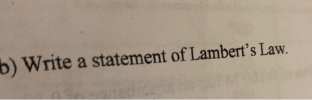 b) Write a statement of Lambert's Law. If 2.0 mL of distilled water is added to 3.0 mL of a 0.150 M solution of Cocl, what is the concentration of the resulting solution? Show your work.
If 2.0 mL of distilled water is added to 3.0 mL of a 0.150 M solution...
 If 2.0 mL of distilled water is added to 3.0 mL of a 0.150 M solution of CoCly, what is the concentration of the resulting solution? Show your work. (a) What is a calibration curve? (b) Why do we use a calibration curve to determine the concentration of our unknown 5. A colored sample with a concentration of 0.160 M has an absorbance of 0.80 in a 1.0 cm path length cuvette. (a) What would be the absorbance expected if...
A solution of ethylene glycol in water at 20 degrees celsius has a mass percent of...
A solution of ethylene glycol in water at 20 degrees celsius has a mass percent of 9.78% of ethylene glycol with a density of 1.0108 g/mL. The freezing point depression constant for water (solvent for all solutions) is Kf=-1.86 percent celsius kg/mol and the boiling point elevation constant is Kb=0.512 degrees celsius kg/mol. The density of neat water at 20.0 degrees celsius is 0.9982 g/mL. Answer the following: 1. What is the molarity of the solution? 2. What is the...
2.613 g of NaCl (s) is added to 150.0 mL of water, H2O (l). What is...
2.613 g of NaCl (s) is added to 150.0 mL of water, H2O (l). What is the molarity of this solution?
some ehtylene glycol was added to yoru car's cooling system along with 5 kg of water
Some ethylene glycol (OHCH2CH2OH) was added to your car's cooling system along with 5.0 kg of water.a. if the freezing point of the solution is -15.0 degrees celcius, what mass in grams of glycol must have been added? Kf(H2O)=1.86 degrees celcius kg mol^-1.b. What is the boiling point of the coolant mixture? Kb(H20) = 0.52 degrees celcius kg mol^-1.
0.50 g of calcium chloride (CaCl2) was added to a test tube holding 5 mL of...
0.50 g of calcium chloride (CaCl2) was added to a test tube holding 5 mL of distilled water. A temperature probe was placed in the test tube to record any change in temperature during the reaction. The baseline temperature of the water before adding the CaCl2 was 23.6 degrees Celsius. After the CaCl2 was added to the water the temperature of the solution peaked at 25.7 degrees Celsius. 1) Draw an energy diagram of the process and label the Energy...
When 2.0 moles of KCl is dissolved in 1.0 L of water, the boiling point of...
When 2.0 moles of KCl is dissolved in 1.0 L of water, the boiling point of the solution will be ___ than the boiling point of pure water.
1.05 g of NaOH pellet is added to 45 mL of distilled water and the temperature...
1.05 g of NaOH pellet is added to 45 mL of distilled water and the temperature rises from 25.1 oC to 35.8 oC. Determine the heat per mole of NaOH generated in this process. Assume that the density of water is 1 g/mL and the specific heat capacity of the solution is 4.184 J/goC
 the date you need is: 2.0 grams of KNO3, the temp was
22.1.
extra information that might help if you need it: I added 5 mL
of water to the 2.0 g of KNO3.
please answer the 3 parts of the question. Thanks.
Grams KNO,Cryst. Temp, °c 22.1 2.0 g Type your calculation for solubility (in grams KNO,/100 grams water) using the data for the 2.0 gram sample. Type your calculation for molality of KNO, (in mol KNO3/kg water) using...
the date you need is: 2.0 grams of KNO3, the temp was
22.1.
extra information that might help if you need it: I added 5 mL
of water to the 2.0 g of KNO3.
please answer the 3 parts of the question. Thanks.
Grams KNO,Cryst. Temp, °c 22.1 2.0 g Type your calculation for solubility (in grams KNO,/100 grams water) using the data for the 2.0 gram sample. Type your calculation for molality of KNO, (in mol KNO3/kg water) using...
 b) Write a statement of Lambert's Law. If 2.0 mL of distilled water is added to 3.0 mL of a 0.150 M solution of Cocl, what is the concentration of the resulting solution? Show your work.
 If 2.0 mL of distilled water is added to 3.0 mL of a 0.150 M solution of CoCly, what is the concentration of the resulting solution? Show your work. (a) What is a calibration curve? (b) Why do we use a calibration curve to determine the concentration of our unknown 5. A colored sample with a concentration of 0.160 M has an absorbance of 0.80 in a 1.0 cm path length cuvette. (a) What would be the absorbance expected if...
Most questions answered within 3 hours.
-
Where is the error in this code sequence?
String s1 = "Hello";
String s2 = "ello";...
asked 11 months ago -
Financial data for Joel de Paris, Inc., for last year
follow:
Joel de Paris, Inc.
Balance...
asked 11 months ago -
Consider this reaction:
Al2(SO4)3 (aq)+ BaCl3
(aq) Al2Cl6 (aq)- +
3BaSO4(s) . What is the...
asked 11 months ago -
Suppose that Savneet is considering increasing her
recent random sample from 20 car rentals to 40...
asked 11 months ago -
Trucks arrive at an unloading terminal at an average rate of 120
per hour.
Trucks arrive...
asked 11 months ago -
Why are methanol and ethanol completely soluble in water while
octanol is not very little soluble....
asked 11 months ago -
A facilities manager at a university reads in a research report
that the mean amount of...
asked 11 months ago -
When the CuSO4 is rehydrated by adding water to the anhydrous
compound, is this an endothermic...
asked 11 months ago -
A ray of sunlight is passing from diamond into crown glass; the
angle of incidence is...
asked 11 months ago -
A block of mass 0.249 kg is placed on top of a light, vertical
spring of...
asked 11 months ago -
how do the kidneys compensate in the presences of acidosis
a) trigger hyperventilate
b) reserve acid...
asked 11 months ago -
Question 501 pts
The rental rate of capital to the firm increases. Which of the
following...
asked 11 months ago