A 0.007 kg bullet shot straight up in the air with an initial speed of 200...
A 0.007 kg bullet shot straight up in the air with an initial speed of 200 m/s reaches a vertical height of 600 m. What is the average force of air resistance acting on the bullet?
Homework Answers

Add Answer to:
A 0.007 kg bullet shot straight up in the air with an initial
speed of 200...
A bullet is shot straight up into the air. Its initial speed is 7.5 km/s. What...
A bullet is shot straight up into the air. Its initial speed is 7.5 km/s. What height will it reach? Assume air resistance is absent.
A projectile of mass 1.400 kg is shot straight up with an initial speed of 27.0...
A projectile of mass 1.400 kg is shot straight up with an initial speed of 27.0 m/s. (a) How high would it go if there were no air resistance? m (b) If the projectile rises to a maximum height of only 27.2 m, determine the magnitude of the average force due to air resistance. N
1) A projectile of mass 1.400 kg is shot straight up with an initial speed of...
1) A projectile of mass 1.400 kg is shot straight up with an initial speed of 27.0 m/s. (b) If the projectile rises to a maximum height of only 27.2 m, determine the magnitude of the average force due to air resistance. _______ N
D Question 3 1 pts A bullet is shot straight in the air with an initial...
 D Question 3 1 pts A bullet is shot straight in the air with an initial velocity of 177 f/sec.Calculate how high (absolute value in ft) it will go up before it stops and reverses its motion. Assume g 32.2ft/sec 2 and air resistance is negligible. 1 pts Question 5 A heavy object with negligible buoyancy enters water at a speed of 14 m/sec. Assuming a constant deceleration rate of -3.0 m/s2 in water, calculate how deep does it travel...
A bullet is shot straight in the air with an initial velocity of 139 ft/sec. Calculate...
 A bullet is shot straight in the air with an initial velocity of 139 ft/sec. Calculate how high (absolute value in ft) it will go up before it stops and reverses its motion. Assume g resistance is negligible. tion 5 1 pts A heavy object with negligible buoyancy enters water at a speed of 10 m/sec. Assuming a constant deceleration rate of -3.6 m/s2 in water, calculate how deep does it travel below the surface (absolute value of depth) before...
refer to picture. A 10.0 g bullet is shot straight up and has initial kinetic energy...
 refer to picture.
A 10.0 g bullet is shot straight up and has initial kinetic energy of 2.50 kJ. The speed of the bullet when it is halfway to maximum height is equal to a. 250 m/s 354 m/s 500 m/s 707 m/s 1,000 m/s re constant of 2.990 N/m. The work done in stretching the spring
refer to picture.
A 10.0 g bullet is shot straight up and has initial kinetic energy of 2.50 kJ. The speed of the bullet when it is halfway to maximum height is equal to a. 250 m/s 354 m/s 500 m/s 707 m/s 1,000 m/s re constant of 2.990 N/m. The work done in stretching the spring
An arrow is shot straight up in the air at an initial speed of 18.0 m/s....
An arrow is shot straight up in the air at an initial speed of 18.0 m/s. After how much time is the arrow moving downward at a speed of 4.55 m/s?
A ball of mass 0.083 kg is shot straight up in the air using a compressed...
A ball of mass 0.083 kg is shot straight up in the air using a compressed spring. The spring has a spring constant of 328 N/m and is compressed by 0.05 m initially. The ball reaches a height of 0.252 m above the initial position. How much energy has dissipated due to frictional effects such as air drag ? (in J)
help A 0.20 kg ball is thrown straight up into the air with an initial speed...
 help
A 0.20 kg ball is thrown straight up into the air with an initial speed of 17 m/s. Find the momentum of the ball at the following locations. (a) at its maximum height kg-m/s (b) halfway to its maximum height kg-m/s
help
A 0.20 kg ball is thrown straight up into the air with an initial speed of 17 m/s. Find the momentum of the ball at the following locations. (a) at its maximum height kg-m/s (b) halfway to its maximum height kg-m/s
A ball is shot straight up from the surface of the earth with an initial speed...
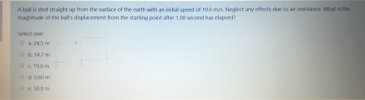 A ball is shot straight up from the surface of the earth with an initial speed of 19.6 m/s. Neglect any effects due to air resistance. What is the magnitude of the ball's displacement from the starting point after 1.00 second has elapsed? Select one: a. 245 m O b. 14.7 m OC 19.6 m d. 9.80 m e. 58.8 m
 D Question 3 1 pts A bullet is shot straight in the air with an initial velocity of 177 f/sec.Calculate how high (absolute value in ft) it will go up before it stops and reverses its motion. Assume g 32.2ft/sec 2 and air resistance is negligible. 1 pts Question 5 A heavy object with negligible buoyancy enters water at a speed of 14 m/sec. Assuming a constant deceleration rate of -3.0 m/s2 in water, calculate how deep does it travel...
 A bullet is shot straight in the air with an initial velocity of 139 ft/sec. Calculate how high (absolute value in ft) it will go up before it stops and reverses its motion. Assume g resistance is negligible. tion 5 1 pts A heavy object with negligible buoyancy enters water at a speed of 10 m/sec. Assuming a constant deceleration rate of -3.6 m/s2 in water, calculate how deep does it travel below the surface (absolute value of depth) before...
 refer to picture.
A 10.0 g bullet is shot straight up and has initial kinetic energy of 2.50 kJ. The speed of the bullet when it is halfway to maximum height is equal to a. 250 m/s 354 m/s 500 m/s 707 m/s 1,000 m/s re constant of 2.990 N/m. The work done in stretching the spring
refer to picture.
A 10.0 g bullet is shot straight up and has initial kinetic energy of 2.50 kJ. The speed of the bullet when it is halfway to maximum height is equal to a. 250 m/s 354 m/s 500 m/s 707 m/s 1,000 m/s re constant of 2.990 N/m. The work done in stretching the spring
 help
A 0.20 kg ball is thrown straight up into the air with an initial speed of 17 m/s. Find the momentum of the ball at the following locations. (a) at its maximum height kg-m/s (b) halfway to its maximum height kg-m/s
help
A 0.20 kg ball is thrown straight up into the air with an initial speed of 17 m/s. Find the momentum of the ball at the following locations. (a) at its maximum height kg-m/s (b) halfway to its maximum height kg-m/s
 A ball is shot straight up from the surface of the earth with an initial speed of 19.6 m/s. Neglect any effects due to air resistance. What is the magnitude of the ball's displacement from the starting point after 1.00 second has elapsed? Select one: a. 245 m O b. 14.7 m OC 19.6 m d. 9.80 m e. 58.8 m
Most questions answered within 3 hours.
-
Where is the error in this code sequence?
String s1 = "Hello";
String s2 = "ello";...
asked 11 months ago -
Financial data for Joel de Paris, Inc., for last year
follow:
Joel de Paris, Inc.
Balance...
asked 11 months ago -
Consider this reaction:
Al2(SO4)3 (aq)+ BaCl3
(aq) Al2Cl6 (aq)- +
3BaSO4(s) . What is the...
asked 11 months ago -
Suppose that Savneet is considering increasing her
recent random sample from 20 car rentals to 40...
asked 11 months ago -
Trucks arrive at an unloading terminal at an average rate of 120
per hour.
Trucks arrive...
asked 11 months ago -
Why are methanol and ethanol completely soluble in water while
octanol is not very little soluble....
asked 11 months ago -
A facilities manager at a university reads in a research report
that the mean amount of...
asked 11 months ago -
When the CuSO4 is rehydrated by adding water to the anhydrous
compound, is this an endothermic...
asked 11 months ago -
A ray of sunlight is passing from diamond into crown glass; the
angle of incidence is...
asked 11 months ago -
A block of mass 0.249 kg is placed on top of a light, vertical
spring of...
asked 11 months ago -
how do the kidneys compensate in the presences of acidosis
a) trigger hyperventilate
b) reserve acid...
asked 11 months ago -
Question 501 pts
The rental rate of capital to the firm increases. Which of the
following...
asked 11 months ago