Calculate the density of radon at 325 K and 1.10 atm of pressure.
Calculate the density of radon at 325 K and 1.10 atm of pressure.
Homework Answers
Ideal gas equation is
PV = nRT
where,
P = Pressure, 1.10atm
V = volume
n = number of moles
R = gas constant , 0.082057 ( L atm / mol K)
T = Temperature , 325K
n/V = P/RT
n/V = 1.10atm / (0.082057(L.atm/mol K) × 325K)
n/V = 0.04125 mol/L
Therfore,
Molarity of radon at 325K and 1.10atm = 0.04125 M
Part 1 (2.5 pts) See Periodic Table See Hint Calculate the density of radon at 303 K and 0.950 atm of pressure. g/L...
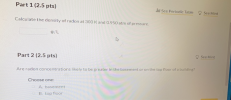 Part 1 (2.5 pts) See Periodic Table See Hint Calculate the density of radon at 303 K and 0.950 atm of pressure. g/L Part 2 (2.5 pts) See Hint Are radon concentrations likely to be greater in the basement or on the top floor of a building? Choose one: A. basement B. top floor
Calculate the density of CO2 gas at 100.oC and a pressure of 1.10 atm.
Calculate the density of CO2 gas at 100.oC and a pressure of 1.10 atm.
What volume is occupied by 28.2 g of argon gas at a pressure of 1.10 atm...
What volume is occupied by 28.2 g of argon gas at a pressure of 1.10 atm and a temperature of 326 K ?
At 298 K, the osmotic pressure of a glucose solution (C6H12O6 (aq)) is 21.7 atm. Calculate...
At 298 K, the osmotic pressure of a glucose solution (C6H12O6 (aq)) is 21.7 atm. Calculate the freezing point of the solution. The density of the solution is 1.060 g/mL. FP=____________________C
At 298 K, the osmotic pressure of a glucose solution (C6H12O6 (aq)) is 18.9 atm. Calculate...
 At 298 K, the osmotic pressure of a glucose solution (C6H12O6 (aq)) is 18.9 atm. Calculate the freezing point of the solution. The density of the solution is 1.052 g/mL FP = oC
If 5.0 Liters of a gas is allowed to expand against a pressure of 1.10 atm...
If 5.0 Liters of a gas is allowed to expand against a pressure of 1.10 atm to a 43.0 Liters and 2.5 KJ of heat is given off, calculate the work done and the internal energy change ∆E.
1. The critical temperature and pressure of water are 647.1 K and 217.7 atm. For a...
 1. The critical temperature and pressure of water are 647.1 K and 217.7 atm. For a sample of steam just below its critical point, 600.0 K and 200.0 atm, a. Calculate the number density. b. Calculate the mean free path. Assume the diameter of a water molecule is 0.15 nm. c. Compare these results to those for air at 1 atm and 298 K. d. Calculate the average speed of water molecules under these conditions, e. Calculate the collision frequency...
Extra-credit: Calculate the density of a gas if the pressure in a vessel is 3.2 atm...
 Extra-credit: Calculate the density of a gas if the pressure in a vessel is 3.2 atm at 182 °C. The molar mass of the compound is 52.2 g/mol.
A certain ideal dilute solution has an osmotic pressure of 0.50 atm at 300. K. Calculate...
 A certain ideal dilute solution has an osmotic pressure of 0.50 atm at 300. K. Calculate the difference between the chemical potential of water (solvent) in the solution and that of pure water, Mill) – ui(2), in J/mol. The density of the solution is the same as that of water.
If 0.65 g of a gas occupies 275 mL at 26°C and 1.10 atm, calculate the...
 If 0.65 g of a gas occupies 275 mL at 26°C and 1.10 atm, calculate the molar mass of the gas. The density of air 090 lat com and Oce a n
 Part 1 (2.5 pts) See Periodic Table See Hint Calculate the density of radon at 303 K and 0.950 atm of pressure. g/L Part 2 (2.5 pts) See Hint Are radon concentrations likely to be greater in the basement or on the top floor of a building? Choose one: A. basement B. top floor
 At 298 K, the osmotic pressure of a glucose solution (C6H12O6 (aq)) is 18.9 atm. Calculate the freezing point of the solution. The density of the solution is 1.052 g/mL FP = oC
 1. The critical temperature and pressure of water are 647.1 K and 217.7 atm. For a sample of steam just below its critical point, 600.0 K and 200.0 atm, a. Calculate the number density. b. Calculate the mean free path. Assume the diameter of a water molecule is 0.15 nm. c. Compare these results to those for air at 1 atm and 298 K. d. Calculate the average speed of water molecules under these conditions, e. Calculate the collision frequency...
 Extra-credit: Calculate the density of a gas if the pressure in a vessel is 3.2 atm at 182 °C. The molar mass of the compound is 52.2 g/mol.
 A certain ideal dilute solution has an osmotic pressure of 0.50 atm at 300. K. Calculate the difference between the chemical potential of water (solvent) in the solution and that of pure water, Mill) – ui(2), in J/mol. The density of the solution is the same as that of water.
 If 0.65 g of a gas occupies 275 mL at 26°C and 1.10 atm, calculate the molar mass of the gas. The density of air 090 lat com and Oce a n
Most questions answered within 3 hours.
-
Where is the error in this code sequence?
String s1 = "Hello";
String s2 = "ello";...
asked 11 months ago -
Financial data for Joel de Paris, Inc., for last year
follow:
Joel de Paris, Inc.
Balance...
asked 11 months ago -
Consider this reaction:
Al2(SO4)3 (aq)+ BaCl3
(aq) Al2Cl6 (aq)- +
3BaSO4(s) . What is the...
asked 11 months ago -
Suppose that Savneet is considering increasing her
recent random sample from 20 car rentals to 40...
asked 11 months ago -
Trucks arrive at an unloading terminal at an average rate of 120
per hour.
Trucks arrive...
asked 11 months ago -
Why are methanol and ethanol completely soluble in water while
octanol is not very little soluble....
asked 11 months ago -
A facilities manager at a university reads in a research report
that the mean amount of...
asked 11 months ago -
When the CuSO4 is rehydrated by adding water to the anhydrous
compound, is this an endothermic...
asked 11 months ago -
A ray of sunlight is passing from diamond into crown glass; the
angle of incidence is...
asked 11 months ago -
A block of mass 0.249 kg is placed on top of a light, vertical
spring of...
asked 11 months ago -
how do the kidneys compensate in the presences of acidosis
a) trigger hyperventilate
b) reserve acid...
asked 11 months ago -
Question 501 pts
The rental rate of capital to the firm increases. Which of the
following...
asked 11 months ago