Consider the following two investment alternatives: First, a risky portfolio that pays a 20% rate of...
Consider the following two investment alternatives: First, a risky portfolio that pays a 20% rate of return with a probability of 60% or a 5% rate of return with a probability of 40%. Second, a Treasury bill that pays 6%. If you invest $50,000 in the risky portfolio, your expected profit after one year would be
Homework Answers
Risky Portfolio:
Return of 20% with a probability of 60% and a return of 5 % with a probability of 40%.
Expected Return of Risky Portfolio = Rp = 20 x 0.6 + 5 x 0.4 = 14 %
Investment Value = $ 50000
Expected Investment Value After One Year = 50000 x 1.14 = $ 57000
Expected Profit = 57000 - 50000 = $ 7000
Add Answer to:
Consider the following two investment alternatives: First, a
risky portfolio that pays a 20% rate of...
3) Assume that you manage a risky portfolio with an expected rate of return of 14%...
 3) Assume that you manage a risky portfolio with an expected rate of return of 14% and standard deviation of 19%. The risk-free rate rate on a Treasury-bill is 6%. a. Your client chooses to invest 60% of a portfolio in your fund and 40% in a risk-free T-bill money market fund. What is the expected return and standard deviation of your client's portfolio? b. Suppose another investor decides to invest in your risky portfolio a proportion (w) of his...
3. You have a risky portfolio that yields an expected rate of return of 15% with...
3. You have a risky portfolio that yields an expected rate of return of 15% with a standard deviation of 25%. Draw the CAL for an expected return/standard deviation diagram if the risk free rate is 5%. a. What is the slope of the CAL? b. If your coefficient of risk aversion is 5, how much should you invest in the risky portfolio? 4. A pension fund manager is considering three mutual funds. The first is a stock fund, the...
You invest $3,000 in a complete portfolio. The complete portfolio is composed of a risky asset...
You invest $3,000 in a complete portfolio. The complete portfolio is composed of a risky asset with an expected rate of return of 15% and a standard deviation of 20% and a Treasury bill with a rate of return of 10%. __________ of your complete portfolio should be invested in the risky portfolio if you want your complete portfolio to have a standard deviation of 8%. rev: 02_12_2013_QC_26430 17% 5% 37% 40%
urgent, thanks Benjamin Green manages a risky portfolio with an expected rate of return of 16%...
 urgent, thanks
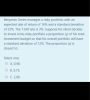
Benjamin Green manages a risky portfolio with an expected rate of return of 16% and a standard deviation of 25%. The T-bill rate is 3%. Suppose his client decides to invest in his risky portfolio a proportion (y) of his total investment budget so that his overall portfolio will have a standard deviation of 12%. The proportion (y) is closest to: Select one: O A. 0.48. OB. 0.75. O C. 2.08. Paul Lynch manages a risky portfolio with...
urgent, thanks
Benjamin Green manages a risky portfolio with an expected rate of return of 16% and a standard deviation of 25%. The T-bill rate is 3%. Suppose his client decides to invest in his risky portfolio a proportion (y) of his total investment budget so that his overall portfolio will have a standard deviation of 12%. The proportion (y) is closest to: Select one: O A. 0.48. OB. 0.75. O C. 2.08. Paul Lynch manages a risky portfolio with...
Q2: A: Suppose that you manage a risky portfolio with an expected rate of return of...
Q2: A: Suppose that you manage a risky portfolio with an expected rate of return of 12% and a standard deviation of 25%. The T-bill rate is 3%. Your client chooses to invest 60% of a portfolio in your fund and 40% in the T-bills. What is the slope of the Capial Allocation Line (CAL)? 0.36 B: Suppose the same client in the previous problem decides to invest in your risky portfolio a proportion (y) of his total investment budget...
12. An investor invests 40% of his wealth in a risky asset with an expected rate...
 12. An investor invests 40% of his wealth in a risky asset with an expected rate of return of 15% and a variance of 0.04 and 60% in a treasury bill that pays 6%. Her portfolio's expected rate of return is and her portfolio return's standard deviation is 1) 8.0%, 12% 2) 9.6%, 8% 3) 11.4%, 10% 4) 13%, 12% moto of 4% One year
You invest $100 in a portfolio. The portfolio is composed of a risky asset with an...
You invest $100 in a portfolio. The portfolio is composed of a risky asset with an expected rate of return of 12% and a standard deviation of 15% and a Treasury bill with a rate of return of 5%. What proportion of your total portfolio should be invested in the risky asset to form a portfolio with an expected rate of return of 9%?
You invest $100 in a portfolio. The portfolio is composed of a risky asset with an...
You invest $100 in a portfolio. The portfolio is composed of a risky asset with an expected rate of return of 12% and a standard deviation of 15% and a Treasury bill with a rate of return of 5%. What proportion of your total portfolio should be invested in the risky asset to form a portfolio with an expected rate of return of 9%?
You invest $1,200 in a complete portfolio. The complete portfolio is composed of a risky asset...
You invest $1,200 in a complete portfolio. The complete portfolio is composed of a risky asset with an expected rate of return of 13% and a standard deviation of 20% and a Treasury bill with a rate of return of 4%. __________ of your complete portfolio should be invested in the risky portfolio if you want your complete portfolio to have a standard deviation of 7%.
Assume that you manage a risky portfolio with an expected rate of return of 17% and...
Assume that you manage a risky portfolio with an expected rate of return of 17% and a standard deviation of 27%. The T-bill rate is 7%. Your risky portfolio includes the following investments in the given proportions: Stock A 27% Stock B 33% Stock C 40% Your client decides to invest in your risky portfolio a proportion (y) of his total investment budget with the remainder in a T-bill money market fund so that his overall portfolio will have an...
 3) Assume that you manage a risky portfolio with an expected rate of return of 14% and standard deviation of 19%. The risk-free rate rate on a Treasury-bill is 6%. a. Your client chooses to invest 60% of a portfolio in your fund and 40% in a risk-free T-bill money market fund. What is the expected return and standard deviation of your client's portfolio? b. Suppose another investor decides to invest in your risky portfolio a proportion (w) of his...
 urgent, thanks
Benjamin Green manages a risky portfolio with an expected rate of return of 16% and a standard deviation of 25%. The T-bill rate is 3%. Suppose his client decides to invest in his risky portfolio a proportion (y) of his total investment budget so that his overall portfolio will have a standard deviation of 12%. The proportion (y) is closest to: Select one: O A. 0.48. OB. 0.75. O C. 2.08. Paul Lynch manages a risky portfolio with...
urgent, thanks
Benjamin Green manages a risky portfolio with an expected rate of return of 16% and a standard deviation of 25%. The T-bill rate is 3%. Suppose his client decides to invest in his risky portfolio a proportion (y) of his total investment budget so that his overall portfolio will have a standard deviation of 12%. The proportion (y) is closest to: Select one: O A. 0.48. OB. 0.75. O C. 2.08. Paul Lynch manages a risky portfolio with...
 12. An investor invests 40% of his wealth in a risky asset with an expected rate of return of 15% and a variance of 0.04 and 60% in a treasury bill that pays 6%. Her portfolio's expected rate of return is and her portfolio return's standard deviation is 1) 8.0%, 12% 2) 9.6%, 8% 3) 11.4%, 10% 4) 13%, 12% moto of 4% One year
Most questions answered within 3 hours.
-
Where is the error in this code sequence?
String s1 = "Hello";
String s2 = "ello";...
asked 10 months ago -
Financial data for Joel de Paris, Inc., for last year
follow:
Joel de Paris, Inc.
Balance...
asked 10 months ago -
Consider this reaction:
Al2(SO4)3 (aq)+ BaCl3
(aq) Al2Cl6 (aq)- +
3BaSO4(s) . What is the...
asked 10 months ago -
Suppose that Savneet is considering increasing her
recent random sample from 20 car rentals to 40...
asked 10 months ago -
Trucks arrive at an unloading terminal at an average rate of 120
per hour.
Trucks arrive...
asked 10 months ago -
Why are methanol and ethanol completely soluble in water while
octanol is not very little soluble....
asked 10 months ago -
A facilities manager at a university reads in a research report
that the mean amount of...
asked 10 months ago -
When the CuSO4 is rehydrated by adding water to the anhydrous
compound, is this an endothermic...
asked 10 months ago -
A ray of sunlight is passing from diamond into crown glass; the
angle of incidence is...
asked 10 months ago -
A block of mass 0.249 kg is placed on top of a light, vertical
spring of...
asked 10 months ago -
how do the kidneys compensate in the presences of acidosis
a) trigger hyperventilate
b) reserve acid...
asked 10 months ago -
Question 501 pts
The rental rate of capital to the firm increases. Which of the
following...
asked 10 months ago