Ethylene oxide is produced by the catalytic oxidation of ethylene: 2C2H4 + O2 → 2C2H4O An...
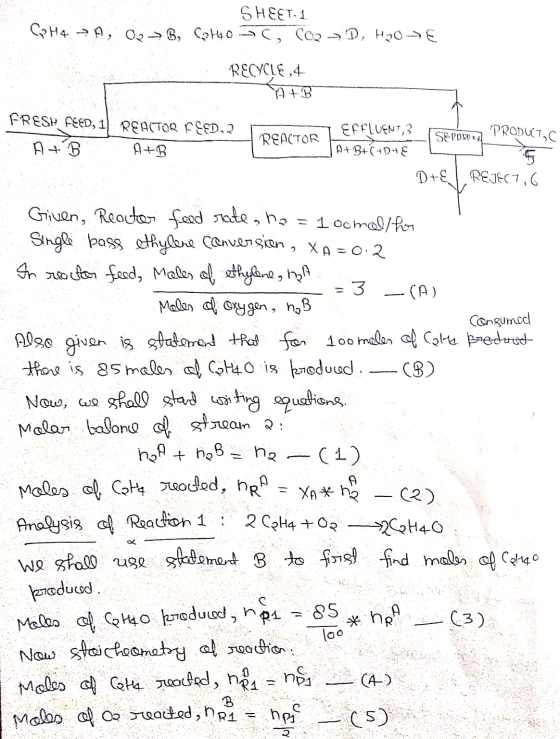
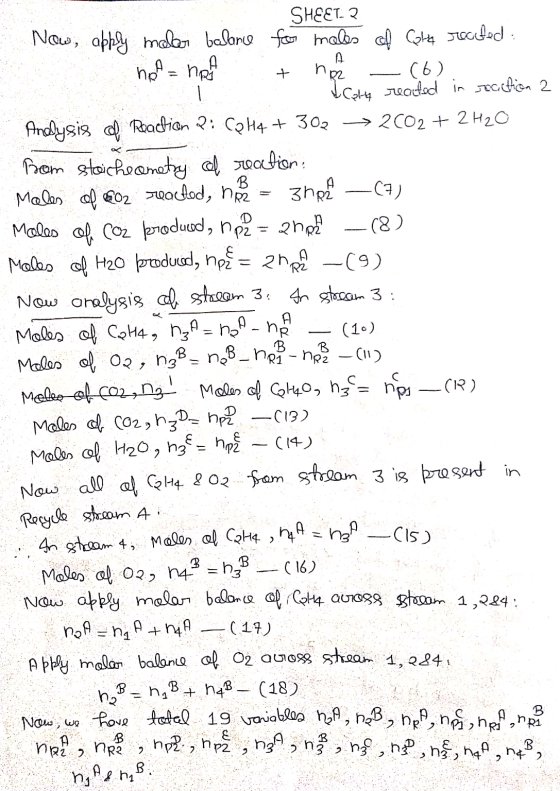
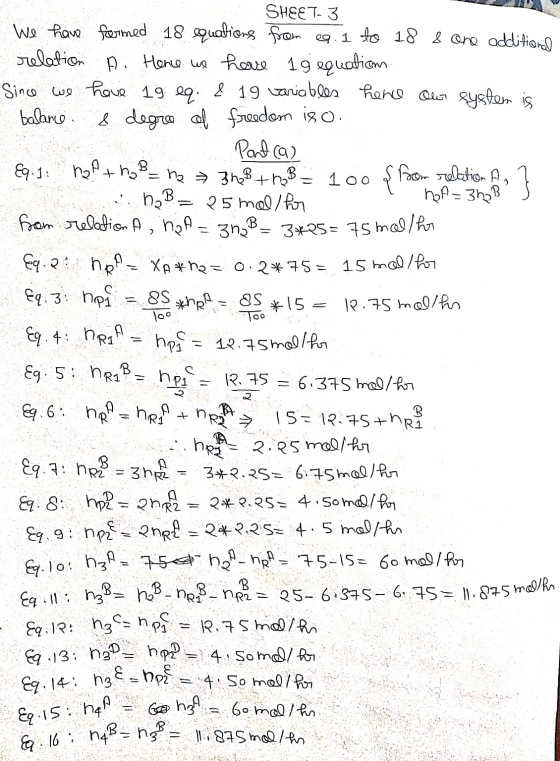
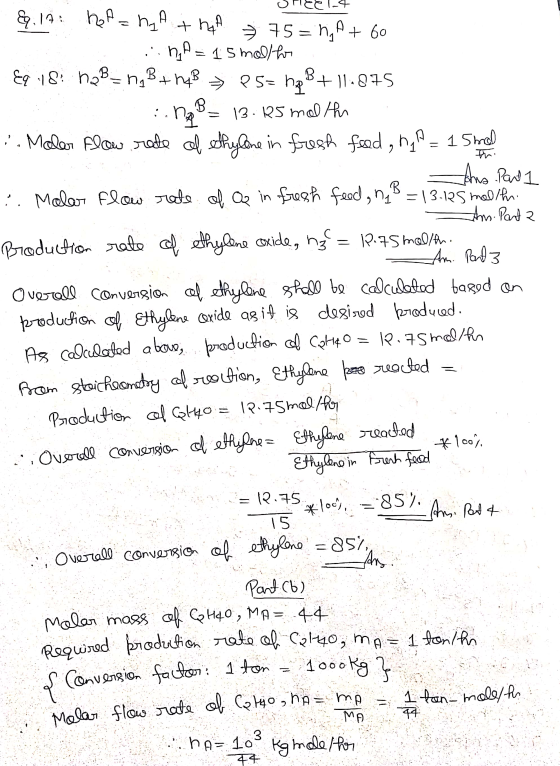
Ethylene oxide is produced by the catalytic oxidation of ethylene: 2C2H4 + O2 → 2C2H4O An undesired competing reaction is the combustion of ethylene: C2H4 + 3O2 → 2CO2 + 2H2O The feed to the reactor (not the fresh feed to the process) consists of 3.00 moles of ethylene per mole of oxygen. The single-pass conversion of ethylene to either ethylene oxide or carbon dioxide is 20.0%, and for every 100.0 moles of ethylene consumed in the reactor, 85.0 moles of ethylene oxide emerges in the reactor products. A multiple-unit process is used to separate the products: ethylene and oxygen are recycled to the reactor, ethylene oxide is sold as a product, and carbon dioxide and water are discarded. Assume a quantity (100.0 mol/h) of the reactor feed stream as a basis of calculation, draw and label the flowchart, perform a degree-of-freedom analysis, and write the equations you would use to calculate (i) the molar flow rates of ethylene and oxygen in the fresh feed, (ii) the production rate of ethylene oxide, and (iii) the overall conversion of ethylene.
a. Calculate the following quantities.
1)Molar flow rate of ethylene in the fresh feed: =mol/h C2H4. 2) Molar flow rate of oxygen in the fresh feed = mol/h O2 . 3)Production rate of ethylene oxide= mol/h C2H4O. 4) Overall conversion of ethylene =%.
b. Calculate the molar flow rates of ethylene and oxygen in the fresh feed needed to produce 1 ton per hour of ethylene oxide. Molar flow rate of ethylene: = b-mol/h C2H4 Molar flow rate of oxygen= lb-mol/h O2.
Homework Answers
Dear student, this question shall be solved based on
stoichemoetric analysis of reaction system. First we shall write
all possible material balance equations and find degree of freedom.
For part b, answers of part a shall be used to get desired results.
 Dear
student, if you have any query kindly ask me. I shall definitely
help in resolving your query. Please ask me. Thank you.
Dear
student, if you have any query kindly ask me. I shall definitely
help in resolving your query. Please ask me. Thank you.
Add Answer to:
Ethylene oxide is produced by the catalytic oxidation of
ethylene: 2C2H4 + O2 → 2C2H4O An...
Problem 4.78 Ethylene Oxide Production Ethylene oxide is produced by the catalytic oxidation of ethylene 2C2Н4...
 Problem 4.78 Ethylene Oxide Production Ethylene oxide is produced by the catalytic oxidation of ethylene 2C2Н4 + 02 - 2C,Ндо An undesired competing reaction is the combustion of ethylene C2H43022CO22H20 The feed to the reactor (not the fresh feed to the process) consists of 3.00 moles of ethylene per mole of oxygen The single-pass conversion the reactor products. ethylene to either ethylene oxide or carbon dioxide is 20.0 %, and for every 100.0 moles of ethylene consumed in the reactor,...
Ethylene oxide is produced by the catalytic oxidation of ethylene: C2H4 (g) + 1/2 O2 (g)...
Ethylene oxide is produced by the catalytic oxidation of ethylene: C2H4 (g) + 1/2 O2 (g) --> C2H4O (g) An undesired competing reaction is the combustion of ethylene to CO2. The feed to a reactor contains 2 mol C2H4/mol O2. The conversion and yield in the reactor are respectively 25% and 0.70 mol C2H4O produced/mol C2H4 consumed. A multiple-unit process separates the reactor outlet stream components: C2H4 and O2 are recycled to the reactor, C2H4O is sold, and CO2 and...
. (5pt) Ethylene oxide is produced by the catalytic oxidation of cthylenc C3H4 + O2 →...
 . (5pt) Ethylene oxide is produced by the catalytic oxidation of cthylenc C3H4 + O2 → C2H40 An undesired competing reaction is the combustion of ethylene CO2 + H2O C2H4 + O2 The feed to the reactor contains 4 moles of ethylene per mole of oxygen, while the oxygen contains 0.4% inerts. The single pass conversion of ethylene is 15% and for every 100 moles of ethylene consumed in the reactor, 80 moles of ethylene oxide emerges in the reactor...
8) Ethylene oxide is produced by the catalytic oxidation of ethylene. C2Ha(g)+1/202(g) C2H4O(g) An undesired competing...
 8) Ethylene oxide is produced by the catalytic oxidation of ethylene. C2Ha(g)+1/202(g) C2H4O(g) An undesired competing reaction is the combustion of ethylene to CO2. The feed to a reactor contains 2 mol C2H4/mol O2. The conversion in the reactor is 25% , and 0.70 mol of CaHeO is produced per mol of C2H4 consumed. A multiple- unit process is used to separate the products: C2H4 and O2 are recycled back to the reactor, C2H4O(g) is produced as a product (at...
Ethylene oxide is produced by the catalytic oxidation of ethylene. The feed into the reactor contains...
Ethylene oxide is produced by the catalytic oxidation of ethylene. The feed into the reactor contains 1700 g/min ethylene and 3700 moles/min air. 2C2H4+O2 --> 2C2H4O a) What is the limiting reactant? b) What is the extent of reaction if only 81% of the limiting reactant is converted to the product? c) What is the molar composition of the product stream?
please show all of your work. thanks. Problem 4: Ethylene oxide (C2Ha0), an intermediate in the...
 please show all of your work. thanks.
Problem 4: Ethylene oxide (C2Ha0), an intermediate in the production of plastics, is produced by the partial oxidation of ethylene (Reaction #1) C2H4+ O2 CH4O 25% 1. Reaction #2-the combustion of ethylene to form CO2 and H20-is an undesired side reaction: 2. C2H4+ O2 CO2 H20 (Note: This reaction is not balanced) Assume no other reactions occur-specifically that recycled ethylene oxide is not further oxidized. Pure oxygen (not air) is used in the...
please show all of your work. thanks.
Problem 4: Ethylene oxide (C2Ha0), an intermediate in the production of plastics, is produced by the partial oxidation of ethylene (Reaction #1) C2H4+ O2 CH4O 25% 1. Reaction #2-the combustion of ethylene to form CO2 and H20-is an undesired side reaction: 2. C2H4+ O2 CO2 H20 (Note: This reaction is not balanced) Assume no other reactions occur-specifically that recycled ethylene oxide is not further oxidized. Pure oxygen (not air) is used in the...
1. Acrylonitrile is produced by the reaction of propylene, ammonia, and oxygen C3H6 + NH3 +...
1. Acrylonitrile is produced by the reaction of propylene, ammonia, and oxygen C3H6 + NH3 + O2 C3H3N + 3H2O The feed contains 10 mole% propylene, 12% ammonia, and 78% air. A fractional conversion of 30% of the limiting reactant is achieved. Determine which reactant is limiting, the percentage by which each of the other reactants is in excess, and the molar flow rates of all product gas constituents for a 30% conversion of the limiting reactant, taking 100...
Problem 4.80 Methanol Synthesis Methanol is synthesized from carbon monoxide and hydrogen in a catalytic reactor....
 Problem 4.80 Methanol Synthesis Methanol is synthesized from carbon monoxide and hydrogen in a catalytic reactor. The fresh feed to the process contains 32.0 mol% CO 64.0 mol% H2 and 4.00 mol% N2: This stream is mixed with a recycle stream in a ratio of 10.00 mol recycle / mol fresh feed to produce th feed to the reactor, which contains 12.0 mol% N2 The reactor effluent goes to a condenser from which two streams emerge: a liquid product stream...
Use extent of reaction method. Formaldehyde can be produced by oxidation of ethylene and the following...
Use extent of reaction method. Formaldehyde can be produced by oxidation of ethylene and the following reaction may occur. C2H4 + ½ O2 ® C2H4O C2H4 + 3O2 ® 2CO2 + 2H2O The product gas analysis shows 28.57% C2H4O, 11.43% CO2, 11.43% H2O, 22.86% C2H4 and 25.71 % O2. Calculate the % conversion of C2H4 and selectivity, C2H4O / CO2.
16. The gas ethane, C2H4, reacts with oxygen gas to form ethylene oxide, C2H40, according to...
 16. The gas ethane, C2H4, reacts with oxygen gas to form ethylene oxide, C2H40, according to the unbalanced equation: C2H2() + O2(e) → C2H4O(8) a. What is the theoretical yield if ethylene oxide from 120.0g of ethane? b. If 180.Og of ethylene oxide is obtained from 120.0g of ethane, what is the percent yield? h ydrogen
 Problem 4.78 Ethylene Oxide Production Ethylene oxide is produced by the catalytic oxidation of ethylene 2C2Н4 + 02 - 2C,Ндо An undesired competing reaction is the combustion of ethylene C2H43022CO22H20 The feed to the reactor (not the fresh feed to the process) consists of 3.00 moles of ethylene per mole of oxygen The single-pass conversion the reactor products. ethylene to either ethylene oxide or carbon dioxide is 20.0 %, and for every 100.0 moles of ethylene consumed in the reactor,...
 . (5pt) Ethylene oxide is produced by the catalytic oxidation of cthylenc C3H4 + O2 → C2H40 An undesired competing reaction is the combustion of ethylene CO2 + H2O C2H4 + O2 The feed to the reactor contains 4 moles of ethylene per mole of oxygen, while the oxygen contains 0.4% inerts. The single pass conversion of ethylene is 15% and for every 100 moles of ethylene consumed in the reactor, 80 moles of ethylene oxide emerges in the reactor...
 8) Ethylene oxide is produced by the catalytic oxidation of ethylene. C2Ha(g)+1/202(g) C2H4O(g) An undesired competing reaction is the combustion of ethylene to CO2. The feed to a reactor contains 2 mol C2H4/mol O2. The conversion in the reactor is 25% , and 0.70 mol of CaHeO is produced per mol of C2H4 consumed. A multiple- unit process is used to separate the products: C2H4 and O2 are recycled back to the reactor, C2H4O(g) is produced as a product (at...
 please show all of your work. thanks.
Problem 4: Ethylene oxide (C2Ha0), an intermediate in the production of plastics, is produced by the partial oxidation of ethylene (Reaction #1) C2H4+ O2 CH4O 25% 1. Reaction #2-the combustion of ethylene to form CO2 and H20-is an undesired side reaction: 2. C2H4+ O2 CO2 H20 (Note: This reaction is not balanced) Assume no other reactions occur-specifically that recycled ethylene oxide is not further oxidized. Pure oxygen (not air) is used in the...
please show all of your work. thanks.
Problem 4: Ethylene oxide (C2Ha0), an intermediate in the production of plastics, is produced by the partial oxidation of ethylene (Reaction #1) C2H4+ O2 CH4O 25% 1. Reaction #2-the combustion of ethylene to form CO2 and H20-is an undesired side reaction: 2. C2H4+ O2 CO2 H20 (Note: This reaction is not balanced) Assume no other reactions occur-specifically that recycled ethylene oxide is not further oxidized. Pure oxygen (not air) is used in the...
 Problem 4.80 Methanol Synthesis Methanol is synthesized from carbon monoxide and hydrogen in a catalytic reactor. The fresh feed to the process contains 32.0 mol% CO 64.0 mol% H2 and 4.00 mol% N2: This stream is mixed with a recycle stream in a ratio of 10.00 mol recycle / mol fresh feed to produce th feed to the reactor, which contains 12.0 mol% N2 The reactor effluent goes to a condenser from which two streams emerge: a liquid product stream...
 16. The gas ethane, C2H4, reacts with oxygen gas to form ethylene oxide, C2H40, according to the unbalanced equation: C2H2() + O2(e) → C2H4O(8) a. What is the theoretical yield if ethylene oxide from 120.0g of ethane? b. If 180.Og of ethylene oxide is obtained from 120.0g of ethane, what is the percent yield? h ydrogen
Most questions answered within 3 hours.
-
Where is the error in this code sequence?
String s1 = "Hello";
String s2 = "ello";...
asked 10 months ago -
Financial data for Joel de Paris, Inc., for last year
follow:
Joel de Paris, Inc.
Balance...
asked 10 months ago -
Consider this reaction:
Al2(SO4)3 (aq)+ BaCl3
(aq) Al2Cl6 (aq)- +
3BaSO4(s) . What is the...
asked 10 months ago -
Suppose that Savneet is considering increasing her
recent random sample from 20 car rentals to 40...
asked 10 months ago -
Trucks arrive at an unloading terminal at an average rate of 120
per hour.
Trucks arrive...
asked 10 months ago -
Why are methanol and ethanol completely soluble in water while
octanol is not very little soluble....
asked 10 months ago -
A facilities manager at a university reads in a research report
that the mean amount of...
asked 10 months ago -
When the CuSO4 is rehydrated by adding water to the anhydrous
compound, is this an endothermic...
asked 10 months ago -
A ray of sunlight is passing from diamond into crown glass; the
angle of incidence is...
asked 10 months ago -
A block of mass 0.249 kg is placed on top of a light, vertical
spring of...
asked 10 months ago -
how do the kidneys compensate in the presences of acidosis
a) trigger hyperventilate
b) reserve acid...
asked 10 months ago -
Question 501 pts
The rental rate of capital to the firm increases. Which of the
following...
asked 10 months ago