1) A proton moves in an electric field given by E = (4i + 2j) x10-3N...
1) A proton moves in an electric field given by E = (4i + 2j) x10-3N / C. Give the magnitude and direction of the acceleration with which moves the proton.
2) An electron is launched at 27.3 ° above the horizontal with a speed of 4x10⁵ m / s in a region of the space where there is an electric field given by E = 100j N / C. Neglecting the action of gravity, calculate the maximum height reached by the electron.
Homework Answers


Add Answer to:
1) A proton moves in an electric field given by E = (4i + 2j)
x10-3N...
A proton moves through a region containing a uniform electric field given by E = 79.0...
 A proton moves through a region containing a uniform electric field given by E = 79.0 j V/m and a uniform magnetic field B-(0.200i +0.300j +0.400 k) T. Determine the acceleration of the proton when it has a velocity V - 191 im/s.
A proton traveling to the right moves in between the two large plates. A vertical electric...
 A proton traveling to the right moves in between the two large
plates. A vertical electric field, pointing downwards with
magnitude 3.0N/C, is produced by the plates.
What is the direction of the force on the proton?
Draw the electric field lines on the diagram.
If the electric field is 3.0N/C, what is the acceleration of
the proton in the region of the plates?
Pretend the force of gravity doesnot exist; then sketch the
path of the proton.
We take...
A proton traveling to the right moves in between the two large
plates. A vertical electric field, pointing downwards with
magnitude 3.0N/C, is produced by the plates.
What is the direction of the force on the proton?
Draw the electric field lines on the diagram.
If the electric field is 3.0N/C, what is the acceleration of
the proton in the region of the plates?
Pretend the force of gravity doesnot exist; then sketch the
path of the proton.
We take...
A proton moves through a region containing a uniform electric field given by E 53.0jV/m and...
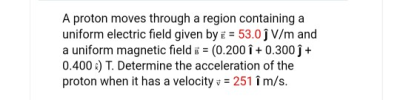 A proton moves through a region containing a uniform electric field given by E 53.0jV/m and a uniform magnetic field (0.200+ 0.300 j+ 0.400 : T. Determine the acceleration of the proton when it has a velocity 251 î m/s.
A proton moves through a region containing a uniform electric field given by E with arrow...
A proton moves through a region containing a uniform electric field given by E with arrow = 64.0 ĵ V/m and a uniform magnetic field B with arrow = (0.200 î + 0.300 ĵ + 0.400 k) T. Determine the acceleration of the proton when it has a velocity v with arrow = 230 î m/s.
A proton moves through a region containing a uniform electric field given by E with arrow...
A proton moves through a region containing a uniform electric field given by E with arrow = 64.0 ĵ V/m and a uniform magnetic field B with arrow = (0.200 î + 0.300 ĵ + 0.400 k) T. Determine the acceleration of the proton when it has a velocity v with arrow = 170 î m/s. a with arrow = m/s2
Problem 22.14 A6.70 - C particle moves through a region of space where an electric field...
 Problem 22.14 A6.70 - C particle moves through a region of space where an electric field of magnitude 1300 N/C points in the positive direction, and a magnetic field of magnitude 1.25 T points in the positive z direction. Part A If the net force acting on the particle is 6.25*10-3N in the positive e direction find the components of the particle's velocity. Assume the particle's velocity is in the 2-y plane Enter your answers numerically separated by commas.
A proton moves through a region containing a uniform electric field given by = 30.0 ĵ V/m...
A proton moves through a region containing a uniform electric field given by = 30.0 ĵ V/m and a uniform magnetic field = (0.200 î + 0.300 ĵ + 0.400 ) T. Determine the acceleration of the proton when it has a velocity = 230 î m/s. could you also explain in detail the vector addition process?
Question 8 (5 points) A proton moves through a region containing a uniform electric field given...
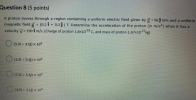 Question 8 (5 points) A proton moves through a region containing a uniform electric field given by = 56 V/m and a uniform magnetic field B - (0.21 +0.3]) T. Determine the acceleration of the proton (in m/s) when it has a velocity v. 190 i m/s.(Charge of proton 1.6x10c, and mass of proton 1.67X10kg) (5.37+ 4.5)) x 10 (3.51 - 5:49 x 10 (5.32.5.47 x 10
A proton is projected in the positive x direction into a region of uniform electric field...
 A proton is projected in the positive x direction into a region of uniform electric field E = (-6.90 × 10⁵) Î N/C at t = 0, The proton travels 6.90 cm as it comes to rest. (a) Determine the acceleration of the proton magnitude direction | Select- m/s2 (b) Determine the initial speed of the proton. magnitude direction | Select- m/s (c) Determine the time interval over which the proton comes to rest.
A proton is projected in the positive x direction into a region of uniform electric field...
 A proton is projected in the positive x direction into a region of uniform electric field E (-5.20 x 10) i N/C at t 0. The proton travels 6.00 cm as it comes to rest. (a) Determine the acceleration of the proton magnitude directionSelect m/s (b) Determine the initial speed of the proton. magnitude direction-Select m/s (c) Determine the time interval over which the proton comes to rest.
 A proton moves through a region containing a uniform electric field given by E = 79.0 j V/m and a uniform magnetic field B-(0.200i +0.300j +0.400 k) T. Determine the acceleration of the proton when it has a velocity V - 191 im/s.
 A proton traveling to the right moves in between the two large
plates. A vertical electric field, pointing downwards with
magnitude 3.0N/C, is produced by the plates.
What is the direction of the force on the proton?
Draw the electric field lines on the diagram.
If the electric field is 3.0N/C, what is the acceleration of
the proton in the region of the plates?
Pretend the force of gravity doesnot exist; then sketch the
path of the proton.
We take...
A proton traveling to the right moves in between the two large
plates. A vertical electric field, pointing downwards with
magnitude 3.0N/C, is produced by the plates.
What is the direction of the force on the proton?
Draw the electric field lines on the diagram.
If the electric field is 3.0N/C, what is the acceleration of
the proton in the region of the plates?
Pretend the force of gravity doesnot exist; then sketch the
path of the proton.
We take...
 A proton moves through a region containing a uniform electric field given by E 53.0jV/m and a uniform magnetic field (0.200+ 0.300 j+ 0.400 : T. Determine the acceleration of the proton when it has a velocity 251 î m/s.
 Problem 22.14 A6.70 - C particle moves through a region of space where an electric field of magnitude 1300 N/C points in the positive direction, and a magnetic field of magnitude 1.25 T points in the positive z direction. Part A If the net force acting on the particle is 6.25*10-3N in the positive e direction find the components of the particle's velocity. Assume the particle's velocity is in the 2-y plane Enter your answers numerically separated by commas.
 Question 8 (5 points) A proton moves through a region containing a uniform electric field given by = 56 V/m and a uniform magnetic field B - (0.21 +0.3]) T. Determine the acceleration of the proton (in m/s) when it has a velocity v. 190 i m/s.(Charge of proton 1.6x10c, and mass of proton 1.67X10kg) (5.37+ 4.5)) x 10 (3.51 - 5:49 x 10 (5.32.5.47 x 10
 A proton is projected in the positive x direction into a region of uniform electric field E = (-6.90 × 10⁵) Î N/C at t = 0, The proton travels 6.90 cm as it comes to rest. (a) Determine the acceleration of the proton magnitude direction | Select- m/s2 (b) Determine the initial speed of the proton. magnitude direction | Select- m/s (c) Determine the time interval over which the proton comes to rest.
 A proton is projected in the positive x direction into a region of uniform electric field E (-5.20 x 10) i N/C at t 0. The proton travels 6.00 cm as it comes to rest. (a) Determine the acceleration of the proton magnitude directionSelect m/s (b) Determine the initial speed of the proton. magnitude direction-Select m/s (c) Determine the time interval over which the proton comes to rest.
Most questions answered within 3 hours.
-
Where is the error in this code sequence?
String s1 = "Hello";
String s2 = "ello";...
asked 10 months ago -
Financial data for Joel de Paris, Inc., for last year
follow:
Joel de Paris, Inc.
Balance...
asked 10 months ago -
Consider this reaction:
Al2(SO4)3 (aq)+ BaCl3
(aq) Al2Cl6 (aq)- +
3BaSO4(s) . What is the...
asked 10 months ago -
Suppose that Savneet is considering increasing her
recent random sample from 20 car rentals to 40...
asked 10 months ago -
Trucks arrive at an unloading terminal at an average rate of 120
per hour.
Trucks arrive...
asked 10 months ago -
Why are methanol and ethanol completely soluble in water while
octanol is not very little soluble....
asked 10 months ago -
A facilities manager at a university reads in a research report
that the mean amount of...
asked 10 months ago -
When the CuSO4 is rehydrated by adding water to the anhydrous
compound, is this an endothermic...
asked 10 months ago -
A ray of sunlight is passing from diamond into crown glass; the
angle of incidence is...
asked 10 months ago -
A block of mass 0.249 kg is placed on top of a light, vertical
spring of...
asked 10 months ago -
how do the kidneys compensate in the presences of acidosis
a) trigger hyperventilate
b) reserve acid...
asked 10 months ago -
Question 501 pts
The rental rate of capital to the firm increases. Which of the
following...
asked 10 months ago