(a) What is the “financial hockey stick?” (b) Is business investment mainly responsible for the shape...
(a) What is the “financial hockey stick?”
(b) Is business investment mainly responsible for the shape of the hockey stick? If not, what is?
Homework Answers
A)
Financial hockey stick refers to the growth chart of businesses which are characterized by rapid growth and cash inflows in the initial years, followed by sluggish and stable growth overtime.
This is majorly common for startups, which experience a boost in their growth rates in the starting years and eventually experience losses or sluggish growth.
B)
No, rather than business investment, consumer response, lack of innovative ideas or glitches in the sales process are some of the main reasons behind the hockey stick effect. Businesses are always ready to invest and grow, however low consumer response or glitches in their production or sales process lead to their falling growth.
Add Answer to:
(a) What is the “financial hockey stick?”
(b) Is business investment mainly responsible for the shape...
identify the effect on the financial statement on the following senarios: b) the clients business mainly...
identify the effect on the financial statement on the following senarios: b) the clients business mainly dues with cash sales which is more susceptible to theft than credit sales. and state how the auditor can reduce the risk
Two hockey players are skating on the ice when they collide and stick together. Before the...
Two hockey players are skating on the ice when they collide and stick together. Before the collision the 111 kg defensive player is moving at 1.50 m/s in the West direction, and the 93 kg right wing player is moving at 5.90 m/s at an angle of 27.0° South of Westward. a. What type of collision occurs? Will energy be conserved? b. Find the final velocity of the joined hockey players. Answer in POLAR form. c. Calculate the % of...
The construction a new shopping center is an example of: A) business fixed investment B) residential investment C) inventory investment D)financial investment.
The construction a new shopping center is an example of: A) business fixed investment B) residential investment C) inventory investment D)financial investment.
A hockey puck (mass = 2.5 kg) leaves the players stick with a speed of 25...
A hockey puck (mass = 2.5 kg) leaves the players stick with a speed of 25 m/s and slides on the ice for 90 meters before coming to rest. A) What is the magnitude of the acceleration on the puck? m/s2 Tries 0/2 B) What is the magnitude of the friction force exerted on the puck due to the ice? N Tries 0/2 C) What is the normal force on the puck? N Tries 0/2 D) What is the friction...
18. Responsibility Centers. Petroleum Products, Inc., operates primarily in the United States and has several segments: 1. Accounting and finance: responsible for recording financial information and...
 18. Responsibility Centers. Petroleum Products, Inc., operates primarily in the United States and has several segments: 1. Accounting and finance: responsible for recording financial information and preparing financial reports. 2. Human resources: responsible for hiring employees and maintaining personnel records 3. Retail stores: responsible for sales prices and all costs within each store. 4. Advertising: responsible for promotional materials 5. Production: responsible for manufacturing company products. 6. International operations: acts as an independent segment responsible for all facets of the...
Question Sarbanes-Oxley holds personally responsible for disclosures А. CFOs; financial B. CFOs; IT c. CIOs, financial...
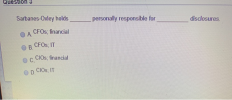 Question Sarbanes-Oxley holds personally responsible for disclosures А. CFOs; financial B. CFOs; IT c. CIOs, financial CIOs: IT D
What organizations are responsible for setting Category A GAAP? What are the components of the equity...
What organizations are responsible for setting Category A GAAP? What are the components of the equity section of the financial statements for the following types of organizations: Not-for-profit, Business-Oriented Organizations Investor-Owned Health Care Enterprises Government Health Care Organizations
What is the government's role in regulation? Should they be responsible for regulating business at all?...
What is the government's role in regulation? Should they be responsible for regulating business at all? Shouldn't that fall on the business itself? For instance, in my profession, we have a code of conduct that we must abide by. If we don't, the profession itself will hold us accountable - such that we can be reprimanded and even lose our license to practice. If anything, shouldn't the government just require the business to self-regulate? Thoughts?
You are a business manager responsible for the successful implementation of a new information system. What...
You are a business manager responsible for the successful implementation of a new information system. What problems would you anticipate from staff when the new system is introduced? What measures could you take to minimise these?
. A treasurer typically is primarily responsible for the following, except. a. managing financial risk b....
. A treasurer typically is primarily responsible for the following, except. a. managing financial risk b. overseeing day-to-day liquidity c. investing for the short and long term d. developing treasury policies e. setting corporate credit policies
 18. Responsibility Centers. Petroleum Products, Inc., operates primarily in the United States and has several segments: 1. Accounting and finance: responsible for recording financial information and preparing financial reports. 2. Human resources: responsible for hiring employees and maintaining personnel records 3. Retail stores: responsible for sales prices and all costs within each store. 4. Advertising: responsible for promotional materials 5. Production: responsible for manufacturing company products. 6. International operations: acts as an independent segment responsible for all facets of the...
 Question Sarbanes-Oxley holds personally responsible for disclosures А. CFOs; financial B. CFOs; IT c. CIOs, financial CIOs: IT D
Most questions answered within 3 hours.
-
Where is the error in this code sequence?
String s1 = "Hello";
String s2 = "ello";...
asked 11 months ago -
Financial data for Joel de Paris, Inc., for last year
follow:
Joel de Paris, Inc.
Balance...
asked 11 months ago -
Consider this reaction:
Al2(SO4)3 (aq)+ BaCl3
(aq) Al2Cl6 (aq)- +
3BaSO4(s) . What is the...
asked 11 months ago -
Suppose that Savneet is considering increasing her
recent random sample from 20 car rentals to 40...
asked 11 months ago -
Trucks arrive at an unloading terminal at an average rate of 120
per hour.
Trucks arrive...
asked 11 months ago -
Why are methanol and ethanol completely soluble in water while
octanol is not very little soluble....
asked 11 months ago -
A facilities manager at a university reads in a research report
that the mean amount of...
asked 11 months ago -
When the CuSO4 is rehydrated by adding water to the anhydrous
compound, is this an endothermic...
asked 11 months ago -
A ray of sunlight is passing from diamond into crown glass; the
angle of incidence is...
asked 11 months ago -
A block of mass 0.249 kg is placed on top of a light, vertical
spring of...
asked 11 months ago -
how do the kidneys compensate in the presences of acidosis
a) trigger hyperventilate
b) reserve acid...
asked 11 months ago -
Question 501 pts
The rental rate of capital to the firm increases. Which of the
following...
asked 11 months ago