QUESTION 5 Aerobic degradation of benzoic acid by a mixed culture of microorganisms can be represented...
QUESTION 5
-
Aerobic degradation of benzoic acid by a mixed culture of microorganisms can be represented by the following reaction:
C6H5COOH + a O2 + b NH3 → c C5H7NO2 + d H2O + e CO2
where C6H5COOH is the substrate, and C5H7NO2 is the bacteria.
Determine a, b, c, d and e, knowing that 0.9 moles of CO2 are produced per mole of O2 consumed.
MCQ Options:
a = - 4.5
b = 2.4
c = 2.4
d = - 1.8
e = - 5
a = 5
b = 0.5
c = 0.5
d = 2
e = 4.5
a = 2.73
b = 0.91
c = 0.91
d = 0.73
e = 2.45
a = 4.5
b = 2.4
c = 2.4
d = 1.8
e = 5
a = 3
b = 0.48
c = 0.48
d = 4.32
e = 3.12
Homework Answers


Add Answer to:
QUESTION 5
Aerobic degradation of benzoic acid by a mixed culture of
microorganisms can be represented...
Aerobic degradation of an organic compound by a mixed culture of organisms in waste water can...
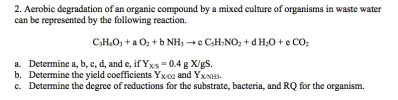 Aerobic degradation of an organic compound by a mixed culture of organisms in waste water can be represented by the following reaction. C_3 H_6 O_3 + a O_2 + b NH_3 rightarrow c C_5H_7NO_2 + d H_2O + e CO_2 a. Determine a, b, c, d, and e, if Y_X/S = 0.4 g X/gS. b. Determine the yield coefficients Y_X/O2 and Y_X/NH3. c. Determine the degree of reductions for the substrate, bacteria, and RQ for the organism.
Benzoic acid, C6H5COOH, is a weak acid with Ka = 6.3 × 10⁻⁵. What amount of...
Benzoic acid, C6H5COOH, is a weak acid with Ka = 6.3 × 10⁻⁵. What amount of sodium benzoate, C6H5COONa, must be dissolved in 300. mL of 0.400 M C6H5COOH, in order to prepare a buffer of pH 4.50? A. 0.24 mol B. 0.12 mol C. 0.36 mol D. 0.60 mol E. 0.48 mol
Titrate 40.0 mL of 0.0350 M benzoic acid (C6H5COOH, Ka = 6.3 × 10⁻⁵) with 0.0700...
Titrate 40.0 mL of 0.0350 M benzoic acid (C6H5COOH, Ka = 6.3 × 10⁻⁵) with 0.0700 M NaOH Calculate the pH in the solution at equivalent point. a) 5.716 b) 8.284 c) 8.372 d) 5.628 e) 7.546
Top question. P1. (Sec. 16.2) What is the pH of a solution prepared by adding 0.45...
 Top question.
P1. (Sec. 16.2) What is the pH of a solution prepared by adding 0.45 moles of formic acid HCO2H, and 0.40 moles of sodium formate, NaCO,H, in enough water to make a 1.0-liter solution? (Formic Acid: K 1.81 10-) a) 4.32 b) 3.69 c) 5.52 d) 7.32 e) 9.11 P2. (Sec. 16.2) What is the pH of a solution prepared by adding 100 mL of a 0.25 M solution of sodium acetate, NaC2H,O2, into 110 mL of 0.30...
Top question.
P1. (Sec. 16.2) What is the pH of a solution prepared by adding 0.45 moles of formic acid HCO2H, and 0.40 moles of sodium formate, NaCO,H, in enough water to make a 1.0-liter solution? (Formic Acid: K 1.81 10-) a) 4.32 b) 3.69 c) 5.52 d) 7.32 e) 9.11 P2. (Sec. 16.2) What is the pH of a solution prepared by adding 100 mL of a 0.25 M solution of sodium acetate, NaC2H,O2, into 110 mL of 0.30...
D Question 4 5 pts 2b) There are 0.10 moles of N2O4 and 0.20 moles of...
 D Question 4 5 pts 2b) There are 0.10 moles of N2O4 and 0.20 moles of NO 2 present in a 2.0 L container which may react according to: N2O4(g) = 2N028) Kp = 11 What is the value of Qp for the initial gas mixture? a. 4.0 b. 0.20 c. 0.40 d.5.0 . a. b. Consider the following equilibrium systems. Which direction will the reactions shift (reactants or products) when cooled? 200g + O2(g) = 2CO2(g) H2e+12(e)=2HI® H2(g) +126)...
5) How many moles of hydrogen gas are needed to react with oxygen to form one...
 5) How many moles of hydrogen gas are needed to react with oxygen to form one mole of 5) water? 2H2(8) + O268) - 2H20(1) A) 4 mol B) 1 mol C) 2 mol D) 0.5 mol E) 6 mol 6) Incomplete combustion occurs when there is insufficient oxygen to react with a compound. The suffocating gas carbon monoxide is a product of incomplete combustion. How many moles of oxygen gas are required for the complete combustion of 11.0 moles...
Only need question C answered Problem 3 (5 marks): The advantage of fossil fuels is that a lot of energy can be transpor...
 Only need question C answered
Problem 3 (5 marks): The advantage of fossil fuels is that a lot of energy can be transported in a small amount of mass. The disadvantage is that their combustion produces CO2 (a greenhouse gas). a) Calculate how much energy is recoverable by the combustion of 1 g of octane. In a hydrogen-based economy, H2 could be produced collected and compressed so that it could be transported and burned like fossil fuels in car engines....
Only need question C answered
Problem 3 (5 marks): The advantage of fossil fuels is that a lot of energy can be transported in a small amount of mass. The disadvantage is that their combustion produces CO2 (a greenhouse gas). a) Calculate how much energy is recoverable by the combustion of 1 g of octane. In a hydrogen-based economy, H2 could be produced collected and compressed so that it could be transported and burned like fossil fuels in car engines....
QUESTION 3 The textbook discusses 3 types of environmental degradation affecting the environment. Below, please match...
 QUESTION 3 The textbook discusses 3 types of environmental degradation affecting the environment. Below, please match each type of degradation discussed to the type of consequence suggested in the textbook. (Answer based on what the book says, not based on your personal opinion.) Air pollution A., is killinig humans 8,..isklin the earth Land poliution Water pollution address chiticar Watel Air Pollution Air pollution occurs when the release of materials to the atmosphere cannot be safelv disposed of by natural processes....
 Aerobic degradation of an organic compound by a mixed culture of organisms in waste water can be represented by the following reaction. C_3 H_6 O_3 + a O_2 + b NH_3 rightarrow c C_5H_7NO_2 + d H_2O + e CO_2 a. Determine a, b, c, d, and e, if Y_X/S = 0.4 g X/gS. b. Determine the yield coefficients Y_X/O2 and Y_X/NH3. c. Determine the degree of reductions for the substrate, bacteria, and RQ for the organism.
 Top question.
P1. (Sec. 16.2) What is the pH of a solution prepared by adding 0.45 moles of formic acid HCO2H, and 0.40 moles of sodium formate, NaCO,H, in enough water to make a 1.0-liter solution? (Formic Acid: K 1.81 10-) a) 4.32 b) 3.69 c) 5.52 d) 7.32 e) 9.11 P2. (Sec. 16.2) What is the pH of a solution prepared by adding 100 mL of a 0.25 M solution of sodium acetate, NaC2H,O2, into 110 mL of 0.30...
Top question.
P1. (Sec. 16.2) What is the pH of a solution prepared by adding 0.45 moles of formic acid HCO2H, and 0.40 moles of sodium formate, NaCO,H, in enough water to make a 1.0-liter solution? (Formic Acid: K 1.81 10-) a) 4.32 b) 3.69 c) 5.52 d) 7.32 e) 9.11 P2. (Sec. 16.2) What is the pH of a solution prepared by adding 100 mL of a 0.25 M solution of sodium acetate, NaC2H,O2, into 110 mL of 0.30...
 D Question 4 5 pts 2b) There are 0.10 moles of N2O4 and 0.20 moles of NO 2 present in a 2.0 L container which may react according to: N2O4(g) = 2N028) Kp = 11 What is the value of Qp for the initial gas mixture? a. 4.0 b. 0.20 c. 0.40 d.5.0 . a. b. Consider the following equilibrium systems. Which direction will the reactions shift (reactants or products) when cooled? 200g + O2(g) = 2CO2(g) H2e+12(e)=2HI® H2(g) +126)...
 5) How many moles of hydrogen gas are needed to react with oxygen to form one mole of 5) water? 2H2(8) + O268) - 2H20(1) A) 4 mol B) 1 mol C) 2 mol D) 0.5 mol E) 6 mol 6) Incomplete combustion occurs when there is insufficient oxygen to react with a compound. The suffocating gas carbon monoxide is a product of incomplete combustion. How many moles of oxygen gas are required for the complete combustion of 11.0 moles...
 Only need question C answered
Problem 3 (5 marks): The advantage of fossil fuels is that a lot of energy can be transported in a small amount of mass. The disadvantage is that their combustion produces CO2 (a greenhouse gas). a) Calculate how much energy is recoverable by the combustion of 1 g of octane. In a hydrogen-based economy, H2 could be produced collected and compressed so that it could be transported and burned like fossil fuels in car engines....
Only need question C answered
Problem 3 (5 marks): The advantage of fossil fuels is that a lot of energy can be transported in a small amount of mass. The disadvantage is that their combustion produces CO2 (a greenhouse gas). a) Calculate how much energy is recoverable by the combustion of 1 g of octane. In a hydrogen-based economy, H2 could be produced collected and compressed so that it could be transported and burned like fossil fuels in car engines....
 QUESTION 3 The textbook discusses 3 types of environmental degradation affecting the environment. Below, please match each type of degradation discussed to the type of consequence suggested in the textbook. (Answer based on what the book says, not based on your personal opinion.) Air pollution A., is killinig humans 8,..isklin the earth Land poliution Water pollution address chiticar Watel Air Pollution Air pollution occurs when the release of materials to the atmosphere cannot be safelv disposed of by natural processes....
Most questions answered within 3 hours.
-
Where is the error in this code sequence?
String s1 = "Hello";
String s2 = "ello";...
asked 11 months ago -
Financial data for Joel de Paris, Inc., for last year
follow:
Joel de Paris, Inc.
Balance...
asked 11 months ago -
Consider this reaction:
Al2(SO4)3 (aq)+ BaCl3
(aq) Al2Cl6 (aq)- +
3BaSO4(s) . What is the...
asked 11 months ago -
Suppose that Savneet is considering increasing her
recent random sample from 20 car rentals to 40...
asked 11 months ago -
Trucks arrive at an unloading terminal at an average rate of 120
per hour.
Trucks arrive...
asked 11 months ago -
Why are methanol and ethanol completely soluble in water while
octanol is not very little soluble....
asked 11 months ago -
A facilities manager at a university reads in a research report
that the mean amount of...
asked 11 months ago -
When the CuSO4 is rehydrated by adding water to the anhydrous
compound, is this an endothermic...
asked 11 months ago -
A ray of sunlight is passing from diamond into crown glass; the
angle of incidence is...
asked 11 months ago -
A block of mass 0.249 kg is placed on top of a light, vertical
spring of...
asked 11 months ago -
how do the kidneys compensate in the presences of acidosis
a) trigger hyperventilate
b) reserve acid...
asked 11 months ago -
Question 501 pts
The rental rate of capital to the firm increases. Which of the
following...
asked 11 months ago