Let P(A) = 0.51, P(B) = 0.26, and P(A ∩ B) = 0.13. a. Calculate P(A...
Let P(A) = 0.51, P(B) = 0.26, and P(A ∩ B) = 0.13. a. Calculate P(A | B). (Round your answer to 2 decimal places.) b. Calculate P(A U B). (Round your answer to 2 decimal places.) c. Calculate P((A U B)c). (Round your answer to 2 decimal places.) P((A U B)c)
Homework Answers

Add Answer to:
Let P(A) = 0.51, P(B) = 0.26, and P(A ∩ B) = 0.13. a. Calculate
P(A...
I need help solving this and how to understand what P(A | B) means? Let P(A)...
I need help solving this and how to understand what P(A | B) means? Let P(A) = 0.38, P(B) = 0.13, and P(A | B) = 0.33 a. Calculate P(A ∩ B). (Round your answer to 3 decimal places.) b. Calculate P(A U B). (Round your answer to 3 decimal places.) c. Calculate P(B | A). (Round your answer to 3 decimal places.)
Let A and B be independent events with P(A) = 0.46 and P(B) = 0.56. a....
Let A and B be independent events with P(A) = 0.46 and P(B) = 0.56. a. Calculate P(A ∩ B). (Round your answer to 2 decimal places.) b. Calculate P((A U B)c). (Round your answer to 2 decimal places.) P((A U B)c) c. Calculate P(A | B). (Round your answer to 2 decimal places.)
Exercise 4-17 Algo Let P(A) = 0.45, P(B) = 0.20, and P(A n B) = 0.09...
 Exercise 4-17 Algo Let P(A) = 0.45, P(B) = 0.20, and P(A n B) = 0.09 a. Calculate P(A | B). (Round your answer to 2 decimal places.) P(A | B) b. Calculate P(A U B). (Round your answer to 2 decimal places.) P(A U B) C. Calculate P((A U B)). (Round your answer to 2 decimal places.) P((A U B)c)
a.) Given P(A) = 0.29, P(B) = 0.96, and P(B|A) = 0.13, what is P(A and...
a.) Given P(A) = 0.29, P(B) = 0.96, and P(B|A) = 0.13, what is P(A and B)? Answer in decimal form. Round to 4 decimal places as needed. b.) Given P(A) = 0.43, P(B) = 0.30, and P(A and B) = 0.39, what is P(A or B)? Answer in decimal form. Round to 2 decimal places as needed.
P(A)=0.35, P(B)=0.58, and P(A and B)=0.26, What is P(A or B)? (Round to 2 decimal places,...
P(A)=0.35, P(B)=0.58, and P(A and B)=0.26, What is P(A or B)? (Round to 2 decimal places, if needed.) P(A)=0.75, P(B)=0.36, and P(A and B)=0.25, What is P(A or B)? (Round to 2 decimal places, if needed.)
Saved Let PA) = 0.53, 6) = 0.28, and PAN 8 -0.15. a. Calculate PAIB). (Round...
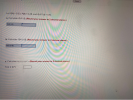 Saved Let PA) = 0.53, 6) = 0.28, and PAN 8 -0.15. a. Calculate PAIB). (Round your answer to 2 decimal places.) P(AIB) b. Calculate PAU). (Round your answer to 2 decimal places.) PIAUB) c. Calculate PIA U2) (Round your answer to 2 decimal places.) PUCA U B)9
Find P(ANE) directly from the table. D E Totals A 0.13 0.37 0.50 B 0.04 0.26...
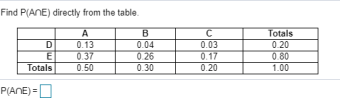 Find P(ANE) directly from the table. D E Totals A 0.13 0.37 0.50 B 0.04 0.26 0.30 с 0.03 0.17 0.20 Totals 0.20 0.80 1.00 P(ANE)=
P(A|비 Suppose that = 0. / P(지 = 0.42 , and P(6) = 0.26 . Determine...
 P(A|비 Suppose that = 0. / P(지 = 0.42 , and P(6) = 0.26 . Determine P(이시 . Round your answer to three decimal places (e.g. 98.765). ,
Given the following information, answer questions 1 - 4. P(A)=0.51P(A)=0.51 P(B)=0.55P(B)=0.55 A and B are independent....
Given the following information, answer questions 1 - 4. P(A)=0.51P(A)=0.51 P(B)=0.55P(B)=0.55 A and B are independent. Round all answers to 5 decimal places as needed 1) Find P(A∩B)P(A∩B). 3) Find P(A∣B)P(A∣B). Given the following information, answer questions 5 - 7. P(A)=0.51P(A)=0.51 P(B)=0.55P(B)=0.55 A and B are dependent. P(A∣B)=0.61P(A∣B)=0.61 Round all answers to 5 decimal places as needed 5) Find P(A∩B)P(A∩B). PART 2 In a survey funded by the University of Arizona Psychology Department, 750 of 1000 adult Arizona residents said...
Let RA)-065, AB) : 0.30, and RA I :0.45. a. Calculate PAn B). (Round your answer...
 Let RA)-065, AB) : 0.30, and RA I :0.45. a. Calculate PAn B). (Round your answer to 3 decimal places.) P(AnB) b. Calculate PIAU B). (Round your answer to 3 decimal places.) P(AU B) c. Calculate P(BI A). (Round your answer to 3 decimal places.) P(B | A)
 Exercise 4-17 Algo Let P(A) = 0.45, P(B) = 0.20, and P(A n B) = 0.09 a. Calculate P(A | B). (Round your answer to 2 decimal places.) P(A | B) b. Calculate P(A U B). (Round your answer to 2 decimal places.) P(A U B) C. Calculate P((A U B)). (Round your answer to 2 decimal places.) P((A U B)c)
 Saved Let PA) = 0.53, 6) = 0.28, and PAN 8 -0.15. a. Calculate PAIB). (Round your answer to 2 decimal places.) P(AIB) b. Calculate PAU). (Round your answer to 2 decimal places.) PIAUB) c. Calculate PIA U2) (Round your answer to 2 decimal places.) PUCA U B)9
 Find P(ANE) directly from the table. D E Totals A 0.13 0.37 0.50 B 0.04 0.26 0.30 с 0.03 0.17 0.20 Totals 0.20 0.80 1.00 P(ANE)=
 P(A|비 Suppose that = 0. / P(지 = 0.42 , and P(6) = 0.26 . Determine P(이시 . Round your answer to three decimal places (e.g. 98.765). ,
 Let RA)-065, AB) : 0.30, and RA I :0.45. a. Calculate PAn B). (Round your answer to 3 decimal places.) P(AnB) b. Calculate PIAU B). (Round your answer to 3 decimal places.) P(AU B) c. Calculate P(BI A). (Round your answer to 3 decimal places.) P(B | A)
Most questions answered within 3 hours.
-
Where is the error in this code sequence?
String s1 = "Hello";
String s2 = "ello";...
asked 11 months ago -
Financial data for Joel de Paris, Inc., for last year
follow:
Joel de Paris, Inc.
Balance...
asked 11 months ago -
Consider this reaction:
Al2(SO4)3 (aq)+ BaCl3
(aq) Al2Cl6 (aq)- +
3BaSO4(s) . What is the...
asked 11 months ago -
Suppose that Savneet is considering increasing her
recent random sample from 20 car rentals to 40...
asked 11 months ago -
Trucks arrive at an unloading terminal at an average rate of 120
per hour.
Trucks arrive...
asked 11 months ago -
Why are methanol and ethanol completely soluble in water while
octanol is not very little soluble....
asked 11 months ago -
A facilities manager at a university reads in a research report
that the mean amount of...
asked 11 months ago -
When the CuSO4 is rehydrated by adding water to the anhydrous
compound, is this an endothermic...
asked 11 months ago -
A ray of sunlight is passing from diamond into crown glass; the
angle of incidence is...
asked 11 months ago -
A block of mass 0.249 kg is placed on top of a light, vertical
spring of...
asked 11 months ago -
how do the kidneys compensate in the presences of acidosis
a) trigger hyperventilate
b) reserve acid...
asked 11 months ago -
Question 501 pts
The rental rate of capital to the firm increases. Which of the
following...
asked 11 months ago