Discuss the unique marketing characteristics a product or service requires based on the specific phase of...
Discuss the unique marketing characteristics a product or service requires based on the specific phase of the product life cycle
in 350 words
Homework Answers
All products and services have a certain life span which is measured by the chronological history of sales from the launch of the product until its withdrawal from the market. For the development of effective marketing strategies, an understanding of the different characteristics of the product life cycle stages is absolutely crucial. Based on this understanding, marketing implications can be derived. In the following, each PLC stage is explained in detail. After investigating the characteristics of the product life cycle stages, the marketing activities that accompany each stage are explicated.
The 4 Product Life Cycle Stages (PLC)
After the launch of a product, there will be times when sales grow, times when they will be relatively static and other times when they will decline. This does in particular apply when the product is superseded by a new product which satisfies customer needs better. Consider for instance consumer preference for CDs over vinyl records, or the disappearance of launderettes in town centres as a result of the introduction of affordable washing machines. The characteristics of the product life cycle stages help us to explain the development of sales that can be observed over the lifetime of a product. In addition, the model aids in determining the required marketing activities and the level of support that is needed to secure the future success of the product.
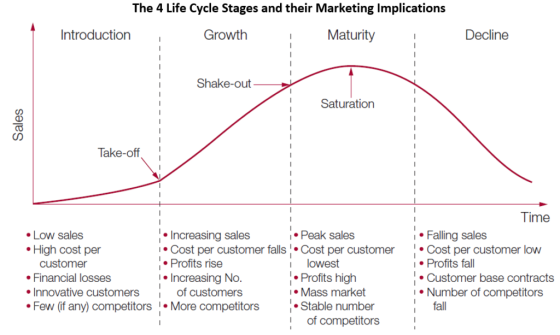
There are four main stages in the product life cycle, as you can see in the figure below. The characteristics of the product life cycle stages are discussed in greater detail along with their implications on the appropriate marketing strategy.
Characteristics of the Product Life Cycle Stages and Marketing Implications
The PLC describes the four key stages that a product is likely to experience between its launch and its disappearance from the market. The characteristics of the product life cycle stages are discussed below.
Introduction Stage
When a product is launched on the market, its sales will begin to grow slowly and profit, if any, will be rather small. This can be attributed to the lead time which is required for marketing efforts to take effect. At this stage, the product is new and untested, which implicates that potential customers may be unwilling or reluctant to purchase it. A second reason for rather low profitability at the introduction stage is that the company is unlikely to be making full use of its production capacity. As a result, it will be unable to benefit from the economies of scale that are associated with higher levels of production. The low profitability does also come from the need to recover development and launch costs. The main priority of the firm at the introduction stage is to generate widespread awareness of the product in its target segment and to stimulate trial. This is especially the case for new-to-the-world products, which are truly innovative by nature. In this case, primary demand will first have to be established. The company should focus its marketing activities on those buyers who are readiest to buy: innovators, which are usually to be found within the higher-income groups. This behaviour was evident for instance when the manufacturers of the first smartphones targeted B2B customers when the products were first introduced to the market.
There are various marketing strategies that can be used for introducing a new product to the market. Two pricing strategies are available. The choice between the two strategies depends on the nature of the product and the level of competition:
- Price skimming involves charging a high initial price, before reducing the price gradually to “skim” each potential target group in the market as the market grows.
- Price penetration involves setting a low price to enter the market quickly and capturing market share, before adjusting the price to increase profits once the market has grown.
Actually, a significant share of new products fails to progress beyond the introduction stage of the PLC. This is often caused by a lack of understanding of the characteristics of the product life cycle stages and their implication on the required marketing strategies. At the introduction stage, this failure is worst: Customers who are dissatisfied with their first purchase of a product or a brand will be unlikely to make repeat purchases and recommendations, which are in turn essential for sales increases. Therefore, it is absolutely crucial to ensure that the products provide valuable benefits to the customer and superior customer value if survival and growth are to follow. The most important point is to get it right the first time.
Growth Stage
If the product meets existing market needs or stimulates previously untapped needs, it will enter the growth stage. In this stage, sales will usually lift off. This point is called the take-off point. Profits are generated as sales revenues increase faster than costs. But competitors will also have had time to assess the product, predict its impact on the market and potentially respond with a similar or improved version of the offering. As a result, the total size of the market tends to grow, and the new competitors can increase their sales by attracting new customers rather than undercutting each other on price. An increase in the number of distribution outlets tends to go in hand with this.
Maturity Stage
When a the sales growth of the product slows down, the maturity stage is reached. During this stage, there is a tendency for companies to capture customers from their competitors by undercutting each other on prices and increasing promotional efforts. As competitive rivalry intensifies, the weaker competitors are forced out of the market. This point is known as the shake-out point. Thus, only the strongest players remain to dominate the more stable market. The maturity stage does usually last longer than the previous stages, but also poses the strongest challenges to the marketing: the firm will try to prevent the sales to decline, while maintaining profitability. The problem at this stage is heavy price competition and resulting increased marketing expenditure from all competitors in order to retain brand loyalty.
Certainly, there are some famous brands and products that are still in the maturity stage after thirty years and more. For instance, consider Mars’ bars or Coca-Cola. Although these products have changes only very little since their launch, they are still highly successful or even more successful than ever. Other products survive by evolving to meet changing consumer needs.
During the maturity stage, the firm can choose from a number of alternative strategies to ensure the future success of the product. These strategies range from innovating the market (market development) over modifying the product (product development) to altering the marketing mix (marketing innovation).
Decline Stage
If the characteristics of the product life cycle stages and their marketing implications are understood properly, the product may have made it to the final stage in the PLC: the decline stage. Usually, the firm will have tried to keep the product as long as possible in the maturity stage. However, once the sales of a product start to fall or profitability can no further be maintained, the decline stage is reached. This does often happen as a result of the market entry of substitute products which satisfy customer needs better than the previous product.
There are several alternative strategies available for handling the decline stage appropriately.
- Milking or Harvesting: When this strategy is used, the product receives only little or no marketing support. The firm aims to maximize the life of the product while generating the cash and the time required to establish new products. In addition, the slow decline of the product provides the firm with sufficient time to adjust to the declining cash flow and to find alternative means of generating income.
- Phased Withdrawal: Unlike under the milking approach, where the product could in theory continue indefinitely, phased withdrawal involves setting a hard cut-off date for the product. Before the cut-off date, there may be interim stages at which the product is either pulled form certain channels of distribution or certain geographic areas. Phased withdrawal provides the advantage of enabling the firm to plan the introduction of replacement products. However, it can be a source of dissatisfaction to customers, who may not like the sudden disappearance of their favoured product. A typical example of the phased withdrawal strategy can be found in the automotive industry: car manufacturers normally set hard cut-off dates to existing products, so that both dealers and the public are notified of product withdrawals and new product launches.
- Contracting out or Selling: Loyal users of a product can be retained when the brand or the rights to produce and sell the product are handed on to a niche operator or by subcontracting. Many smaller firms use this strategy since they are flexible enough to offer the product’s market a satisfactory return. Each party involved in this strategy benefits from the deal: the originating firm can dispose profitably of a product it no longer wants, consumers can keep buying products they desire, and the subcontractor or buyer can gain the benefits of a brand they could never have established on their own.
The table below provides a summary of the characteristics of the product life cycle stages and the appropriate marketing responses for each stage.
| Product Life Cycle Stage | ||||
| Introduction | Growth | Maturity | Decline | |
| Marketing emphasis | Create product awareness
Encourage product trial |
Establish high market share | Fight off competition
Generate profits |
Minimize marketing expenditure |
| Product strategy | Introduce basic products | Improve features of basic products | Design product versions for different segments | Rationalize the product range |
| Pricing strategy | Price skimming or price penetration | Reduce prices enough to expand the market and establish market share | Match or beat the competition | Reduce prices further |
| Promotional strategy | Advertising and sales promotion to end-users and dealers | Mass media advertising establish brand image | Emphasize brand strengths to different segments | Minimal level to retain loyal customers |
| Distribution strategy | Build selective distribution outlets | Increase the number of outlets | Maintain intensive distribution | Rationalize outlets to minimize distribution costs |
Add Answer to:
Discuss the unique marketing characteristics a product or
service requires based on the specific phase of...
Discuss a product you are familiar with. Based on your knowledge of the product life cycle,...
Discuss a product you are familiar with. Based on your knowledge of the product life cycle, what types of changes will occur to your selected product as it continues through the product life cycle? How will this affect the marketing of your selected product? (Iphone)
Marketing plans describe the current situation for the product, service, or brand, and the plan for...
Marketing plans describe the current situation for the product, service, or brand, and the plan for the future. What are the objectives of the marketing plan? In other words, why is one needed? What are the possible outcomes if marketers do not have a marketing plan? Provide specific examples to support your ideas. In replies to peers, discuss whether you agree or disagree with their position and justify your reply with specific reasons, facts, and examples.
Discuss how the marketing mix will vary in relationship to the offering of a service and...
Discuss how the marketing mix will vary in relationship to the offering of a service and of a product. (400 words minimum)
Choose a product/service (not the same one you are using for the final project (marketing plan)....
Choose a product/service (not the same one you are using for the final project (marketing plan). Answer the following questions: Considering direct, online, social media and mobile marketing options, which 2 options do you feel would be the best to use in relation to the product/service you have chosen? Why? Describe the options you justified above and outline specific methods you would adopt in using those 2 options. Discuss specific uses, platforms, and messages you would ensure are marketed through...
Respond to the following in a minimum of 175 words: Select a product you are familiar with. Based on your knowledge of t...
Respond to the following in a minimum of 175 words: Select a product you are familiar with. Based on your knowledge of the product life cycle, what types of changes will occur to your selected product as it continues through the product life cycle? How will this affect the marketing of your selected product?
Describe the stages of a product/service’s life cycle. How is an analysis of a product/service life...
Describe the stages of a product/service’s life cycle. How is an analysis of a product/service life cycle useful when thinking about the strategic alternatives of a health care organization? Give some specific examples of health care products/services and their specific points in the product/service life cycles.
discuss how the marketing mix changes in one of the product life cycle stages (introduction, maturity,...
discuss how the marketing mix changes in one of the product life cycle stages (introduction, maturity, decline) how does a marketer change the way he or she manages product, price, place, and promotion in the introduction stage? in the growth stage? etc..
1. Discuss some differences between a service business and a merchandising business. Provide unique examples of...
1. Discuss some differences between a service business and a merchandising business. Provide unique examples of each in your discussion. Are there some businesses that incorporate both approaches and have products and services? If so, provide examples of these also. 2. Define Cost of Merchandise Sold in the context of an example of a business. In other words, define it by illustrating it as it pertains to a business you have chosen. As always, make your choice unique from your...
Marketing a service poses new challenges to the marketer. You have a product that you can't...
Marketing a service poses new challenges to the marketer. You have a product that you can't see or touch so the customer can't be sure of what they are getting. For this assignment you will be marketing an online class. This should be something you are all familiar with! First – Choose the type of class you will be marketing. It does not have to be necessarily have to be an academic course in a degree program, you may choose...
Marketing a service poses new challenges to the marketer. You have a product that you can't...
Marketing a service poses new challenges to the marketer. You have a product that you can't see or touch so the customer can't be sure of what they are getting. For this assignment you will be marketing an online class. This should be something you are all familiar with! First – Choose the type of class you will be marketing. It does not have to be necessarily have to be an academic course in a degree program, you may choose...
Most questions answered within 3 hours.
-
Where is the error in this code sequence?
String s1 = "Hello";
String s2 = "ello";...
asked 11 months ago -
Financial data for Joel de Paris, Inc., for last year
follow:
Joel de Paris, Inc.
Balance...
asked 11 months ago -
Consider this reaction:
Al2(SO4)3 (aq)+ BaCl3
(aq) Al2Cl6 (aq)- +
3BaSO4(s) . What is the...
asked 11 months ago -
Suppose that Savneet is considering increasing her
recent random sample from 20 car rentals to 40...
asked 11 months ago -
Trucks arrive at an unloading terminal at an average rate of 120
per hour.
Trucks arrive...
asked 11 months ago -
Why are methanol and ethanol completely soluble in water while
octanol is not very little soluble....
asked 11 months ago -
A facilities manager at a university reads in a research report
that the mean amount of...
asked 11 months ago -
When the CuSO4 is rehydrated by adding water to the anhydrous
compound, is this an endothermic...
asked 11 months ago -
A ray of sunlight is passing from diamond into crown glass; the
angle of incidence is...
asked 11 months ago -
A block of mass 0.249 kg is placed on top of a light, vertical
spring of...
asked 11 months ago -
how do the kidneys compensate in the presences of acidosis
a) trigger hyperventilate
b) reserve acid...
asked 11 months ago -
Question 501 pts
The rental rate of capital to the firm increases. Which of the
following...
asked 11 months ago