Do aldehydes, ketones, amines, alcohols, or carboxylic acids have higher BP when they are of similar...
Do aldehydes, ketones, amines, alcohols, or carboxylic acids have higher BP when they are of similar molecular weights? Arrange from lowest BP to highest BP and explain your reasoning.
Homework Answers
The boiling points of aldehydes, ketones, amines, alcohols and carboxylic acids are much higher than the boiling points of alkanes of comparable molecular masses. The boiling points of these compounds vary in the order
Acid > Alcohol > Amine > Aldehyde > Ketone > Alkane.
The above order of boiling points can be easily explained on the basis of the intermolecular forces present in the molecules. The stronger are the intermolecular forces present in an organic compound, the stronger are the bonds in the molecule and thus, the higher is the boiling point.
The major intermolecular forces present in organic molecules are dispersion forces, dipole-dipole forces and hydrogen bonding forces. The strength of these forces vary in the order
hydrogen bonding > dipole-dipole forces > dispersion forces.
The major intermolecular forces in alkanes are dispersion forces. Dispersion forces depend on the molecular mass of the compound and hence, increases with increasing molecular weights.
The major forces present in aldehydes and ketones are dipole-dipole forces. Aldehydes can show some hydrogen bonding forces due to the presence of a hydrogen atom attached to a highly electron-withdrawing C=O group.
The major forces in alcohols and amines are hydrogen bonding forces. Since O atom is more electronegative than N atom, hence, the hydrogen bonding in alcohol is stronger than in amines.
Carboxylic acids show the strongest intermolecular forces and the intermolecular forces present in acids are a combination of both dipole-dipole forces and hydrogen bonding forces and thus, carboxylic acids have the highest boiling points.
Add Answer to:
Do aldehydes, ketones, amines, alcohols, or carboxylic acids
have higher BP when they are of similar...
Name Structure Examples Alcohols Ethers Aldehydes Ketones Carboxylic Acids Ester
Name Structure Examples Alcohols Ethers Aldehydes Ketones Carboxylic Acids Ester
Complete the following table: Name Structure Examples Alcohols Ethers Aldehydes Ketones Carboxylic Acids Ester
Complete the following table: Name Structure Examples Alcohols Ethers Aldehydes Ketones Carboxylic Acids Ester
Why do esters, carboxylic acids and amides undergo acyl substitution but aldehydes and ketones cannot?
Why do esters, carboxylic acids and amides undergo acyl substitution but aldehydes and ketones cannot?
Why do alcohols and carboxylic acids have a higher boiling points than hydrocarbons and halocarbons?
Why do alcohols and carboxylic acids have a higher boiling points than hydrocarbons and halocarbons?
Question 5 Aldehydes react with CrO 3/H 30 O A. ketones. to form B. carboxylic acids. C. alcohols D. alkanes...
 Question 5 Aldehydes react with CrO 3/H 30 O A. ketones. to form B. carboxylic acids. C. alcohols D. alkanes. Moving to another question will save this response A Moving to another question will save this response. Question 4 The Williamson ether synthesis requires that the alkyl halide must be either a OA methyl or primary alkyl halide. OB. secondary or tertiary alkyl halide. OC methyl or tertiary alkyl halide. O D. primary or a secondary alkyl halide. A Moving...
True and False questions!! 1. True and False Question (1) Carbonyl compounds have higher boiling points...
 True and False questions!!
1. True and False Question (1) Carbonyl compounds have higher boiling points than hydrocarbons, but lower boiling points than corresponding alcohols. (2) Aldehydes and ketones react with primary amines to form imines and with secondary amines to form enamines. (3) Aldehydes and ketones can be oxidized to carboxylic acids. (4) Diols can form acetal with the ketone or aldehyde to protect them for selective reduction of the ester (5) The electron-withdrawing group in Wittig reagent does...
True and False questions!!
1. True and False Question (1) Carbonyl compounds have higher boiling points than hydrocarbons, but lower boiling points than corresponding alcohols. (2) Aldehydes and ketones react with primary amines to form imines and with secondary amines to form enamines. (3) Aldehydes and ketones can be oxidized to carboxylic acids. (4) Diols can form acetal with the ketone or aldehyde to protect them for selective reduction of the ester (5) The electron-withdrawing group in Wittig reagent does...
Explain why aldehydes and ketones have a higher boiling point than the corresponding hydrocarbons.
Explain why aldehydes and ketones have a higher boiling point than the corresponding hydrocarbons.
1. True and False Question (0.5 point per question) a) Carbonyl compounds have higher boiling points...
1. True and False Question (0.5 point per question) a) Carbonyl compounds have higher boiling points than hydrocarbons, but lower boiling points than corresponding alcohols. b) Aldehydes and ketones react with primary amines to form imines and with secondary amines to form enamines. c) Aldehydes and ketones can be oxidized to carboxylic acids. d) Diols can form acetal with the ketone or aldehyde to protect them for selective reduction of the ester. e) The electron-withdrawing group in Wittig reagent does...
21-Ketones are easily reduced to secondary alcohols. b- Primary CH, CCH, a-Secondary alcohol alcohol C- to...
 21-Ketones are easily reduced to secondary alcohols. b- Primary CH, CCH, a-Secondary alcohol alcohol C- to acetaldehyde acid d-to carboxylic 22-Ozonolysis of alkenes yields aa-ketones if one of the unsaturated carbon atoms is disubstituted b-alcohol C-carboxylic acid d-alkane 23-Aldehyde C=0 is more polarized than ketone C-0 because a-As in carbocations, more alkyl groups stabilize + character b-Ketone has more alkyl groups, stabilizing the C=0 carbon inductively cc- due to a and b d- none of the above 24-Aldehydes and unhindered...
1-7 please The functional group structures for aldehydes, esters, ethers, carboxylic acids and ketones are respectively:...
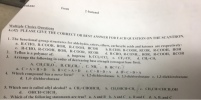 1-7 please
The functional group structures for aldehydes, esters, ethers, carboxylic acids and ketones are respectively: R-CHO, R-COOH R, ROR, R-COOH, RCOR R-CHO, R-COOR, RCOR, R-COOH, ROR R-CHO, R-COOH, ROR, R-COOR, RCOR R-CHO, R-CONH_, ROR, R-COOH, RCOR Teflon is a polymer of: isoprene CCI_2 = CCI_2 CF_2 = CF_2 CH_2 = CH_2 Arrange the following in order of decreasing base strength (strongest base first). CH_3CH_3O, CH_3CH_2:, NH_2, HC identical C: C > A > B > D B > C...
1-7 please
The functional group structures for aldehydes, esters, ethers, carboxylic acids and ketones are respectively: R-CHO, R-COOH R, ROR, R-COOH, RCOR R-CHO, R-COOR, RCOR, R-COOH, ROR R-CHO, R-COOH, ROR, R-COOR, RCOR R-CHO, R-CONH_, ROR, R-COOH, RCOR Teflon is a polymer of: isoprene CCI_2 = CCI_2 CF_2 = CF_2 CH_2 = CH_2 Arrange the following in order of decreasing base strength (strongest base first). CH_3CH_3O, CH_3CH_2:, NH_2, HC identical C: C > A > B > D B > C...
 Question 5 Aldehydes react with CrO 3/H 30 O A. ketones. to form B. carboxylic acids. C. alcohols D. alkanes. Moving to another question will save this response A Moving to another question will save this response. Question 4 The Williamson ether synthesis requires that the alkyl halide must be either a OA methyl or primary alkyl halide. OB. secondary or tertiary alkyl halide. OC methyl or tertiary alkyl halide. O D. primary or a secondary alkyl halide. A Moving...
 True and False questions!!
1. True and False Question (1) Carbonyl compounds have higher boiling points than hydrocarbons, but lower boiling points than corresponding alcohols. (2) Aldehydes and ketones react with primary amines to form imines and with secondary amines to form enamines. (3) Aldehydes and ketones can be oxidized to carboxylic acids. (4) Diols can form acetal with the ketone or aldehyde to protect them for selective reduction of the ester (5) The electron-withdrawing group in Wittig reagent does...
True and False questions!!
1. True and False Question (1) Carbonyl compounds have higher boiling points than hydrocarbons, but lower boiling points than corresponding alcohols. (2) Aldehydes and ketones react with primary amines to form imines and with secondary amines to form enamines. (3) Aldehydes and ketones can be oxidized to carboxylic acids. (4) Diols can form acetal with the ketone or aldehyde to protect them for selective reduction of the ester (5) The electron-withdrawing group in Wittig reagent does...
 21-Ketones are easily reduced to secondary alcohols. b- Primary CH, CCH, a-Secondary alcohol alcohol C- to acetaldehyde acid d-to carboxylic 22-Ozonolysis of alkenes yields aa-ketones if one of the unsaturated carbon atoms is disubstituted b-alcohol C-carboxylic acid d-alkane 23-Aldehyde C=0 is more polarized than ketone C-0 because a-As in carbocations, more alkyl groups stabilize + character b-Ketone has more alkyl groups, stabilizing the C=0 carbon inductively cc- due to a and b d- none of the above 24-Aldehydes and unhindered...
 1-7 please
The functional group structures for aldehydes, esters, ethers, carboxylic acids and ketones are respectively: R-CHO, R-COOH R, ROR, R-COOH, RCOR R-CHO, R-COOR, RCOR, R-COOH, ROR R-CHO, R-COOH, ROR, R-COOR, RCOR R-CHO, R-CONH_, ROR, R-COOH, RCOR Teflon is a polymer of: isoprene CCI_2 = CCI_2 CF_2 = CF_2 CH_2 = CH_2 Arrange the following in order of decreasing base strength (strongest base first). CH_3CH_3O, CH_3CH_2:, NH_2, HC identical C: C > A > B > D B > C...
1-7 please
The functional group structures for aldehydes, esters, ethers, carboxylic acids and ketones are respectively: R-CHO, R-COOH R, ROR, R-COOH, RCOR R-CHO, R-COOR, RCOR, R-COOH, ROR R-CHO, R-COOH, ROR, R-COOR, RCOR R-CHO, R-CONH_, ROR, R-COOH, RCOR Teflon is a polymer of: isoprene CCI_2 = CCI_2 CF_2 = CF_2 CH_2 = CH_2 Arrange the following in order of decreasing base strength (strongest base first). CH_3CH_3O, CH_3CH_2:, NH_2, HC identical C: C > A > B > D B > C...
Most questions answered within 3 hours.
-
Where is the error in this code sequence?
String s1 = "Hello";
String s2 = "ello";...
asked 10 months ago -
Financial data for Joel de Paris, Inc., for last year
follow:
Joel de Paris, Inc.
Balance...
asked 10 months ago -
Consider this reaction:
Al2(SO4)3 (aq)+ BaCl3
(aq) Al2Cl6 (aq)- +
3BaSO4(s) . What is the...
asked 10 months ago -
Suppose that Savneet is considering increasing her
recent random sample from 20 car rentals to 40...
asked 10 months ago -
Trucks arrive at an unloading terminal at an average rate of 120
per hour.
Trucks arrive...
asked 10 months ago -
Why are methanol and ethanol completely soluble in water while
octanol is not very little soluble....
asked 10 months ago -
A facilities manager at a university reads in a research report
that the mean amount of...
asked 10 months ago -
When the CuSO4 is rehydrated by adding water to the anhydrous
compound, is this an endothermic...
asked 10 months ago -
A ray of sunlight is passing from diamond into crown glass; the
angle of incidence is...
asked 10 months ago -
A block of mass 0.249 kg is placed on top of a light, vertical
spring of...
asked 10 months ago -
how do the kidneys compensate in the presences of acidosis
a) trigger hyperventilate
b) reserve acid...
asked 10 months ago -
Question 501 pts
The rental rate of capital to the firm increases. Which of the
following...
asked 10 months ago