. An electric charge + 3Q is distributed uniformly throughout a non conducting sphere of radius...
. An electric charge + 3Q is distributed uniformly throughout a non conducting sphere of radius R.
(a) Using integral form of Gauss’s law show that the electric field at a point r is given by;
(i) ? = 3?/4????2 for ? > ?
(ii) ? = 3?/4????2 for ? = ?
(ii) ? = 3?/4????3 ? for ? < ?
(b) Sketch a profile of the electric field against r from r = 0 from the axis of the cylinder to a point far away from the axis of the cylinder.
(c) How would your solution to part (b) above change if the sphere was conducting with a uniform area charge distribution of σ C/m2 ?
please answer only b and c part.
Homework Answers
Dear student,
Find this solution.if any issue with that don't forget to write in comment section.I will rectify them as soon as possible.
If you find the solution helpful and kindly RATE THE ANSWER it would be appreciated.
Your rating is important to me.
Thanks for asking..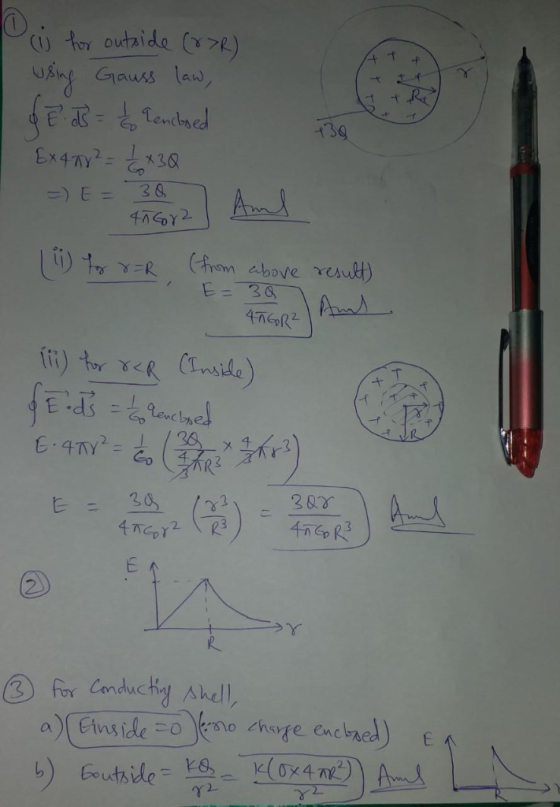
Add Answer to:
. An electric charge + 3Q is distributed uniformly throughout a
non conducting sphere of radius...
An electric charge Q is distributed uniformly throughout a non-conducting sphere of radius r0
 An electric charge Q is distributed uniformly throughout a non-conducting sphere of radius r0, See Fig. below. Using the Gauss's law, determine the electric field: a) Outside of sphere (r0>r). b) Inside the sphere (r0<r).
(A) A non conducting solid sphere of radius 2.30 cm carries a uniformly distributed positive charge...
(A) A non conducting solid sphere of radius 2.30 cm carries a uniformly distributed positive charge of 6.8*10^-9 C. Calculate the magnitude of the electric field at a point 1.40 cm away from the center of the sphere. (B) Calculate the magnitude of the electric field at a point 3.8 cm away from the center of the sphere. (C) Assume that the sphere is conducting. Calculate the magnitude of the electric field at a point 1.4 cm away from the...
A uniformly charged non-conducting sphere of radius a is placed at the center of a spherical...
A uniformly charged non-conducting sphere of radius a is placed at the center of a spherical conducting shell of inner radius b and outer radius c. A charge +Q is distributed uniformly throughout the inner sphere. The outer shell has charge -Q. Using Gauss' Law: a) Determine the electric field in the region r< a b) Determine the electric field in the region a < r < b c) Determine the electric field in the region r > c d)...
1a) An insulating sphere of radius 2.0 m contains +50 μC of electric charge uniformly distributed...
1a) An insulating sphere of radius 2.0 m contains +50 μC of electric charge uniformly distributed throughout the volume of the sphere. i) What is the electric field 1.5 m away from the center of the sphere? ii) What is the volume charge density? iii) What is the electric field 3.0 m away from the center of the sphere? 1b) A potential difference of 6.00 nV is set up across a 5.00 cm length of copper wire that has a...
A solid non-conductive sphere of radius R has a total charge Q which is distributed uniformly...
A solid non-conductive sphere of radius R has a total charge Q which is distributed uniformly throughout the sphere. a) What is the electric field a distance r from the center of the sphere if r<R? b) What is the electric field a distance r from the center of the sphere if r>R? c) Test your solutions for part a) and b) by checking for agreement when r=R.
A nonconducting solid sphere of radius 2.10 cm carries a uniformly distributed positive charge of 8.50...
 A nonconducting solid sphere of radius 2.10 cm carries a uniformly distributed positive charge of 8.50 times 10^-9 C. Calculate the magnitude of the electric field at a point 1.90 cm away from the center of the sphere. Incompatible units. No conversion found between "N/M" and the required units. Calculate the magnitude of the electric field at a point 3.60 cm away from the center of the sphere. Assume that the sphere is conducting. Calculate the magnitude of the electric...
An insulating sphere of radius 2 contains 50 of electric charge uniformly distributed throughout volume of the sphere. Calculate the electric field 1.5 away from the center of the sphere.
An insulating sphere of radius 2 contains 50 of electric charge uniformly distributed throughout volume of the sphere. Calculate the electric field 1.5 away from the center of the sphere.Please Explain each step in the solution
(a) A conducting sphere of radius R has total charge Q, which is distributed uniformly on its surface.
1) (a) A conducting sphere of radius R has total charge Q, which is distributed uniformly on its surface. Using Gauss's law, find the electric field at a point outside the sphere at a distance r from its center, i.e. with r > R, and also at a point inside the sphere, i.e. with r < R. (b) A charged rod with length L lies along the z-axis from x= 0 to x = L and has linear charge density λ(x)...
Charge Q is distributed uniformly throughout the volume of an insulating sphere of radius R =...
Charge Q is distributed uniformly throughout the volume of an insulating sphere of radius R = 4.00 cm. At a distance of r = 8.00 cm from the center of the sphere, the electric field due to the charge distribution has magnitude 640 N/C . a. What is the volume charge density for the sphere? Express your answer to two significant figures and include the appropriate units. b. What is the magnitude of the electric field at a distance...
A solid insulating sphere of radius a carries a net positive charge +2Q, uniformity distributed throughout...
A solid insulating sphere of radius a carries a net positive charge +2Q, uniformity distributed throughout its volume. Concentric with this sphere is a conducting spherical shell with inner radius b and outer radius c, having a net charge of -3Q. Let the variable r represent the radial variable defined from the center of the sphere to an arbitrary point of interest defined by the following questions. A) Derive an expression for the electric field only in terms of the...
 A nonconducting solid sphere of radius 2.10 cm carries a uniformly distributed positive charge of 8.50 times 10^-9 C. Calculate the magnitude of the electric field at a point 1.90 cm away from the center of the sphere. Incompatible units. No conversion found between "N/M" and the required units. Calculate the magnitude of the electric field at a point 3.60 cm away from the center of the sphere. Assume that the sphere is conducting. Calculate the magnitude of the electric...
Most questions answered within 3 hours.
-
Where is the error in this code sequence?
String s1 = "Hello";
String s2 = "ello";...
asked 10 months ago -
Financial data for Joel de Paris, Inc., for last year
follow:
Joel de Paris, Inc.
Balance...
asked 10 months ago -
Consider this reaction:
Al2(SO4)3 (aq)+ BaCl3
(aq) Al2Cl6 (aq)- +
3BaSO4(s) . What is the...
asked 10 months ago -
Suppose that Savneet is considering increasing her
recent random sample from 20 car rentals to 40...
asked 10 months ago -
Trucks arrive at an unloading terminal at an average rate of 120
per hour.
Trucks arrive...
asked 10 months ago -
Why are methanol and ethanol completely soluble in water while
octanol is not very little soluble....
asked 10 months ago -
A facilities manager at a university reads in a research report
that the mean amount of...
asked 10 months ago -
When the CuSO4 is rehydrated by adding water to the anhydrous
compound, is this an endothermic...
asked 10 months ago -
A ray of sunlight is passing from diamond into crown glass; the
angle of incidence is...
asked 10 months ago -
A block of mass 0.249 kg is placed on top of a light, vertical
spring of...
asked 10 months ago -
how do the kidneys compensate in the presences of acidosis
a) trigger hyperventilate
b) reserve acid...
asked 10 months ago -
Question 501 pts
The rental rate of capital to the firm increases. Which of the
following...
asked 10 months ago