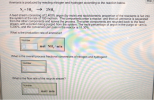
The feed to an ammonia synthesis reactor contains 35.0 mole% nitrogen (N2) and the balance hydrogen...
The feed to an ammonia synthesis reactor contains 35.0 mole% nitrogen (N2) and the balance hydrogen (H2). The flow rate of the stream is 2400.0 kg/h. Calculate the rate of the flow of nitrogen into the reactor in kg/h.
Homework Answers

Add Answer to:
The feed to an ammonia synthesis reactor contains 35.0 mole%
nitrogen (N2) and the balance hydrogen...
Problem 2.1 The feed to an ammonia synthesis reactor contains 25 mole% nitrogen and the balance...
 Problem 2.1 The feed to an ammonia synthesis reactor contains 25 mole% nitrogen and the balance hydrogen. The flow rate of the stream is 3000 kg/hr. Calculate the rate of flow of nitrogen into the reactor in kg/hr. (MW N2-28 g/mol and MW H2-2 g/mol) Problem 2.2 A 40-wt% aqueous sulfuric acid solution is prepared by mixing pure sulfuric acid (100-wt%; density, ρ = 1.84 g/mL; molar mass, Mw-98 g/mol) with pure water (ρ = 1 g/mL, MW = 18...
12 3. (35 pts) Ammonia (NHa) is synthesized from nitrogen and hydrogen. Fresh feed, which contains...
 12 3. (35 pts) Ammonia (NHa) is synthesized from nitrogen and hydrogen. Fresh feed, which contains only N2 and H2, is blended with a recycle stream containing the same species composition of the mixture entering the reactor contains 50% excess H2 The fractional conversion of N2 in the reactor operated at T = 400°C, P = 2000 psig isXu2-05. Allspecie exit ammonia as a pure liquid and recycles the volatile components the reactor in the gas phase and are directed...
7. A process takes hydrogen and nitrogen to make ammonia. It consists of a feed stream...
 7. A process takes hydrogen and nitrogen to make ammonia. It consists of a feed stream (Hz: 330 kmol/h and N2: 110 kmol/h), a mixer in which the feed stream is mixed with the recycle stream, and a reactor (25% conversion), followed by a separator where the product is removed and the reactants are recycled. The recycle stream takes 95% of the unreacted H2 and N, and 2% of the produced ammonia. Draw the BFD for the process and number...
Problem 4.80 Methanol Synthesis Methanol is synthesized from carbon monoxide and hydrogen in a catalytic reactor....
 Problem 4.80 Methanol Synthesis Methanol is synthesized from carbon monoxide and hydrogen in a catalytic reactor. The fresh feed to the process contains 32.0 mol% CO 64.0 mol% H2 and 4.00 mol% N2: This stream is mixed with a recycle stream in a ratio of 10.00 mol recycle / mol fresh feed to produce th feed to the reactor, which contains 12.0 mol% N2 The reactor effluent goes to a condenser from which two streams emerge: a liquid product stream...
Figure 1 represents the flow diagram of the production of ammonia from hydrogen and nitrogen (Haber...
 Figure 1 represents the flow diagram of the production of ammonia from hydrogen and nitrogen (Haber process), according to the following reaction at 400°C and atmospheric pressure: N2(g) + 3H2(g) + 2NH3(9) TN).6 TH).6 7 Yis 1,6 = 9.7 6 5TH = 0 kmol h-1 3 TH(a). T.1 ANN (9) TIN2(g) 4 = 1,623.4 = 0 kmol h-1 Figure 1. Flow diagram for question 1. The process is designed for a target production of 200 kmol h of pure ammonia....
Methanol is synthesized from carbon monoxide and hydrogen (H2) in a catalytic reactor. CO + 2H2...
Methanol is synthesized from carbon monoxide and hydrogen (H2) in a catalytic reactor. CO + 2H2 → CH3OH The fresh feed to the process contains 32.0% mol of CO, 64% of H2 and 4% N2. This stream is mixed with a recirculation stream at a ratio of 5 mol recirculation / 1 mol fresh feed to the process. The mixture of these streams forms the feed stream to the reactor, which contains 13.0 mol% of N2. Low conversion is achieved...
The synthesis of methanol from carbon monoxide and hydrogen is carried out in a continuous vapor-phase...
 The synthesis of methanol from carbon monoxide and hydrogen is carried out in a continuous vapor-phase reactor at 5.00 atm absolute. The feed contains CO and H2 in stoichiometric proportion and enters the reactor at 25.0°C and 5.00 atm at a rate of 31.1 m3/h. The product stream emerges from the reactor at 127°C. The rate of heat transfer from the reactor is 24.0 kW. Calculate the fractional conversion (0 to 1) of carbon monoxide achieved and the volumetric flow...
Solve the part of material balance using "Atomic Balance" 0.2 The synthesis of methanol from carbon...
 Solve the part of material balance using "Atomic
Balance"
0.2 The synthesis of methanol from carbon monoxide and hydrogen is carried out in a continuous vapor phase reactor at 5.00 atm absolute. The feed contains CO and H2 in stoichiometric proportion and enters the reactor at 25°C and 5.00 atm at a rate of 17.1 m3/h. The product stream emerges from the reactor at 127°C. The rate of heat transfer from the reactor is 17.05 kW. Using heat of formation...
Solve the part of material balance using "Atomic
Balance"
0.2 The synthesis of methanol from carbon monoxide and hydrogen is carried out in a continuous vapor phase reactor at 5.00 atm absolute. The feed contains CO and H2 in stoichiometric proportion and enters the reactor at 25°C and 5.00 atm at a rate of 17.1 m3/h. The product stream emerges from the reactor at 127°C. The rate of heat transfer from the reactor is 17.05 kW. Using heat of formation...
The synthesis of methanol from carbon monoxide and hydrogen is carried out in a continuous vapor-phase...
 The synthesis of methanol from carbon monoxide and hydrogen is carried out in a continuous vapor-phase reactor at 5.00 atm absolute. The feed contains CO and H2 in stoichiometric proportion and enters the reactor at 25.0°C and 5.00 atm at a rate of 26.1 m3/h. The product stream emerges from the reactor at 187°C. The rate of heat transfer from the reactor is 24.0 kW. Calculate the fractional conversion (0 to 1) of carbon monoxide achieved and the volumetric flow...
Please be clear with the answers and put the answers in boxes Map Ammonia is produced...
 Please be clear with the answers and put the answers in
boxes
Map Ammonia is produced by reacting nitrogen and hydrogen according to the reaction below A feed stream consisting of 2.400% argon (by mole) and stoichiometric proportion of the reactants is fed into the system at the rate of 100 mol/min. The components enter a reactor, and then all ammonia is separated from the other components and leaves the process. The other components are recycled back to the feed...
Please be clear with the answers and put the answers in
boxes
Map Ammonia is produced by reacting nitrogen and hydrogen according to the reaction below A feed stream consisting of 2.400% argon (by mole) and stoichiometric proportion of the reactants is fed into the system at the rate of 100 mol/min. The components enter a reactor, and then all ammonia is separated from the other components and leaves the process. The other components are recycled back to the feed...
 Problem 2.1 The feed to an ammonia synthesis reactor contains 25 mole% nitrogen and the balance hydrogen. The flow rate of the stream is 3000 kg/hr. Calculate the rate of flow of nitrogen into the reactor in kg/hr. (MW N2-28 g/mol and MW H2-2 g/mol) Problem 2.2 A 40-wt% aqueous sulfuric acid solution is prepared by mixing pure sulfuric acid (100-wt%; density, ρ = 1.84 g/mL; molar mass, Mw-98 g/mol) with pure water (ρ = 1 g/mL, MW = 18...
 12 3. (35 pts) Ammonia (NHa) is synthesized from nitrogen and hydrogen. Fresh feed, which contains only N2 and H2, is blended with a recycle stream containing the same species composition of the mixture entering the reactor contains 50% excess H2 The fractional conversion of N2 in the reactor operated at T = 400°C, P = 2000 psig isXu2-05. Allspecie exit ammonia as a pure liquid and recycles the volatile components the reactor in the gas phase and are directed...
 7. A process takes hydrogen and nitrogen to make ammonia. It consists of a feed stream (Hz: 330 kmol/h and N2: 110 kmol/h), a mixer in which the feed stream is mixed with the recycle stream, and a reactor (25% conversion), followed by a separator where the product is removed and the reactants are recycled. The recycle stream takes 95% of the unreacted H2 and N, and 2% of the produced ammonia. Draw the BFD for the process and number...
 Problem 4.80 Methanol Synthesis Methanol is synthesized from carbon monoxide and hydrogen in a catalytic reactor. The fresh feed to the process contains 32.0 mol% CO 64.0 mol% H2 and 4.00 mol% N2: This stream is mixed with a recycle stream in a ratio of 10.00 mol recycle / mol fresh feed to produce th feed to the reactor, which contains 12.0 mol% N2 The reactor effluent goes to a condenser from which two streams emerge: a liquid product stream...
 Figure 1 represents the flow diagram of the production of ammonia from hydrogen and nitrogen (Haber process), according to the following reaction at 400°C and atmospheric pressure: N2(g) + 3H2(g) + 2NH3(9) TN).6 TH).6 7 Yis 1,6 = 9.7 6 5TH = 0 kmol h-1 3 TH(a). T.1 ANN (9) TIN2(g) 4 = 1,623.4 = 0 kmol h-1 Figure 1. Flow diagram for question 1. The process is designed for a target production of 200 kmol h of pure ammonia....
 The synthesis of methanol from carbon monoxide and hydrogen is carried out in a continuous vapor-phase reactor at 5.00 atm absolute. The feed contains CO and H2 in stoichiometric proportion and enters the reactor at 25.0°C and 5.00 atm at a rate of 31.1 m3/h. The product stream emerges from the reactor at 127°C. The rate of heat transfer from the reactor is 24.0 kW. Calculate the fractional conversion (0 to 1) of carbon monoxide achieved and the volumetric flow...
 Solve the part of material balance using "Atomic
Balance"
0.2 The synthesis of methanol from carbon monoxide and hydrogen is carried out in a continuous vapor phase reactor at 5.00 atm absolute. The feed contains CO and H2 in stoichiometric proportion and enters the reactor at 25°C and 5.00 atm at a rate of 17.1 m3/h. The product stream emerges from the reactor at 127°C. The rate of heat transfer from the reactor is 17.05 kW. Using heat of formation...
Solve the part of material balance using "Atomic
Balance"
0.2 The synthesis of methanol from carbon monoxide and hydrogen is carried out in a continuous vapor phase reactor at 5.00 atm absolute. The feed contains CO and H2 in stoichiometric proportion and enters the reactor at 25°C and 5.00 atm at a rate of 17.1 m3/h. The product stream emerges from the reactor at 127°C. The rate of heat transfer from the reactor is 17.05 kW. Using heat of formation...
 The synthesis of methanol from carbon monoxide and hydrogen is carried out in a continuous vapor-phase reactor at 5.00 atm absolute. The feed contains CO and H2 in stoichiometric proportion and enters the reactor at 25.0°C and 5.00 atm at a rate of 26.1 m3/h. The product stream emerges from the reactor at 187°C. The rate of heat transfer from the reactor is 24.0 kW. Calculate the fractional conversion (0 to 1) of carbon monoxide achieved and the volumetric flow...
 Please be clear with the answers and put the answers in
boxes
Map Ammonia is produced by reacting nitrogen and hydrogen according to the reaction below A feed stream consisting of 2.400% argon (by mole) and stoichiometric proportion of the reactants is fed into the system at the rate of 100 mol/min. The components enter a reactor, and then all ammonia is separated from the other components and leaves the process. The other components are recycled back to the feed...
Please be clear with the answers and put the answers in
boxes
Map Ammonia is produced by reacting nitrogen and hydrogen according to the reaction below A feed stream consisting of 2.400% argon (by mole) and stoichiometric proportion of the reactants is fed into the system at the rate of 100 mol/min. The components enter a reactor, and then all ammonia is separated from the other components and leaves the process. The other components are recycled back to the feed...
Most questions answered within 3 hours.
-
Where is the error in this code sequence?
String s1 = "Hello";
String s2 = "ello";...
asked 11 months ago -
Financial data for Joel de Paris, Inc., for last year
follow:
Joel de Paris, Inc.
Balance...
asked 11 months ago -
Consider this reaction:
Al2(SO4)3 (aq)+ BaCl3
(aq) Al2Cl6 (aq)- +
3BaSO4(s) . What is the...
asked 11 months ago -
Suppose that Savneet is considering increasing her
recent random sample from 20 car rentals to 40...
asked 11 months ago -
Trucks arrive at an unloading terminal at an average rate of 120
per hour.
Trucks arrive...
asked 11 months ago -
Why are methanol and ethanol completely soluble in water while
octanol is not very little soluble....
asked 11 months ago -
A facilities manager at a university reads in a research report
that the mean amount of...
asked 11 months ago -
When the CuSO4 is rehydrated by adding water to the anhydrous
compound, is this an endothermic...
asked 11 months ago -
A ray of sunlight is passing from diamond into crown glass; the
angle of incidence is...
asked 11 months ago -
A block of mass 0.249 kg is placed on top of a light, vertical
spring of...
asked 11 months ago -
how do the kidneys compensate in the presences of acidosis
a) trigger hyperventilate
b) reserve acid...
asked 11 months ago -
Question 501 pts
The rental rate of capital to the firm increases. Which of the
following...
asked 11 months ago