A certain affects virus 0.9% of the population. A test used to detect the virus in...
A certain affects virus 0.9% of the population. A test used to detect the virus in a person is positive 87% of the time if the person has the virus (true positive) and 10% of the time if the person does not have the virus (false postive). Fill out the remainder of the following table and use it to answer the two questions below.
| Infected | Not Infected | Total | |
| Positive Test | |||
| Negative Test | |||
| Total | 900 | 99,100 | 100,000 |
a) Find the probability that a person has the virus given that
they have tested positive. Round your answer to the nearest tenth
of a percent and do not include a percent sign.
P(Infected | Positive Test)= %
b) Find the probability that a person does not have the virus given
that they test negative. Round your answer to the nearest tenth of
a percent and do not include a percent sign.
P(Not Infected | Negative Test) = %
Homework Answers
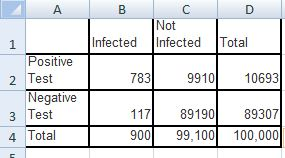
a.
P(a person has the virus given that they have tested positive) = 783/10693 = 0.07322 = 7.3%
b.
P(Not Infected | Negative Test) = 89190/89307 = 0.9986 = 99.87%
Add Answer to:
A certain affects virus 0.9% of the population. A test used to
detect the virus in...
A certain virus infects one in every 300 people. A test used to detect the virus...
A certain virus infects one in every 300 people. A test used to detect the virus in a person is positive 80% of the time if the person has the virus and 5% of the time if the person does not have the virus. (This 5% result is called a false positive.) Let A be the event "the person is infected" and B be the event "the person tests positive". a) Find the probability that a person has the virus...
A certain virus infects one in every 200 people. A test used to detect the virus in a person is positive 90% of the tim...
 A certain virus infects one in every 200 people. A test used to detect the virus in a person is positive 90% of the time if the person has the virus and 8% of the time if the person does not have the virus. (This 8% result is called a false positive.) Let A be the event "the person is infected" and B be the event "the person tests positive". a) Find the probability that a person has the virus...
2 pts 1 Details < > Question 16 A certain virus infects one in every 300...
 2 pts 1 Details < > Question 16 A certain virus infects one in every 300 people. A test used to detect the virus in a person is positive 80% of the time if the person has the virus and 8% of the time if the person does not have the virus. (This 8% result is called a false positive.) Let A be the event the person is infected" and B be the event "the person tests positive". a) Find...
A certain virus infects one in every 500 people. A test used to detect the virus...
A certain virus infects one in every 500 people. A test used to detect the virus in a person is positive 90% of the time if the person has the virus and 10% of the time if the person does not have the virus. Let A be the event "the person is infected" and B be the event "the person tests positive." (a) Find the probability that a person has the virus given that they have tested positive. (b)...
A certain virus infects one in every 300 people. A test used to detect the virus...
 A certain virus infects one in every 300 people. A test used to detect the virus in a person is positive 90% of the time when the person has the virus and 15% of the time when the person does not have the virus. (This 15% result is called a false positive.) Let A be the event the person is infected" and B be the event the person tests positive." (a) Using Bayes' Theorem, when a person tests positive, determine...
A certain virus infects one in every 300 people. A test used to detect the virus...
A certain virus infects one in every 300 people. A test used to detect the virus in a person is positive 80% of the time when the person has the virus and 15 % of the time when the person does not have the virus. (This 15 % result is called a false positive.) Let A be the event "the person is infected" and B be the event "the person tests positive." (a) Using Bayes' Theorem, when a person tests...
A certain virus infects one in every 250 people. A test used to detect the virus...
A certain virus infects one in every 250 people. A test used to detect the virus in a person is positive 80% of the time when the person has the virus and 15% of the time when the person does not have the virus. (This 15% result is called a false positive) Let A be the event "the person is infected" and B be the event "the person tests positive." (a) Using Bayes' Theorem, when a person tests positive, determine...
Problem 7. A certain virus infects five in every 100 people. A test used to detect...
Problem 7. A certain virus infects five in every 100 people. A test used to detect the virus in a person is positive 70% of the time if the person has the virus, and 9% of the time if the person does not have the virus. Using the Bayes’s theorem, if a person tests positive, determine the probability that the person is infected.
A certain virus infects one in every 200 people. A test used to detect the virus...
 A certain virus infects one in every 200 people. A test used to detect the virus in a person is positive 80% of the time if the person has the virus and 5% of the time if the person does not have the virus. Using Bayes' Rule, if a person tests positive, determine the probability the person has the virus. Round to four decimal places.
RBV testing Suppose that 1% of all people are infected with the rare banana virus (RBV)....
 RBV testing Suppose that 1% of all people are infected with the rare banana virus (RBV). There is a test to detect the RBV: if you do have the RBV, then the test will correctly detect this 99% of the time; if you do not have RBV, then the test will correctly indicate this 97% of the time. We assume that if the RBV test is given repeatedly to the same person, then the test results are independent of cach...
 A certain virus infects one in every 200 people. A test used to detect the virus in a person is positive 90% of the time if the person has the virus and 8% of the time if the person does not have the virus. (This 8% result is called a false positive.) Let A be the event "the person is infected" and B be the event "the person tests positive". a) Find the probability that a person has the virus...
 2 pts 1 Details < > Question 16 A certain virus infects one in every 300 people. A test used to detect the virus in a person is positive 80% of the time if the person has the virus and 8% of the time if the person does not have the virus. (This 8% result is called a false positive.) Let A be the event the person is infected" and B be the event "the person tests positive". a) Find...
 A certain virus infects one in every 300 people. A test used to detect the virus in a person is positive 90% of the time when the person has the virus and 15% of the time when the person does not have the virus. (This 15% result is called a false positive.) Let A be the event the person is infected" and B be the event the person tests positive." (a) Using Bayes' Theorem, when a person tests positive, determine...
 A certain virus infects one in every 200 people. A test used to detect the virus in a person is positive 80% of the time if the person has the virus and 5% of the time if the person does not have the virus. Using Bayes' Rule, if a person tests positive, determine the probability the person has the virus. Round to four decimal places.
 RBV testing Suppose that 1% of all people are infected with the rare banana virus (RBV). There is a test to detect the RBV: if you do have the RBV, then the test will correctly detect this 99% of the time; if you do not have RBV, then the test will correctly indicate this 97% of the time. We assume that if the RBV test is given repeatedly to the same person, then the test results are independent of cach...
Most questions answered within 3 hours.
-
Where is the error in this code sequence?
String s1 = "Hello";
String s2 = "ello";...
asked 10 months ago -
Financial data for Joel de Paris, Inc., for last year
follow:
Joel de Paris, Inc.
Balance...
asked 10 months ago -
Consider this reaction:
Al2(SO4)3 (aq)+ BaCl3
(aq) Al2Cl6 (aq)- +
3BaSO4(s) . What is the...
asked 10 months ago -
Suppose that Savneet is considering increasing her
recent random sample from 20 car rentals to 40...
asked 10 months ago -
Trucks arrive at an unloading terminal at an average rate of 120
per hour.
Trucks arrive...
asked 10 months ago -
Why are methanol and ethanol completely soluble in water while
octanol is not very little soluble....
asked 10 months ago -
A facilities manager at a university reads in a research report
that the mean amount of...
asked 10 months ago -
When the CuSO4 is rehydrated by adding water to the anhydrous
compound, is this an endothermic...
asked 10 months ago -
A ray of sunlight is passing from diamond into crown glass; the
angle of incidence is...
asked 10 months ago -
A block of mass 0.249 kg is placed on top of a light, vertical
spring of...
asked 10 months ago -
how do the kidneys compensate in the presences of acidosis
a) trigger hyperventilate
b) reserve acid...
asked 10 months ago -
Question 501 pts
The rental rate of capital to the firm increases. Which of the
following...
asked 10 months ago