geography Severe weather describes a sub-type of weather that has particularly notable negative impacts on society....
Homework Answers
THE IMPACT OF WEATHER AND CLIMATE ON SOCIETY
There is widespread appreciation for the fact that the value of weather, climate, and environmental data, information, and forecasts is growing in importance to the U.S. economy (e.g., Colgan and Weiher, 2003). According to some estimates, up to 40 percent of the approximately $10 trillion U.S. economy is affected by weather and climate events annually (NRC, 1998a; NOAA, 2001b; Dutton, 2002). The cost of U.S. disasters related to weather and climate is rising rapidly, a consequence of population growth, rising wealth, and social behavior (Changnon, 2000; Pielke and Carbone, 2002). Approximately 90 percent of all presidentially declared disasters in the United States are weather-related (Kelly, 2001). Weather affects aviation, air quality, health, ground and marine transportation, defense, agriculture, fisheries, water, energy, construction, tourism, and many other sectors of the economy. Even “good” weather can cause problems in this complex society; for example, one unexpectedly warm winter day in the Northeast can cost utility companies millions of dollars a day in unused energy.
There is also a growing awareness of the impact of climate variability and change, on time scales ranging from months to decades (NRC, 2001a). Shifts in rainfall patterns associated with climatic variability, such as those accompanying El Niño and La Niña, result in a nation and a world that is often plagued by drought and floods at the same time. Demand for climate data, information, and forecasts is growing rapidly, with NOAA’s National Climate Data Center (NCDC) receiving nearly 2 million online contacts from users in the year 2000, 77 percent from industry.
As society becomes more sensitive to weather, the importance of weather prediction for the protection of lives and property and continued economic growth increases. For example, the U.S. population that resides within 50 miles of the nation’s coastlines and is most threatened by hurricanes and flooding is growing rapidly. Such population growth in these and other high-risk areas significantly increases the need for improved weather predictions and warnings to minimize risks to life and property. Another consideration is that the new economic concept of “just-in-time manufacturing” uses computer-timed and -directed supply systems to eliminate the warehousing of parts and products at ports and factories. However, even minor weather disruptions of land, sea, and air-supply-system pathways caused by snow, ice, and high-wind weather systems can now have large, leveraged impacts on these production systems, whereas previously they had little effect.
According to IPCC (2011) estimates of annual losses have ranged since 1980 from a few billion to above US$200 billion (in 2010 dollars), with the highest value for 2005 (the year of Hurricane Katrina). The global weather-related disaster losses, such as loss of human lives, cultural heritage, and ecosystem services, are difficult to value and monetize, and thus they are poorly reflected in estimates of losses. Yet, recent abnormally intense storms, hurricanes, floods, heatwaves, droughts and associated large-scale wildfires have led to unprecendente negative ecological consequences for tropical forests and coral reefs around the world.
Extreme temperatures
Heat waves

2003 European heat wave
Heat waves are periods of abnormally high temperatures and heat index. Definitions of a heatwave vary because of the variation of temperatures in different geographic locations. Excessive heat is often accompanied by high levels of humidity, but can also be catastrophically dry.
Because heat waves are not visible as other forms of severe weather are, like hurricanes, tornadoes, and thunderstorms, they are one of the less known forms of extreme weather. Severe heat weather can damage populations and crops due to potential dehydration or hyperthermia, heat cramps, heat expansion and heat stroke. Dried soils are more susceptible to erosion, decreasing lands available for agriculture. Outbreaks of wildfires can increase in frequency as dry vegetation has increased likeliness of igniting. The evaporation of bodies of water can be devastating to marine populations, decreasing the size of the habitats available as well as the amount of nutrition present within the waters. Livestock and other animal populations may decline as well.
During excessive heat plants shut their leaf pores (stomata), a protective mechanism to conserve water but also curtails plants' absorption capabilities. This leaves more pollution and ozone in the air, which leads to higher mortality in the population. It has been estimated that extra pollution during the hot summer 2006 in the UK, cost 460 lives.The European heat waves from summer 2003 are estimated to have caused 30,000 excess deaths, due to heat stress and air pollution.Over 200 U.S cities have registered new record high temperatures. The worst heatwave in the USA occurred in 1936 and killed more than 5000 people directly. The worst heat wave in Australia occurred in 1938–39 and killed 438. The second worst was in 1896.
Power outages can also occur within areas experiencing heat waves due to the increased demand for electricity (i.e. air conditioning use). The urban heat island effect can increase temperatures, particularly overnight.
Cold waves
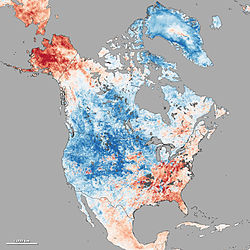
Cold wave in continental North America from Dec-03 to Dec-10, 2013. Red color means above mean temperature; blue represents below normal temperature.
A cold wave is a weather phenomenon that is distinguished by a cooling of the air. Specifically, as used by the U.S. National Weather Service, a cold wave is a rapid fall in temperature within a 24-hour period requiring substantially increased protection to agriculture, industry, commerce, and social activities. The precise criterion for a cold wave is determined by the rate at which the temperature falls, and the minimum to which it falls. This minimum temperature is dependent on the geographical region and time of year. Cold waves generally are capable of occurring any geological location and are formed by large cool air masses that accumulate over certain regions, caused by movements of air streams.
A cold wave can cause death and injury to livestock and wildlife. Exposure to cold mandates greater caloric intake for all animals, including humans, and if a cold wave is accompanied by heavy and persistent snow, grazing animals may be unable to reach necessary food and water, and die of hypothermia or starvation. Cold waves often necessitate the purchase of fodder for livestock at considerable cost to farmers. Human populations can be inflicted with frostbites when exposed for extended periods of time to cold and may result in the loss of limbs or damage to internal organs.
Extreme winter cold often causes poorly insulated water pipes to freeze. Even some poorly protected indoor plumbing may rupture as frozen water expands within them, causing property damage. Fires, paradoxically, become more hazardous during extreme cold. Water mains may break and water supplies may become unreliable, making firefighting more difficult.
Cold waves that bring unexpected freezes and frosts during the growing season in mid-latitude zones can kill plants during the early and most vulnerable stages of growth. This results in crop failure as plants are killed before they can be harvested economically. Such cold waves have caused famines. Cold waves can also cause soil particles to harden and freeze, making it harder for plants and vegetation to grow within these areas. One extreme was the so-called Year Without a Summer of 1816, one of several years during the 1810s in which numerous crops failed during freakish summer cold snaps after volcanic eruptions reduced incoming sunlight.
Global warming
In general, climate models show that with climate change, the planet will experience more extreme weather. In particular temperature record highs outpace record lows and some types of extreme weather such as extreme heat, intense precipitation, and drought have become more frequent and severe in recent decades. Some studies assert a connection between rapidly warming arctic temperatures and thus a vanishing cryosphere to extreme weather in mid-latitudes.
Heat stress
In the PNAS, Steven C. Sherwood and Matthew Huber state that humans and other mammals cannot tolerate a wet-bulb temperature of over 35 °C for extended periods, and that this "would begin to occur with global-mean warming of about 7 °C ... With 11–12 °C warming, such regions would spread to encompass the majority of the human population as currently distributed. Eventual warmings of 12 °C are possible from fossil fuel burning."
Tropical cyclones

NASA film In Katrina's Wake, covering the impacts from Hurricane Katrina.
There has been long ongoing debate about a possible increase of tropical cyclones as an effect of global warming.However, the 2012 IPCC special report on extreme events SREX states that "there is low confidence in any observed long-term (i.e., 40 years or more) increases in tropical cyclone activity (i.e., intensity, frequency, duration), after accounting for past changes in observing capabilities." Increases in population densities increase the number of people affected and damage caused by an event of given severity. The World Meteorological Organization and the U.S. Environmental Protection Agency have in the past linked increasing extreme weather events to global warming, as have Hoyos et al. (2006), writing that the increasing number of category 4 and 5 hurricanes is directly linked to increasing temperatures. Similarly, Kerry Emanuel in Nature writes that hurricane power dissipation is highly correlated with temperature, reflecting global warming.
Hurricane modeling has produced similar results, finding that hurricanes, simulated under warmer, high CO2 conditions, are more intense than under present-day conditions. Thomas Knutson and Robert E. Tuleya of the NOAA stated in 2004 that warming-induced by greenhouse gas may lead to the increasing occurrence of highly destructive category-5 storms. Vecchi and Soden find that wind shear, the increase of which acts to inhibit tropical cyclones, also changes in model-projections of global warming. There are projected increases of wind shear in the tropical Atlantic and East Pacific associated with the deceleration of the Walker circulation, as well as decreases of wind shear in the western and central Pacific.The study does not make claims about the net effect on Atlantic and East Pacific hurricanes of the warming and moistening atmospheres, and the model-projected increases in Atlantic wind shear.
b)
“There is a real possibility that we will be entering a phase of accelerated Arctic warming in the next two to four decades if mitigation action isn’t taken soon,” says Post, a climate change ecologist at the University of California, Davis.
Post is lead author of the report published today in Science Advances, in which an international group of scientists looks at current and future impacts of polar warming across a range of disciplines.
The Arctic is warming far more quickly than anywhere else on the planet. Temperatures climbed nearly 1.8 degrees Fahrenheit (1 Celsius) in the past decade alone. At the current rate of greenhouse gas emissions, the North is on track to warm 7.2 F (4 C) year-round—and top 12.6 F (7 C) in autumns—by the middle of this century, according to the report. That’s about when the planet as a whole is projected to reach the 3.6 F (2 C) warming often cited as the threshold for disastrous impacts.
Already, the High North is seeing unprecedented changes, including drastic ice losses on land and sea, galloping permafrost thaw, raging wildfires, unseasonal storms, earlier springs, and more. Summer sea ice this year shrank to its second lowest extent since satellite measurements began in 1979, while record July heat melted billions of tons of ice off the Greenland ice sheet. Wildfires blazed across millions of acres from Alaska to Siberia.
“Consequences of recent Arctic warming have already been widespread and pronounced, and yet we haven’t even seen what’s expected to be the most rapid phase of warming,” Post says.
While both the Arctic and Antarctic are experiencing rising temperatures, thinning glaciers, disturbed ecosystems, and other alarming shifts as heat-trapping fossil fuel emissions build up, changes are sweeping the northern region far faster. The impacts of a warming Arctic will be felt well beyond the high latitudes in the near future, the report warns.
Cold fronts are bodies of air with cooler temperatures than the surrounding air, and they normally move from northwest to southeast. The temperature shift between cold and warm fronts can be drastic, from freezing temperatures near the cold front to warm temperatures close to the warm front. On a weather map, cold fronts are shown as curved blue lines with triangles pointing in the direction that the front is moving.
Add Answer to:
geography
Severe weather describes a sub-type of weather that has
particularly notable negative impacts on society....
geography Q:1Several scientific studies have linked human-induced global warming to increased probabilities of extremely heavy precipitation...
geography Q:1Several scientific studies have linked human-induced global warming to increased probabilities of extremely heavy precipitation events and/or to increased intensity of extremely heavy precipitation events in some parts of the world. What property of the atmosphere explains this connection between global warming and increased heavy precipitation? Q2:Name two ways that an atmospheric inversion can form. Q:3During which season is the mid-latitude storm track strongest (note it is the same answer for both hemispheres)? Why? Q4:If cold and warm fronts...
Most questions answered within 3 hours.
-
Where is the error in this code sequence?
String s1 = "Hello";
String s2 = "ello";...
asked 10 months ago -
Financial data for Joel de Paris, Inc., for last year
follow:
Joel de Paris, Inc.
Balance...
asked 10 months ago -
Consider this reaction:
Al2(SO4)3 (aq)+ BaCl3
(aq) Al2Cl6 (aq)- +
3BaSO4(s) . What is the...
asked 10 months ago -
Suppose that Savneet is considering increasing her
recent random sample from 20 car rentals to 40...
asked 10 months ago -
Trucks arrive at an unloading terminal at an average rate of 120
per hour.
Trucks arrive...
asked 10 months ago -
Why are methanol and ethanol completely soluble in water while
octanol is not very little soluble....
asked 10 months ago -
A facilities manager at a university reads in a research report
that the mean amount of...
asked 10 months ago -
When the CuSO4 is rehydrated by adding water to the anhydrous
compound, is this an endothermic...
asked 10 months ago -
A ray of sunlight is passing from diamond into crown glass; the
angle of incidence is...
asked 10 months ago -
A block of mass 0.249 kg is placed on top of a light, vertical
spring of...
asked 10 months ago -
how do the kidneys compensate in the presences of acidosis
a) trigger hyperventilate
b) reserve acid...
asked 10 months ago -
Question 501 pts
The rental rate of capital to the firm increases. Which of the
following...
asked 10 months ago