If i perform a Welch test to obtain the degrees of freedom, and i get 9.998984932...
Homework Answers
The degrees of freedom are rounded down to the nearest integer. Hence, we will use 9 as degrees of freedom for this test
Add Answer to:
If
i perform a Welch test to obtain the degrees of freedom, and i get
9.998984932...
Degrees of Freedom of a Known Test 2 points possible graded) Let us consider a statistical...
 Degrees of Freedom of a Known Test 2 points possible graded) Let us consider a statistical model with parameter ER". Let O be the parameter that generates the n lid samples X1,..., X, Let I ) be the Fisher information and assume that the MLE is asymptotically normal. Assume that I(C) is a diagonal matrix with positive entries 1/t1,...,1/td. We wish to perform a test for the hypotheses H : 8 - and H:8 + . Let the test statistic...
Can I get help in how to work on c with Minitab. Just steps would help...
 Can I get help in how to work on c with Minitab. Just steps
would help a lot. thank you
02 0.0 1.645 1.645 Use Minitab to create a graph showing the 90% confidence multiplier for the t with 63 degrees of freedom. Briefly explain, using what we have discussed about the t distributions, why this number is larger than 1.645. will the 95% confidence multiplier for the t with 63 degrees of freedom be larger or smaller than 1.96?...
Can I get help in how to work on c with Minitab. Just steps
would help a lot. thank you
02 0.0 1.645 1.645 Use Minitab to create a graph showing the 90% confidence multiplier for the t with 63 degrees of freedom. Briefly explain, using what we have discussed about the t distributions, why this number is larger than 1.645. will the 95% confidence multiplier for the t with 63 degrees of freedom be larger or smaller than 1.96?...
Determine (a) the test statistic, (b) the degrees of freedom, (c) the P-alue, and (d) test...
 Determine (a) the test statistic, (b) the degrees of freedom, (c) the P-alue, and (d) test the hypothesis at the a-0.05 level of significance. Outcome Obsenved Expected 25 25 25 25 A B C Do 22 28 24 26 H,: At least one of the proportions is different from the others Click the icon to wew the chi-square distribution table Round to two decimal places as needed.) (b) (True False) The number of degrees of freedom is oneless than the...
Determine how many degrees of freedom we have in a one-sample t-test for a sample size...
Determine how many degrees of freedom we have in a one-sample t-test for a sample size of N=26. (Hypothetical)
please explain. Determine the number of degrees of freedom for the two-sample t test or CI...
 please explain.
Determine the number of degrees of freedom for the two-sample t test or CI in each of the following situations. (Round your answers down to the nearest whole number (a) m-12, n 10, s,3.0, s, 6.0 (b) m 12, n 18, s, 3.0, s, 6.0 (c) m-12, n 18, s, 2.0, 5, 6.0 (d) m 10, n-24, s, 3.0, s, 6.0 You may need to use the appropriate table in the Appendix of Tables to answer this question
please explain.
Determine the number of degrees of freedom for the two-sample t test or CI in each of the following situations. (Round your answers down to the nearest whole number (a) m-12, n 10, s,3.0, s, 6.0 (b) m 12, n 18, s, 3.0, s, 6.0 (c) m-12, n 18, s, 2.0, 5, 6.0 (d) m 10, n-24, s, 3.0, s, 6.0 You may need to use the appropriate table in the Appendix of Tables to answer this question
Solve the problem. For large numbers of degrees of freedom, the critical values can be approximated...
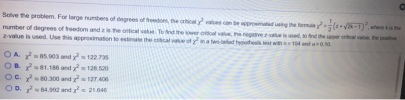 Solve the problem. For large numbers of degrees of freedom, the critical values can be approximated using the formula 2x-1 where k is the number of degrees of freedom and z is the crtical vaue. To find the lower critical value, the negative z-value is used,to find the upper critical value, the postive z-value is used. Use this approximation to estimate the critical value of X2 in a two-tailed hypothesis test with n-104 and .10. to find the upper critical...
12.1.7 Question Help Determine (a) the x? test statistic, (b) the degrees of freedom, (c) the...
 12.1.7 Question Help Determine (a) the x? test statistic, (b) the degrees of freedom, (c) the critical value using a = 0.05, and (d) test the hypothesis at the c = 0.05 level of significance. DO Outcome Observed Expected А 51 50 B 46 50 с 51 50 52 50 Ho: PA=Pg Pc = Po = H, At least one of the proportions is different from the others. (a) The test statistic is 0.44 (Type an exact answer.) (b) There...
a) true b) false 42. For a chi-square distributed random variable with 10 degrees of freedom and a level of sigpificanoe computed value of the test statistics is 16.857. This will lead us to reje...
 a) true b) false 42. For a chi-square distributed random variable with 10 degrees of freedom and a level of sigpificanoe computed value of the test statistics is 16.857. This will lead us to reject the null hypothesis. a) true b) false 43. A chi-square goodness-of-fit test is always conducted as: a. a lower-tail test b. an upper-tail test d. either a lower tail or upper tail test e. a two-tail test 44. A left-tailed area in the chi-square distribution...
When Chi-square distribution is used as a test of independence, the number of degrees of freedom...
When Chi-square distribution is used as a test of independence, the number of degrees of freedom is related to both the number of rows and the number of columns in the contingency table. Select one: True False Question 2 Answer saved Points out of 1.000 Flag question Question text A goodness of fit test can be used to determine if membership in categories of one variable is different as a function of membership in the categories of a second variable...
Question 8 1 pts Suppose we are conducting a hypothesis test to see if the average...
 Question 8 1 pts Suppose we are conducting a hypothesis test to see if the average number of M&Ms one person can eat before getting sick has decreased. We calculate our test statistic on the z-table to be -1.75. Do we reject or fail to reject Ho ata = .05? O Fail to reject; the average does not seem to have fallen O Reject; the average seems to have fallen O Reject: the average does not seem to have fallen...
 Degrees of Freedom of a Known Test 2 points possible graded) Let us consider a statistical model with parameter ER". Let O be the parameter that generates the n lid samples X1,..., X, Let I ) be the Fisher information and assume that the MLE is asymptotically normal. Assume that I(C) is a diagonal matrix with positive entries 1/t1,...,1/td. We wish to perform a test for the hypotheses H : 8 - and H:8 + . Let the test statistic...
 Can I get help in how to work on c with Minitab. Just steps
would help a lot. thank you
02 0.0 1.645 1.645 Use Minitab to create a graph showing the 90% confidence multiplier for the t with 63 degrees of freedom. Briefly explain, using what we have discussed about the t distributions, why this number is larger than 1.645. will the 95% confidence multiplier for the t with 63 degrees of freedom be larger or smaller than 1.96?...
Can I get help in how to work on c with Minitab. Just steps
would help a lot. thank you
02 0.0 1.645 1.645 Use Minitab to create a graph showing the 90% confidence multiplier for the t with 63 degrees of freedom. Briefly explain, using what we have discussed about the t distributions, why this number is larger than 1.645. will the 95% confidence multiplier for the t with 63 degrees of freedom be larger or smaller than 1.96?...
 Determine (a) the test statistic, (b) the degrees of freedom, (c) the P-alue, and (d) test the hypothesis at the a-0.05 level of significance. Outcome Obsenved Expected 25 25 25 25 A B C Do 22 28 24 26 H,: At least one of the proportions is different from the others Click the icon to wew the chi-square distribution table Round to two decimal places as needed.) (b) (True False) The number of degrees of freedom is oneless than the...
 please explain.
Determine the number of degrees of freedom for the two-sample t test or CI in each of the following situations. (Round your answers down to the nearest whole number (a) m-12, n 10, s,3.0, s, 6.0 (b) m 12, n 18, s, 3.0, s, 6.0 (c) m-12, n 18, s, 2.0, 5, 6.0 (d) m 10, n-24, s, 3.0, s, 6.0 You may need to use the appropriate table in the Appendix of Tables to answer this question
please explain.
Determine the number of degrees of freedom for the two-sample t test or CI in each of the following situations. (Round your answers down to the nearest whole number (a) m-12, n 10, s,3.0, s, 6.0 (b) m 12, n 18, s, 3.0, s, 6.0 (c) m-12, n 18, s, 2.0, 5, 6.0 (d) m 10, n-24, s, 3.0, s, 6.0 You may need to use the appropriate table in the Appendix of Tables to answer this question
 Solve the problem. For large numbers of degrees of freedom, the critical values can be approximated using the formula 2x-1 where k is the number of degrees of freedom and z is the crtical vaue. To find the lower critical value, the negative z-value is used,to find the upper critical value, the postive z-value is used. Use this approximation to estimate the critical value of X2 in a two-tailed hypothesis test with n-104 and .10. to find the upper critical...
 12.1.7 Question Help Determine (a) the x? test statistic, (b) the degrees of freedom, (c) the critical value using a = 0.05, and (d) test the hypothesis at the c = 0.05 level of significance. DO Outcome Observed Expected А 51 50 B 46 50 с 51 50 52 50 Ho: PA=Pg Pc = Po = H, At least one of the proportions is different from the others. (a) The test statistic is 0.44 (Type an exact answer.) (b) There...
 a) true b) false 42. For a chi-square distributed random variable with 10 degrees of freedom and a level of sigpificanoe computed value of the test statistics is 16.857. This will lead us to reject the null hypothesis. a) true b) false 43. A chi-square goodness-of-fit test is always conducted as: a. a lower-tail test b. an upper-tail test d. either a lower tail or upper tail test e. a two-tail test 44. A left-tailed area in the chi-square distribution...
 Question 8 1 pts Suppose we are conducting a hypothesis test to see if the average number of M&Ms one person can eat before getting sick has decreased. We calculate our test statistic on the z-table to be -1.75. Do we reject or fail to reject Ho ata = .05? O Fail to reject; the average does not seem to have fallen O Reject; the average seems to have fallen O Reject: the average does not seem to have fallen...
Most questions answered within 3 hours.
-
Where is the error in this code sequence?
String s1 = "Hello";
String s2 = "ello";...
asked 10 months ago -
Financial data for Joel de Paris, Inc., for last year
follow:
Joel de Paris, Inc.
Balance...
asked 10 months ago -
Consider this reaction:
Al2(SO4)3 (aq)+ BaCl3
(aq) Al2Cl6 (aq)- +
3BaSO4(s) . What is the...
asked 10 months ago -
Suppose that Savneet is considering increasing her
recent random sample from 20 car rentals to 40...
asked 10 months ago -
Trucks arrive at an unloading terminal at an average rate of 120
per hour.
Trucks arrive...
asked 10 months ago -
Why are methanol and ethanol completely soluble in water while
octanol is not very little soluble....
asked 10 months ago -
A facilities manager at a university reads in a research report
that the mean amount of...
asked 10 months ago -
When the CuSO4 is rehydrated by adding water to the anhydrous
compound, is this an endothermic...
asked 10 months ago -
A ray of sunlight is passing from diamond into crown glass; the
angle of incidence is...
asked 10 months ago -
A block of mass 0.249 kg is placed on top of a light, vertical
spring of...
asked 10 months ago -
how do the kidneys compensate in the presences of acidosis
a) trigger hyperventilate
b) reserve acid...
asked 10 months ago -
Question 501 pts
The rental rate of capital to the firm increases. Which of the
following...
asked 10 months ago