Suppose we select some initial number ? and then build the sequence of values by the...
Homework Answers
# Pythogoreon Triplets
sum = 300
# For all values of a from (0, 300)
for a in range(sum + 1):
# For all values of b > a and b <
300
for b in range(a + 1, sum + 1):
# For all values of c
> b and c < 300
for c in range(b + 1,
sum + 1):
# If sum(a + b + c) == 300 and a^2 + b^2 = c^2
if (a + b + c == sum) and (a**2 + b**2 == c**2):
# Print the numbers
print(f'A : {a}, B : {b}, C : {c}')

# functions to calculate T based on odd or even
def calculateTEven(Ti):
return int(Ti * 0.5)
def calculateTOdd(Ti):
return int(0.5 * (3 * Ti + 1))
sequences = []
for T in range(1, 26):
T0 = T
seq = []
while True:
seq.append(T0)
if T0 == 1:
break
if(T0 % 2 == 0):
T0 = calculateTEven(T0)
else:
T0 = calculateTOdd(T0)
sequences.append(seq)
print(f'T0\tMaximum\t\tSeries')
for i in range(1, 26):
print(f'{i}\t {max(sequences[i -
1])}\t\t{sequences[i - 1]}')
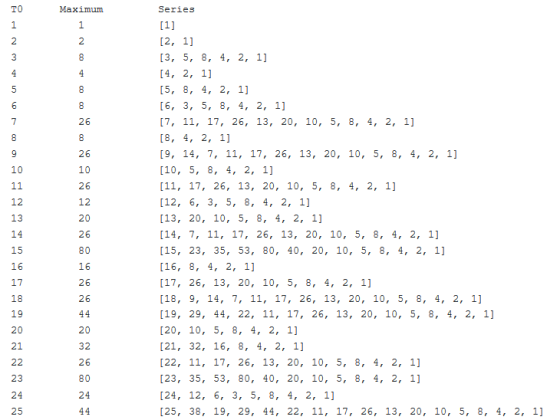
import matplotlib.pyplot as plt
# get the number of elements in each sequence
seq_lengths = [len(seq) for seq in sequences]
# get the T0 (1 to 25)
starting_numbers = [i for i in range(1, 26)]
# plot the graph
plt.plot(starting_numbers, seq_lengths)
# Add title
plt.title("Starting Number VS Number of Elements in Seq")
# Add X label
plt.xlabel("Starting Number")
# Add Y Label
plt.ylabel("Number of Elements per sequence")
# Display the plot
plt.show()
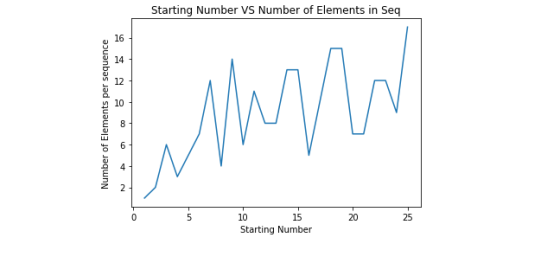
Add Answer to:
Suppose we select some initial number ? and then build the
sequence of values by the...
this is using MATLAB 2. Fibonacci sequence: A Fibonacci sequence is composed of elements created by...
 this is using MATLAB
2. Fibonacci sequence: A Fibonacci sequence is composed of elements created by adding the two previous elements. The simplest Fibonacci sequence starts with 1,1 and proceeds as follows: 1, 1, 2, 3, 5, 8, 13, . However, a Fibonacci sequence can be created with any two starting numbers. Create a MATLAB function called FL_fib_seq' (where F and L are your first and last initials) that creates a Fibonacci sequence. There should be three inputs. The first...
this is using MATLAB
2. Fibonacci sequence: A Fibonacci sequence is composed of elements created by adding the two previous elements. The simplest Fibonacci sequence starts with 1,1 and proceeds as follows: 1, 1, 2, 3, 5, 8, 13, . However, a Fibonacci sequence can be created with any two starting numbers. Create a MATLAB function called FL_fib_seq' (where F and L are your first and last initials) that creates a Fibonacci sequence. There should be three inputs. The first...
The Syracuse sequence is generated by starting with a natural number and repeatedly applying the following...
The Syracuse sequence is generated by starting with a natural number and repeatedly applying the following function until reaching 1: ???(?) = { ?/2 if x is even { 3? + 1 if x is odd For example, the Syracuse sequence starting with 5 is: 5, 16, 8, 4, 2, 1. It is an open question in mathematics whether this sequence will always go to 1 for every possible starting value. Write a function in Python (called syracuse) that gets...
IN PYTHON 1.Choose a positive integer 2. To get the next number in the sequence we...
 IN PYTHON
1.Choose a positive integer
2. To get the next number in the sequence we do the following:
If the integer is odd, we multiply by 3 and add 1. If the integer
is even, we divide by 2. It is hypothesized that the above sequence
will always converge to the value of 1, regardless of any valid
initial choice. This hypothesis is known as the Collatz Conjecture.
For example, if we start at 5, the numbers generated by...
IN PYTHON
1.Choose a positive integer
2. To get the next number in the sequence we do the following:
If the integer is odd, we multiply by 3 and add 1. If the integer
is even, we divide by 2. It is hypothesized that the above sequence
will always converge to the value of 1, regardless of any valid
initial choice. This hypothesis is known as the Collatz Conjecture.
For example, if we start at 5, the numbers generated by...
Fibonacci numbers – for loops We’ll define the Fibonacci numbers to be an integer sequence starting...
Fibonacci numbers – for loops We’ll define the Fibonacci numbers to be an integer sequence starting with 1, 1, and where each subsequent element is got by adding the previous two elements: 1, 1, 2, 3, 5, 8, . . . (Mathematicians start with 0, 1, . . . , but we want to avoid zeros because you can’t take their log. ) Write a python programme in a Jupyter notebook which uses a for-loop to fill an array with...
Suppose an array contains the sequence of values 4, 5, 6, 7, 8, and 10. If...
Suppose an array contains the sequence of values 4, 5, 6, 7, 8, and 10. If the binary search algorithm is used to search the array, how many elements must be visited to determine that element 3 is not in the array? Select one: a. 4 b. 6 c. 3 d. 5
In this assignment we are asking the user to enter two number values, the starting and...
In this assignment we are asking the user to enter two number values, the starting and ending numbers for our application. Having these values, we then construct a loop that will increment by one (1) from the starting number through (and including) the ending number. Within this loop we will check the current value of our number to see if it is evenly divisible by 3, then by 5, and then by both 3 and 5. We will output all...
Let's say you are given a sequence of distinct positive numbers. We want to find a...
Let's say you are given a sequence of distinct positive numbers. We want to find a subsequence with the maximum possible sum, with the restriction that we are not allowed to take three consecutive elements from the original sequence. For example, for input 1, 6, 5, 2, 7, 9, 3, 4, the subsequence with the maximum possible sum is 6, 5, 7, 9, 4 (we have two pairs of consecutive elements 6, 5 and 7, 9 but not three consecutive...
In this assignment we are asking the user to enter two number values, the starting and...
In this assignment we are asking the user to enter two number values, the starting and ending numbers for our application. Having these values, we then construct a loop that will increment by one (1) from the starting number through (and including) the ending number. Within this loop we will check the current value of our number to see if it is evenly divisible by 3, then by 5, and then by both 3 and 5. We will output all...
I want this using while loop This using stringin python Use list or some thing in...
 I want this using while loop
This using stringin python
Use list or some thing in python
Using list in python
I want answer as soon as posdible
E. Last Number time limit per test: 1 second memory limit per test: 256 megabytes input standard input output standard output You are given a sequence of positive integers aj, , 03, ... Print the last element of the sequence. Input The input consists of multiple lines. The i-th line contains a...
I want this using while loop
This using stringin python
Use list or some thing in python
Using list in python
I want answer as soon as posdible
E. Last Number time limit per test: 1 second memory limit per test: 256 megabytes input standard input output standard output You are given a sequence of positive integers aj, , 03, ... Print the last element of the sequence. Input The input consists of multiple lines. The i-th line contains a...
USING MATLAB 7. A Fibonacci sequence is composed of elements created by adding the two previous...
 USING MATLAB
7. A Fibonacci sequence is composed of elements created by adding the two previous elements. The simplest Fibonacci sequence starts with 1, 1 and proceeds as follows: 1,1,2,3,5,8,13, So, if f(1)-1 and f(2) -1, then f(3)-2)+f(1) We can represent this pattern as f(x) - f(x-1)+f(x-2). A Fibonacci sequence can be created with any two numbers. Prompt the user to enter the first two numbers in a Fibonacci sequence and the total number of elements requested in the sequence....
USING MATLAB
7. A Fibonacci sequence is composed of elements created by adding the two previous elements. The simplest Fibonacci sequence starts with 1, 1 and proceeds as follows: 1,1,2,3,5,8,13, So, if f(1)-1 and f(2) -1, then f(3)-2)+f(1) We can represent this pattern as f(x) - f(x-1)+f(x-2). A Fibonacci sequence can be created with any two numbers. Prompt the user to enter the first two numbers in a Fibonacci sequence and the total number of elements requested in the sequence....
 this is using MATLAB
2. Fibonacci sequence: A Fibonacci sequence is composed of elements created by adding the two previous elements. The simplest Fibonacci sequence starts with 1,1 and proceeds as follows: 1, 1, 2, 3, 5, 8, 13, . However, a Fibonacci sequence can be created with any two starting numbers. Create a MATLAB function called FL_fib_seq' (where F and L are your first and last initials) that creates a Fibonacci sequence. There should be three inputs. The first...
this is using MATLAB
2. Fibonacci sequence: A Fibonacci sequence is composed of elements created by adding the two previous elements. The simplest Fibonacci sequence starts with 1,1 and proceeds as follows: 1, 1, 2, 3, 5, 8, 13, . However, a Fibonacci sequence can be created with any two starting numbers. Create a MATLAB function called FL_fib_seq' (where F and L are your first and last initials) that creates a Fibonacci sequence. There should be three inputs. The first...
 IN PYTHON
1.Choose a positive integer
2. To get the next number in the sequence we do the following:
If the integer is odd, we multiply by 3 and add 1. If the integer
is even, we divide by 2. It is hypothesized that the above sequence
will always converge to the value of 1, regardless of any valid
initial choice. This hypothesis is known as the Collatz Conjecture.
For example, if we start at 5, the numbers generated by...
IN PYTHON
1.Choose a positive integer
2. To get the next number in the sequence we do the following:
If the integer is odd, we multiply by 3 and add 1. If the integer
is even, we divide by 2. It is hypothesized that the above sequence
will always converge to the value of 1, regardless of any valid
initial choice. This hypothesis is known as the Collatz Conjecture.
For example, if we start at 5, the numbers generated by...
 I want this using while loop
This using stringin python
Use list or some thing in python
Using list in python
I want answer as soon as posdible
E. Last Number time limit per test: 1 second memory limit per test: 256 megabytes input standard input output standard output You are given a sequence of positive integers aj, , 03, ... Print the last element of the sequence. Input The input consists of multiple lines. The i-th line contains a...
I want this using while loop
This using stringin python
Use list or some thing in python
Using list in python
I want answer as soon as posdible
E. Last Number time limit per test: 1 second memory limit per test: 256 megabytes input standard input output standard output You are given a sequence of positive integers aj, , 03, ... Print the last element of the sequence. Input The input consists of multiple lines. The i-th line contains a...
 USING MATLAB
7. A Fibonacci sequence is composed of elements created by adding the two previous elements. The simplest Fibonacci sequence starts with 1, 1 and proceeds as follows: 1,1,2,3,5,8,13, So, if f(1)-1 and f(2) -1, then f(3)-2)+f(1) We can represent this pattern as f(x) - f(x-1)+f(x-2). A Fibonacci sequence can be created with any two numbers. Prompt the user to enter the first two numbers in a Fibonacci sequence and the total number of elements requested in the sequence....
USING MATLAB
7. A Fibonacci sequence is composed of elements created by adding the two previous elements. The simplest Fibonacci sequence starts with 1, 1 and proceeds as follows: 1,1,2,3,5,8,13, So, if f(1)-1 and f(2) -1, then f(3)-2)+f(1) We can represent this pattern as f(x) - f(x-1)+f(x-2). A Fibonacci sequence can be created with any two numbers. Prompt the user to enter the first two numbers in a Fibonacci sequence and the total number of elements requested in the sequence....
Most questions answered within 3 hours.
-
Where is the error in this code sequence?
String s1 = "Hello";
String s2 = "ello";...
asked 11 months ago -
Financial data for Joel de Paris, Inc., for last year
follow:
Joel de Paris, Inc.
Balance...
asked 11 months ago -
Consider this reaction:
Al2(SO4)3 (aq)+ BaCl3
(aq) Al2Cl6 (aq)- +
3BaSO4(s) . What is the...
asked 11 months ago -
Suppose that Savneet is considering increasing her
recent random sample from 20 car rentals to 40...
asked 11 months ago -
Trucks arrive at an unloading terminal at an average rate of 120
per hour.
Trucks arrive...
asked 11 months ago -
Why are methanol and ethanol completely soluble in water while
octanol is not very little soluble....
asked 11 months ago -
A facilities manager at a university reads in a research report
that the mean amount of...
asked 11 months ago -
When the CuSO4 is rehydrated by adding water to the anhydrous
compound, is this an endothermic...
asked 11 months ago -
A ray of sunlight is passing from diamond into crown glass; the
angle of incidence is...
asked 11 months ago -
A block of mass 0.249 kg is placed on top of a light, vertical
spring of...
asked 11 months ago -
how do the kidneys compensate in the presences of acidosis
a) trigger hyperventilate
b) reserve acid...
asked 11 months ago -
Question 501 pts
The rental rate of capital to the firm increases. Which of the
following...
asked 11 months ago