Calculate the potential at the equivalence point in the oxidation of Fe (II) with potassium permanganate...
Calculate the potential at the equivalence point in the oxidation of Fe (II) with potassium permanganate at pH = 2.00
Eº (MnO4-/Mn(II)) = 1.51 V ; Eº (Fe(III)/Fe(II)) = 0.76V
Homework Answers
Request Answer!
We need at least 10 more requests to produce the answer.
0 / 10 have requested this problem solution
The more requests, the faster the answer.
Add Answer to:
Calculate the potential at the equivalence point in the
oxidation of Fe (II) with potassium permanganate...
An acidic solution of potassium permanganate reacts with oxalate ions to form co2 and manganese(II) ions...
An acidic solution of potassium permanganate reacts with oxalate ions to form co2 and manganese(II) ions according to the following unbalanced REDOX equation: MnO4-(aq)+C2O4 ^ (2-) --> CO2(G) + Mn ^ (2+) In the banalced equation the coefficients for MnO4- and CO2 is?
2. Calculate the volume of potassium hydroxide at equivalence point and the pH at equivalence point...
 2. Calculate the volume of potassium hydroxide at equivalence point and the pH at equivalence point when 10.00 16 of 1200 mM solution of acetic acid was titrated with 9.500 ml potass- sium hydoxide. pka value for acetic acid is 4.76. = 0.012 M acetic acid 12.00m M I M (millionlar) x 1000mm 9.500m IM * 1000 mm - 0.098M KOH mv = Mava of (0.012)(0.016) = 60.0095m) (V2) V2 = 0.012632 = 12.63 m2
Determine the potential of a platinum electrode (vs. SHE) when placed in a mixture of 0.00266...
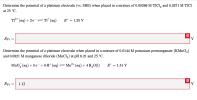 Determine the potential of a platinum electrode (vs. SHE) when placed in a mixture of 0.00266 M TIC12 and 0.0371 M TICi at 25 °C 3+ TI (aq)2 e TI* (aq) E° = 1.25 V Ept = V Determine the potential of a platinum electrode when placed in a mixture of 0.0144 M potassium permanganate (KMnO4) and 0.0821 M manganese chloride (MnCl2) at pH 6.21 and 25 °C ,2+ MnO4 (aq)5e +8H* (aq) Mn2(aq) 4H201) E 1.51 V ЕPРЕ V...
pH be at the equivalence point? Volume NaOH added pH 0.39 The student collected the following...
 pH be at the equivalence point? Volume NaOH added pH 0.39 The student collected the following data: Plot the data above in excel with pH values on the Y axis and the volume of NaOH added on the X axis Graphically determine the equivalence point and indicate the pH on the graph. b. 0.00 2.00 4.00 0.46 0.54 ii. 0.62 6.00 8.00 10.00 0.7 0.78 Show the following calculations on a separate sheet of paper: 0.87 12.00 0.96 1.07 14.00...
Some engineers recommend addition of the strong oxidant potassium permanganate (KMnO4) for remediating aquifers contaminated with...
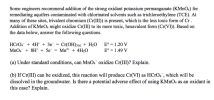 Some engineers recommend addition of the strong oxidant potassium permanganate (KMnO4) for remediating aquifers contaminated with chlorinated solvents such as trichloroethylene (TCE). At many of these sites, trivalent chromium (Cr(III)) is present, which is the less toxic form of Cr. Addition of KMnO4 might oxidize Cr(III) to its more toxic, hexavalent form (Cr(VI)). Based on the data below, answer the following questions. HCrO4 + 4H+ + 3e = Cr(OH)3(s) + H2O Mn04 + 8H+ + 5e = Mn2+ + 4H20...
6. Calculate the electrode potential of the system (in V) at the equivalence point for the...
 6. Calculate the electrode potential of the system (in V) at the
equivalence point for the reaction:
Please show all of your work!
TP1 + 2Pe2t TV +2Fe3t B" Tqi/TT+ = 1.25 V; E0Feat n®/Tlt-1.25 V, E0Fe2+/Fe2+ = 0.771V
6. Calculate the electrode potential of the system (in V) at the
equivalence point for the reaction:
Please show all of your work!
TP1 + 2Pe2t TV +2Fe3t B" Tqi/TT+ = 1.25 V; E0Feat n®/Tlt-1.25 V, E0Fe2+/Fe2+ = 0.771V
A 20.00 mL sample of V2+ is titrated to the equivalence point with 23.71 mL of...
A 20.00 mL sample of V2+ is titrated to the equivalence point with 23.71 mL of 0.0646 M KMnO4in a solution with a pH = 1.11. Calculate the potential of the solution. The reaction of the sample is V2+ -> V3+. The titrant reaction is the one that takes MnO4- to Mn2+. Use Appendix 13. Express the answer with 2 decimal places.
BACKGROUND: Synthesis of Potassium Iron (III) Oxalate Hydrate Salt The iron(II) ions from Fe(NH4)2(SO4)2•6H2O will be precipitated as iron(II) oxalate. Fe^2+(aq) + C2O4^2-(aq) --> FeC2O4 (s) The su...
 BACKGROUND: Synthesis of Potassium Iron
(III) Oxalate Hydrate Salt
The iron(II) ions from
Fe(NH4)2(SO4)2•6H2O
will be precipitated as iron(II) oxalate.
Fe^2+(aq) + C2O4^2-(aq) --> FeC2O4 (s)
The supernatant liquid, containing the ammonium and sulfate
ions, as well as excess oxalate ions and oxalic acid will be
decanted and discarded. The solid will then be re-dissolved and the
iron(II) ions will be oxidized to iron(III) ions by reaction with
hydrogen peroxide.
2Fe^2+(aq) + H2O2(aq) --> 2Fe^3+(aq) +2 OH^ - (aq)
The...
BACKGROUND: Synthesis of Potassium Iron
(III) Oxalate Hydrate Salt
The iron(II) ions from
Fe(NH4)2(SO4)2•6H2O
will be precipitated as iron(II) oxalate.
Fe^2+(aq) + C2O4^2-(aq) --> FeC2O4 (s)
The supernatant liquid, containing the ammonium and sulfate
ions, as well as excess oxalate ions and oxalic acid will be
decanted and discarded. The solid will then be re-dissolved and the
iron(II) ions will be oxidized to iron(III) ions by reaction with
hydrogen peroxide.
2Fe^2+(aq) + H2O2(aq) --> 2Fe^3+(aq) +2 OH^ - (aq)
The...
Question 4 Using the table of standard reduction potentials shown below, calculate the standard cell potential for...
 Question 4 Using the table of standard reduction potentials shown below, calculate the standard cell potential for a battery based on the following reactions. • MnO4 +8H+ + 5e + Mn+2 +4 H20 . 5 Ag + 5 Ag+1 +5e Reduction Half-Reaction F2 +2e + 2F MnO4 + 8 H+ + 5e + Mn+2 + 4H2O Cl2 + 2e + 20 O2 + 4H+ + 4e + 2 H2O Ag++ e + Ag Fet3 Fe + Fet2 O2 + 2...
1. Potassium permanganate (KMnO4 ) is a commonly used oxidant in many redox titrations. In one...
1. Potassium permanganate (KMnO4 ) is a commonly used oxidant in many redox titrations. In one such titration, KMnO4 solution in a buret is added to a solution of oxalic acid in the Erlenmeyer flask. 2MnO4−(aq) + 5H2C2O4(aq) + 6H+(aq) → 2Mn2+(aq) + 10 CO2(g) + 8 H2O(l) Every component except permanganate (purple) is colorless. The end point of the reaction will be signaled by: a. The first appearance of the purple color in the solution being titrated b. The...
 2. Calculate the volume of potassium hydroxide at equivalence point and the pH at equivalence point when 10.00 16 of 1200 mM solution of acetic acid was titrated with 9.500 ml potass- sium hydoxide. pka value for acetic acid is 4.76. = 0.012 M acetic acid 12.00m M I M (millionlar) x 1000mm 9.500m IM * 1000 mm - 0.098M KOH mv = Mava of (0.012)(0.016) = 60.0095m) (V2) V2 = 0.012632 = 12.63 m2
 Determine the potential of a platinum electrode (vs. SHE) when placed in a mixture of 0.00266 M TIC12 and 0.0371 M TICi at 25 °C 3+ TI (aq)2 e TI* (aq) E° = 1.25 V Ept = V Determine the potential of a platinum electrode when placed in a mixture of 0.0144 M potassium permanganate (KMnO4) and 0.0821 M manganese chloride (MnCl2) at pH 6.21 and 25 °C ,2+ MnO4 (aq)5e +8H* (aq) Mn2(aq) 4H201) E 1.51 V ЕPРЕ V...
 pH be at the equivalence point? Volume NaOH added pH 0.39 The student collected the following data: Plot the data above in excel with pH values on the Y axis and the volume of NaOH added on the X axis Graphically determine the equivalence point and indicate the pH on the graph. b. 0.00 2.00 4.00 0.46 0.54 ii. 0.62 6.00 8.00 10.00 0.7 0.78 Show the following calculations on a separate sheet of paper: 0.87 12.00 0.96 1.07 14.00...
 Some engineers recommend addition of the strong oxidant potassium permanganate (KMnO4) for remediating aquifers contaminated with chlorinated solvents such as trichloroethylene (TCE). At many of these sites, trivalent chromium (Cr(III)) is present, which is the less toxic form of Cr. Addition of KMnO4 might oxidize Cr(III) to its more toxic, hexavalent form (Cr(VI)). Based on the data below, answer the following questions. HCrO4 + 4H+ + 3e = Cr(OH)3(s) + H2O Mn04 + 8H+ + 5e = Mn2+ + 4H20...
 6. Calculate the electrode potential of the system (in V) at the
equivalence point for the reaction:
Please show all of your work!
TP1 + 2Pe2t TV +2Fe3t B" Tqi/TT+ = 1.25 V; E0Feat n®/Tlt-1.25 V, E0Fe2+/Fe2+ = 0.771V
6. Calculate the electrode potential of the system (in V) at the
equivalence point for the reaction:
Please show all of your work!
TP1 + 2Pe2t TV +2Fe3t B" Tqi/TT+ = 1.25 V; E0Feat n®/Tlt-1.25 V, E0Fe2+/Fe2+ = 0.771V
 BACKGROUND: Synthesis of Potassium Iron
(III) Oxalate Hydrate Salt
The iron(II) ions from
Fe(NH4)2(SO4)2•6H2O
will be precipitated as iron(II) oxalate.
Fe^2+(aq) + C2O4^2-(aq) --> FeC2O4 (s)
The supernatant liquid, containing the ammonium and sulfate
ions, as well as excess oxalate ions and oxalic acid will be
decanted and discarded. The solid will then be re-dissolved and the
iron(II) ions will be oxidized to iron(III) ions by reaction with
hydrogen peroxide.
2Fe^2+(aq) + H2O2(aq) --> 2Fe^3+(aq) +2 OH^ - (aq)
The...
BACKGROUND: Synthesis of Potassium Iron
(III) Oxalate Hydrate Salt
The iron(II) ions from
Fe(NH4)2(SO4)2•6H2O
will be precipitated as iron(II) oxalate.
Fe^2+(aq) + C2O4^2-(aq) --> FeC2O4 (s)
The supernatant liquid, containing the ammonium and sulfate
ions, as well as excess oxalate ions and oxalic acid will be
decanted and discarded. The solid will then be re-dissolved and the
iron(II) ions will be oxidized to iron(III) ions by reaction with
hydrogen peroxide.
2Fe^2+(aq) + H2O2(aq) --> 2Fe^3+(aq) +2 OH^ - (aq)
The...
 Question 4 Using the table of standard reduction potentials shown below, calculate the standard cell potential for a battery based on the following reactions. • MnO4 +8H+ + 5e + Mn+2 +4 H20 . 5 Ag + 5 Ag+1 +5e Reduction Half-Reaction F2 +2e + 2F MnO4 + 8 H+ + 5e + Mn+2 + 4H2O Cl2 + 2e + 20 O2 + 4H+ + 4e + 2 H2O Ag++ e + Ag Fet3 Fe + Fet2 O2 + 2...
Most questions answered within 3 hours.
-
Where is the error in this code sequence?
String s1 = "Hello";
String s2 = "ello";...
asked 10 months ago -
Financial data for Joel de Paris, Inc., for last year
follow:
Joel de Paris, Inc.
Balance...
asked 10 months ago -
Consider this reaction:
Al2(SO4)3 (aq)+ BaCl3
(aq) Al2Cl6 (aq)- +
3BaSO4(s) . What is the...
asked 10 months ago -
Suppose that Savneet is considering increasing her
recent random sample from 20 car rentals to 40...
asked 10 months ago -
Trucks arrive at an unloading terminal at an average rate of 120
per hour.
Trucks arrive...
asked 10 months ago -
Why are methanol and ethanol completely soluble in water while
octanol is not very little soluble....
asked 10 months ago -
A facilities manager at a university reads in a research report
that the mean amount of...
asked 10 months ago -
When the CuSO4 is rehydrated by adding water to the anhydrous
compound, is this an endothermic...
asked 10 months ago -
A ray of sunlight is passing from diamond into crown glass; the
angle of incidence is...
asked 10 months ago -
A block of mass 0.249 kg is placed on top of a light, vertical
spring of...
asked 10 months ago -
how do the kidneys compensate in the presences of acidosis
a) trigger hyperventilate
b) reserve acid...
asked 10 months ago -
Question 501 pts
The rental rate of capital to the firm increases. Which of the
following...
asked 10 months ago