Senior management asks you to recommend a decision on which project(s) to accept based on the...
Senior management asks you to recommend a decision on which project(s) to accept based on the cash flow forecasts provided.The firm uses a 3-year cutoff when using the payback method. The hurdle rate used to evaluate capital budgeting projects is 15%.
Assume the projects are independent and answer the following:
- Calculate the payback period for each project.
- Which project(s) would you accept based on the payback criterion?
- Calculate the internal rate of return (IRR) for each project.
- Which projects would you accept based on the IRR criterion?
- Calculate the net present value (NPV) for each project.
- Which projects would you accept based on the NPV criterion
|
Project A |
Project B |
Project C |
|
|
Year 0 |
-30,000 |
-20,000 |
-50,000 |
|
Year 1 |
0 |
4,000 |
20,000 |
|
Year 2 |
7,000 |
5,000 |
20,000 |
|
Year 3 |
20,000 |
6,000 |
20,000 |
|
Year 4 |
20,000 |
7,000 |
5,000 |
|
Year 5 |
10,000 |
8,000 |
5,000 |
|
Year 6 |
5,000 |
9,000 |
5,000 |
Homework Answers
| Project A | Project B | Project C | ||||
| Cash inflow | Cummulative Cash inflow | Cash inflow | Cummulative Cash inflow | Cash inflow | Cummulative Cash inflow | |
| Year 0 | $ (30,000) | $ (30,000) | $ (20,000) | $ (20,000) | $ (50,000) | $ (50,000) |
| Year 1 | $ - | $ (30,000) | $ 4,000 | $ (16,000) | $ 20,000 | $ (30,000) |
| Year 2 | $ 7,000 | $ (23,000) | $ 5,000 | $ (11,000) | $ 20,000 | $ (10,000) |
| Year 3 | $ 20,000 | $ (3,000) | $ 6,000 | $ (5,000) | $ 20,000 | $ 10,000 |
| Year 4 | $ 20,000 | $ 17,000 | $ 7,000 | $ 2,000 | $ 5,000 | $ 15,000 |
| Year 5 | $ 10,000 | $ 27,000 | $ 8,000 | $ 10,000 | $ 5,000 | $ 20,000 |
| Year 6 | $ 5,000 | $ 32,000 | $ 9,000 | $ 19,000 | $ 5,000 | $ 25,000 |
| Pay back period between the | Year 3 to 4 | Year 3 to 4 | Year 2 to 3 | |||
| Amount required to recover | $ 3,000 | $ 5,000 | $ 10,000 | |||
| Divided by:Cash flow during the year | $ 20,000 | $ 7,000 | $ 20,000 | |||
| Fraction in year | 0.15 | 0.71 | 0.50 | |||
| Pay back period in a years | 3.15 | 3.71 | 2.50 | |||
| Which project(s) would you accept based on the payback criterion? | ||||||
| Project C would you accept based on the payback criterion | Project C | |||||
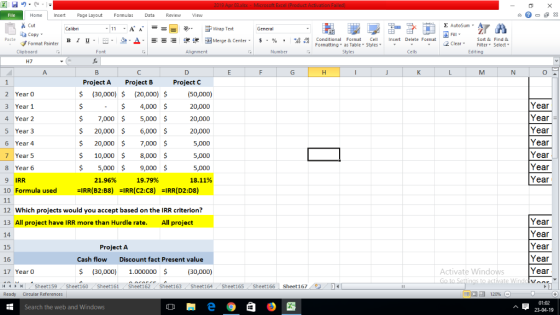
| Project A | |||
| Cash flow | Discount factor @ 15% | Present value | |
| Year 0 | $ (30,000) | 1.000000 | $ (30,000) |
| Year 1 | $ - | 0.869565 | $ - |
| Year 2 | $ 7,000 | 0.756144 | $ 5,293 |
| Year 3 | $ 20,000 | 0.657516 | $ 13,150 |
| Year 4 | $ 20,000 | 0.571753 | $ 11,435 |
| Year 5 | $ 10,000 | 0.497177 | $ 4,972 |
| Year 6 | $ 5,000 | 0.432328 | $ 2,162 |
| Net Present value | $ 7,012 | ||
| Project B | |||
| Cash flow | Discount factor @ 15% | Present value | |
| Year 0 | $ (20,000) | 1.000000 | $ (20,000) |
| Year 1 | $ 4,000 | 0.869565 | $ 3,478 |
| Year 2 | $ 5,000 | 0.756144 | $ 3,781 |
| Year 3 | $ 6,000 | 0.657516 | $ 3,945 |
| Year 4 | $ 7,000 | 0.571753 | $ 4,002 |
| Year 5 | $ 8,000 | 0.497177 | $ 3,977 |
| Year 6 | $ 9,000 | 0.432328 | $ 3,891 |
| Net Present value | $ 3,075 | ||
| Project C | |||
| Cash flow | Discount factor @ 15% | Present value | |
| Year 0 | $ (50,000) | 1.000000 | $ (50,000) |
| Year 1 | $ 20,000 | 0.869565 | $ 17,391 |
| Year 2 | $ 20,000 | 0.756144 | $ 15,123 |
| Year 3 | $ 20,000 | 0.657516 | $ 13,150 |
| Year 4 | $ 5,000 | 0.571753 | $ 2,859 |
| Year 5 | $ 5,000 | 0.497177 | $ 2,486 |
| Year 6 | $ 5,000 | 0.432328 | $ 2,162 |
| Net Present value | $ 3,171 | ||
| Which projects would you accept based on the NPV criterion | |||
| All projects have Positive Net present value. | All projects | ||
Add Answer to:
Senior management asks you to recommend a decision on which
project(s) to accept based on the...
Senior management asks you to recommend a decision on which project(s) to accept based on the...
Senior management asks you to recommend a decision on which project(s) to accept based on the cash flow forecasts provided.The firm uses a 3-year cutoff when using the payback method. The hurdle rate used to evaluate capital budgeting projects is 15%. Assume the projects are mutually exclusive and answer the following: Which project(s) would you accept based on the payback criterion? Which projects would you accept based on the IRR criterion? Which projects would you accept based on the NPV...
b) Assuming the projects are independent, which one(s) would you recommend? c) If the projects are...
 b) Assuming the projects are
independent, which one(s) would you recommend?
c) If the projects are mutually exclusive, which would you
recommend?
d) Notice that the projects have the same cash flow timing
pattern. Why is there a conflict between NPV and IRR?
A firm with a 14% WACC is evaluating two projects for this year's capital budget. After-tax cash flows, including depreciation, are as follows: 1 1 2 3 4 5 Project M Project N - $9,000 $3,000 -$27,000...
b) Assuming the projects are
independent, which one(s) would you recommend?
c) If the projects are mutually exclusive, which would you
recommend?
d) Notice that the projects have the same cash flow timing
pattern. Why is there a conflict between NPV and IRR?
A firm with a 14% WACC is evaluating two projects for this year's capital budget. After-tax cash flows, including depreciation, are as follows: 1 1 2 3 4 5 Project M Project N - $9,000 $3,000 -$27,000...
A firm with a 13% WACC is evaluating two projects for this year's capital budget. After-tax...
A firm with a 13% WACC is evaluating two projects for this year's capital budget. After-tax cash flows, including depreciation, are as follows: 0 1 2 3 4 5 Project M -$21,000 $7,000 $7,000 $7,000 $7,000 $7,000 Project N -$63,000 $19,600 $19,600 $19,600 $19,600 $19,600 Calculate NPV for each project. Round your answers to the nearest cent. Do not round your intermediate calculations. Project M $ Project N $ Calculate IRR for each project. Round your answers to two decimal places. Do...
A firm with a 13% WACC is evaluating two projects for this year's capital budget. After-tax...
A firm with a 13% WACC is evaluating two projects for this year's capital budget. After-tax cash flows, including depreciation, are as follows: 0 1 2 3 4 5 Project M $(21,000) $7,000 $7,000 $7,000 $7,000 $7,000 Project N $(63,000) $19,600 $19,600 $19,600 $19,600 $19,600 Calculate NPV for each project. Round your answers to the nearest cent. Do not round your intermediate calculations. Project M $ Project N $ Calculate IRR for each project. Round your answers to two decimal places. Do...
A firm with a 14% WACC is evaluating two projects for this year's capital budget. After-tax...
A firm with a 14% WACC is evaluating two projects for this year's capital budget. After-tax cash flows, including depreciation, are as follows: 0 1 2 3 4 5 Project M -$15,000 $5,000 $5,000 $5,000 $5,000 $5,000 Project N -$45,000 $14,000 $14,000 $14,000 $14,000 $14,000 Calculate NPV for each project. Do not round intermediate calculations. Round your answers to the nearest cent. Project M: $ Project N: $ Calculate IRR for each project. Do not round intermediate calculations. Round your answers to...
CAPITAL BUDGETING CRITERIA A firm with a 14% WACC is evaluating two projects for this year's...
 CAPITAL BUDGETING CRITERIA A firm with a 14% WACC is evaluating two projects for this year's capital budget. After-tax cash flows, including depreciation, are as follows: 0 1 2 5 Project M Project N - $30,000 $10,000 $10,000 $10,000 $10,000 $10,000 $90,000 $28,000 $28,000 $28,000 $28,000 $28,000 a. Calculate NPV for each project. Round your answers to the nearest cent. Do not round your intermediate calculations. Project M $ Project N $ Calculate IRR for each project. Round your answers...
6 Instructions Your manager wants you to evaluate two mutually exclusive projects. The cash flows of...
 6 Instructions Your manager wants you to evaluate two mutually exclusive projects. The cash flows of the project is given in the flowing tables. 8 Project 1 $ uomi Cash flow (30,000) 8,000 10,000 11,000 17,000 12,000 + Onm Project 2 Cash flow $ (15,000) 2,000 5,000 7,000 2,000 25,000 20 The required rate of return is 15%. The first step is too evaluate the project using NPV, IRR, payback rule 21 You will do so in each tab named...
value 10.00 points Consider the following projects Cash Flows (S) Project Co -2,800 -5,600 -7,000 2,800...
 value 10.00 points Consider the following projects Cash Flows (S) Project Co -2,800 -5,600 -7,000 2,800 2,800 2,800 2,800 2,500 2.800 2,800 2,800 2,800 8 5.800 a. If the opportunity cost of capital is 12%, which project(s) have a positive NPV? Positive NPV projects) O Project A O Project B O Project C O Projects A and B O Projects A and C Projects B and C O Projects A, B, and C O No project b. Calculate the payback...
JC Warehouse Corporation has estimated the cash flows of Projects A, B, and C as follows.
JC Warehouse Corporation has estimated the cash flows of Projects A, B, and C as follows. YearProject AlphaProject BetaProject Delta0-$100,000-$200,000-$100,000170,000130,00075,000270,000130,00060,000 Suppose the company requires a 12 percent return on investment.1.1 Calculate the payback period for each of the three projects.1.2 Calculate the NPV for each of the three projects.1.3 Calculate the profitability index for each of the three projects.1.4 Suppose these three projects are independent and the company has an unlimited amount of funds. If the company makes decision based...
Consider the following two mutually exclusive projects: Year CF of Project A CF of Project B...
Consider the following two mutually exclusive projects: Year CF of Project A CF of Project B 0 -$350,000 -$50,000 1 45,000 24,000 2 65,000 22,000 3 65,000 19,500 4 440,000 14,600 Whichever project you choose, if any, you require a 15 percent return on your investment. a)If you apply the payback (PB) criterion, which investment will you choose? Why? b)If you apply the NPV criterion, which investment will you choose? Why? c)If you apply the IRR criterion, which investment will...
 b) Assuming the projects are
independent, which one(s) would you recommend?
c) If the projects are mutually exclusive, which would you
recommend?
d) Notice that the projects have the same cash flow timing
pattern. Why is there a conflict between NPV and IRR?
A firm with a 14% WACC is evaluating two projects for this year's capital budget. After-tax cash flows, including depreciation, are as follows: 1 1 2 3 4 5 Project M Project N - $9,000 $3,000 -$27,000...
b) Assuming the projects are
independent, which one(s) would you recommend?
c) If the projects are mutually exclusive, which would you
recommend?
d) Notice that the projects have the same cash flow timing
pattern. Why is there a conflict between NPV and IRR?
A firm with a 14% WACC is evaluating two projects for this year's capital budget. After-tax cash flows, including depreciation, are as follows: 1 1 2 3 4 5 Project M Project N - $9,000 $3,000 -$27,000...
 CAPITAL BUDGETING CRITERIA A firm with a 14% WACC is evaluating two projects for this year's capital budget. After-tax cash flows, including depreciation, are as follows: 0 1 2 5 Project M Project N - $30,000 $10,000 $10,000 $10,000 $10,000 $10,000 $90,000 $28,000 $28,000 $28,000 $28,000 $28,000 a. Calculate NPV for each project. Round your answers to the nearest cent. Do not round your intermediate calculations. Project M $ Project N $ Calculate IRR for each project. Round your answers...
 6 Instructions Your manager wants you to evaluate two mutually exclusive projects. The cash flows of the project is given in the flowing tables. 8 Project 1 $ uomi Cash flow (30,000) 8,000 10,000 11,000 17,000 12,000 + Onm Project 2 Cash flow $ (15,000) 2,000 5,000 7,000 2,000 25,000 20 The required rate of return is 15%. The first step is too evaluate the project using NPV, IRR, payback rule 21 You will do so in each tab named...
 value 10.00 points Consider the following projects Cash Flows (S) Project Co -2,800 -5,600 -7,000 2,800 2,800 2,800 2,800 2,500 2.800 2,800 2,800 2,800 8 5.800 a. If the opportunity cost of capital is 12%, which project(s) have a positive NPV? Positive NPV projects) O Project A O Project B O Project C O Projects A and B O Projects A and C Projects B and C O Projects A, B, and C O No project b. Calculate the payback...
Most questions answered within 3 hours.
-
Where is the error in this code sequence?
String s1 = "Hello";
String s2 = "ello";...
asked 10 months ago -
Financial data for Joel de Paris, Inc., for last year
follow:
Joel de Paris, Inc.
Balance...
asked 10 months ago -
Consider this reaction:
Al2(SO4)3 (aq)+ BaCl3
(aq) Al2Cl6 (aq)- +
3BaSO4(s) . What is the...
asked 10 months ago -
Suppose that Savneet is considering increasing her
recent random sample from 20 car rentals to 40...
asked 10 months ago -
Trucks arrive at an unloading terminal at an average rate of 120
per hour.
Trucks arrive...
asked 10 months ago -
Why are methanol and ethanol completely soluble in water while
octanol is not very little soluble....
asked 10 months ago -
A facilities manager at a university reads in a research report
that the mean amount of...
asked 10 months ago -
When the CuSO4 is rehydrated by adding water to the anhydrous
compound, is this an endothermic...
asked 10 months ago -
A ray of sunlight is passing from diamond into crown glass; the
angle of incidence is...
asked 10 months ago -
A block of mass 0.249 kg is placed on top of a light, vertical
spring of...
asked 10 months ago -
how do the kidneys compensate in the presences of acidosis
a) trigger hyperventilate
b) reserve acid...
asked 10 months ago -
Question 501 pts
The rental rate of capital to the firm increases. Which of the
following...
asked 10 months ago