JavaScript 1) The function "hill" is implemented as follows: function hill(x) { return -2 * (x...
JavaScript
1) The function "hill" is implemented as follows:
function hill(x) {
return -2 * (x - 4) * (x - 16);
}
Write a function called quadratic that takes a constant factor and two roots and returns an anonymous function that computes that curve. In other words, quadratic(-2,4,16) should return an anonymous function that behaves the same as hill.
2) The function wrapString(inString, tag) is implemented as follows, so wrapString('foo','em') would return"<em>foo</em>"`:
function wrapString(inString, tag){
return "<" + tag + ">"+ inString + "</" + tag +
">";
}
Write a function called makeWrapper(tag) that returns a one-argument anonymous function that wraps a string with the given tag.
Write a function called wrapStrings that takes an array of strings and a tag (a string), and returns an array of strings where each is wrapped with the given tag. Use the map() method and the makeWrapper function.
Homework Answers
Solution:)
function quadratic(a,b,c){
return function(x){
return a * (x - b) * (x - c);
}
}
function makeWrapper(tag){
return function(inString){
return "<" + tag + ">"+
inString + "</" + tag + ">";
}
}
function wrapStrings(strings,tag){
return strings.map(makeWrapper(tag));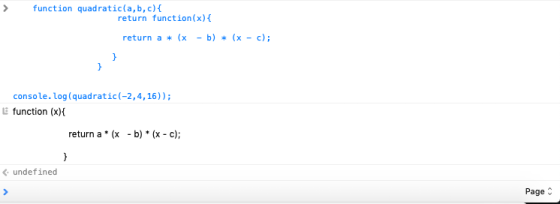
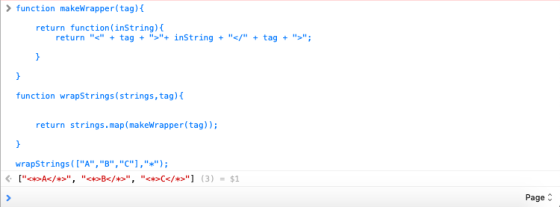
}
Add Answer to:
JavaScript
1) The function "hill" is implemented as follows:
function hill(x) {
return -2 * (x...
write an algorithm function called balance() in javascript that takes in a string and returns a...
write an algorithm function called balance() in javascript that takes in a string and returns a strinf with balanced parantheses only. the string should be able to contain only parantheses, numbers, and letters. include comments of each portion of your code balance(“()()”) should return “()()” balance(“())”) should return “()” balance(“a(b)c”) should return “a(b)c” balance(“a(b)c())”) should return “a(b)c()”
Create a function in JavaScript called "sum" that takes in an array as a parameter and...
Create a function in JavaScript called "sum" that takes in an array as a parameter and returns the sum of all of the EVEN numbers in a given array. Please note: the array passed in can have any data type, i.e. Strings, Numbers, Booleans, undefined, etc. HINT: the expression typeof will help discern var types. For example if I have: var x = 4, and I do typeof(x) - the output would be "Number" Example run: sum([1, 4, 8, 10,...
write C code that uses pointers, arrays, and C strings. 3. Write a function called pow_xy....
write C code that uses pointers, arrays, and C strings. 3. Write a function called pow_xy. The function should be passed 2 parameters, as illustrated in the prototype below. int pow_xy(int *xptr, int y); Assuming that xptr contains the address of variable x, pow_xy should compute x to the y power, and store the result as the new value of x. The function should also return the result. Do not use the built-in C function pow. For the remaining problems,...
JavaScript 1. Write a function which receives one argument (string) and converts the string to uppercase....
JavaScript 1. Write a function which receives one argument (string) and converts the string to uppercase. function('abc') // returns 'ABC' 2. Write a function that accepts an array and a value. Find and return the first array element with bigger than given value. function([5,15,4],6) //returns 15 DO NOT USE THESE IN-BUILT FUNCTIONS BELOW endsWith() includes() indexOf() lastIndexOf() localeCompare() match() repeat() replace() search() slice() split() startsWith() substr() substring() toLocaleLowerCase() toLocaleUpperCase() toLowerCase() toString() toUpperCase() trim() valueOf() trimLeft and trimRight unshift() valueOf() includes()...
Check is 2-CNF satisfiable? Return one of its satisfying assignments.
The input is a Boolean formula in 2-CNF, given as a string of symbols.Example: p /\ (p -> q) /\ (p -> ~r) /\ (~r \/ ~s) /\ (s \/ ~q)1) check whether the given 2-CNF is satisfiable.2) given a 2-CNF, report that it is not satisfiable or return one of its satisfying assignments.Solution in Python3For the first task, you should implement a function called is_satisfiable, which takes the string with the 2-CNF as an argument and returns either True (satisfiable) or False (not satisfiable). The second task...
Note that the main function that I have provided does use <string.h> as it constructs test...
Note that the main function that I have provided does use <string.h> as it constructs test strings to pass to your functions. However, your solutions for the 5 functions below may not use any of the built-in C string functions from the <string.h> library. Write a function called strcmp373. This function is passed two parameters, both of which are C strings. You should use array syntax when writing this function; that is, you may use [ ], but not *...
1. Write a Lisp function called piece which takes a single argument x and implements the followin...
 1. Write a Lisp function called piece which takes a single argument x and implements the following piecewise linear function: piece(x) = x if 0 < x < 1 2. Write a Lisp function called intList which takes two integer arguments, a and b and returns the list of all integers from a to b (inclusive at both ends). For example, (intList 3 8) should return (345678)
1. Write a Lisp function called piece which takes a single argument x...
1. Write a Lisp function called piece which takes a single argument x and implements the following piecewise linear function: piece(x) = x if 0 < x < 1 2. Write a Lisp function called intList which takes two integer arguments, a and b and returns the list of all integers from a to b (inclusive at both ends). For example, (intList 3 8) should return (345678)
1. Write a Lisp function called piece which takes a single argument x...
2. The roots of the quadratic $a x^2 + b x + c$ are given by...
2. The roots of the quadratic $a x^2 + b x + c$ are given by $$\frac{-b \pm \sqrt{b^2-4ac}}{2a}$$ If $b^2-4ac <0$, the quadratic has no real roots. Write a function to calculate the real roots of a quadratic. The function should have 3 arguments, *a*, *b* and *c*. If $b^2-4ac <0$, the function should print "quadratic has no real roots", and then return(NULL). Otherwise, the function should return a vector of length 2, those being the real roots (which...
Problem 1 In this problem, you will write two functions. The first function takes in a...
Problem 1 In this problem, you will write two functions. The first function takes in a string and returns that string without any dashes. The second function takes in the first and last name and returns a string that is lastname_firstname and uses the previous function to remove any dashes (-) in the name. Note that you’ll be testing it by calling it from the command line; you’ll call it from a script in problem 3. Deliverables: Function file that...
IT Review JAVASCRIPT (Can someone please help me answer the below questions. It would be nice...
IT Review JAVASCRIPT (Can someone please help me answer the below questions. It would be nice if you add comments explaining what you are doing? If unable to add comments the answer would be fantastic. Thank you. Given the following function definition: function percent(x) { return x / 100; } Which of the following statements correctly calls the percent function: percent(10); percent: 10; percent(); percent = 10; Indicate whether each of the following evaluates to true or false, given...
 1. Write a Lisp function called piece which takes a single argument x and implements the following piecewise linear function: piece(x) = x if 0 < x < 1 2. Write a Lisp function called intList which takes two integer arguments, a and b and returns the list of all integers from a to b (inclusive at both ends). For example, (intList 3 8) should return (345678)
1. Write a Lisp function called piece which takes a single argument x...
1. Write a Lisp function called piece which takes a single argument x and implements the following piecewise linear function: piece(x) = x if 0 < x < 1 2. Write a Lisp function called intList which takes two integer arguments, a and b and returns the list of all integers from a to b (inclusive at both ends). For example, (intList 3 8) should return (345678)
1. Write a Lisp function called piece which takes a single argument x...
Most questions answered within 3 hours.
-
Where is the error in this code sequence?
String s1 = "Hello";
String s2 = "ello";...
asked 10 months ago -
Financial data for Joel de Paris, Inc., for last year
follow:
Joel de Paris, Inc.
Balance...
asked 10 months ago -
Consider this reaction:
Al2(SO4)3 (aq)+ BaCl3
(aq) Al2Cl6 (aq)- +
3BaSO4(s) . What is the...
asked 10 months ago -
Suppose that Savneet is considering increasing her
recent random sample from 20 car rentals to 40...
asked 10 months ago -
Trucks arrive at an unloading terminal at an average rate of 120
per hour.
Trucks arrive...
asked 10 months ago -
Why are methanol and ethanol completely soluble in water while
octanol is not very little soluble....
asked 10 months ago -
A facilities manager at a university reads in a research report
that the mean amount of...
asked 10 months ago -
When the CuSO4 is rehydrated by adding water to the anhydrous
compound, is this an endothermic...
asked 10 months ago -
A ray of sunlight is passing from diamond into crown glass; the
angle of incidence is...
asked 10 months ago -
A block of mass 0.249 kg is placed on top of a light, vertical
spring of...
asked 10 months ago -
how do the kidneys compensate in the presences of acidosis
a) trigger hyperventilate
b) reserve acid...
asked 10 months ago -
Question 501 pts
The rental rate of capital to the firm increases. Which of the
following...
asked 10 months ago