A molecule cannot be polar if: a. It has a center of inversion b. It has...
A molecule cannot be polar if:
a. It has a center of inversion
b. It has no center of inversion
c. Its dipole moment lies perpendicular to any mirror plane or rotation axis of the molecule
Homework Answers
Request Answer!
We need at least 10 more requests to produce the answer.
0 / 10 have requested this problem solution
The more requests, the faster the answer.
Add Answer to:
A molecule cannot be polar if:
a. It has a center of inversion
b. It has...
The exclusion rule states that: a. If a molecule has a center of inversion, then all...
The exclusion rule states that: a. If a molecule has a center of inversion, then all of its modes can be both IR and Raman active b. If a molecule has a center of inversion, then some of its modes can be both IR and Raman active c. If a molecule has a center of inversion, then none of its modes can be both IR and Raman active
Select the correct statement: a. Some of the most important symmetry operations include: identity, mirror plane,...
Select the correct statement: a. Some of the most important symmetry operations include: identity, mirror plane, center of inversion, n-fold rotation, and reflection b. Some of the most important symmetry operations include: identity, n-fold rotation, reflection, inversion, and n-fold rotation with reflection in a plane perpendicular to the rotation axis c. Some of the most important symmetry operations include: n-fold symmetry axis, "whole of space", mirror plane, center of inversion, and n-fold axis of improper rotation
Question 16 Is the H2SO molecule polar? If it is, what is the direction of its...
 Question 16 Is the H2SO molecule polar? If it is, what is the direction of its total dipole moment? polar, dipole along H-H axis polar, dipole along H-S axis nonpolar polar, dipole along S-O axis Not saved
What is the main rotation axis for mer-CoCl3(CO)3? C2, C3, C4, or C6? Which of the...
What is the main rotation axis for mer-CoCl3(CO)3? C2, C3, C4, or C6? Which of the following additional symmetry elements does mer-CoCl3(CO)3 have? C2 perpendicular? Vertical mirror plane (sigma-v/d)? Horizontal mirror plane (sigma-h)? Center of inversion? Improper rotation? What is the point group for mer-CoCl3(CO)3?
Explain why carbon tetrachloride is a non polar (has a net zero dipole moment) molecule while...
Explain why carbon tetrachloride is a non polar (has a net zero dipole moment) molecule while chloroform is polar molecule.
How do you determine whether a molecule is polar? Choose all that apply. Determine whether the molecule has...
 How do you determine whether a molecule is polar? Choose all that apply. Determine whether the molecule has resonance structures. Determine whether the molecule contains nonpolar bonds. Draw the Lewis structure for the molecule and determine the molecular geometry. Determine whether the polar bonds add together to form a net dipole moment. Determine whether the molecule contains polar bonds.
10. (10 pts.) A trigonal planar molecule, AB,C, has three polar bonds. The A-B bonds and...
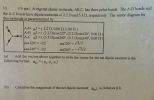 10. (10 pts.) A trigonal planar molecule, AB,C, has three polar bonds. The A-B bonds and the A-C bonds have dipole moments of 2.2 D and 5.3 D, respectively. The vector diagram for this molecule is parameterized by: B A-B ul =( 2.2 D, 0.00 D, 0.00 D) A-B u2 =((2.2 D)cos 120°, (2.2 D) sin 120°, 0.00 D) B A-C u3 =((5.3 D)cos240°, (5.3 D)sin240°, 0.00 D) cos 120° = -1/2 cos240° = -1/2 Add the vectors above together...
What is the main rotation axis for Trans - CoCl2(NH3)4? NOTE: don't consider the H's C2, C3,...
What is the main rotation axis for Trans - CoCl2(NH3)4? NOTE: don't consider the H's C2, C3, C4, or C6 Which of the following additional symmetry elements does Trans - CoCl2(NH3)4 have? C2 perpendicular (yes or no)? Vertical mirror plane (sigma-v) (yes or no)? Horizontal mirror plane (sigma-h) (yes or no)? Center of inversion (yes or no)? Improper rotation (yes or no)? What is the point group for trans - CoCl2(NH3)4 ? C2v, C3v, C4v, D2d, D3d, D4d, D3h, D4h
A CO2 molecule contains two polar bonds, but the net dipole moment is zero. It is because
A CO2 molecule contains two polar bonds, but the net dipole moment is zero. It is because (a) the molecule has symmetrical linear geometry and dipole moments cancel out each other (b) the molecule is non-linear (c) the electronegativity difference between the two atoms is too large (d) the electronegativity difference between the two atoms is too small
Four point particles, each with mass 1/4m, are connected by massless rods so that they form...
Four point particles, each with mass 1/4m, are connected by massless rods so that they form a square whose sides have length a. A) what is the moment of inertia I (COR) of this object if it is spun around an axis going through the center of the square perpendicular to the plane of the square?(COR: Center Of Rotation) B) what would be the moment of inertia I (AOR) of the square if it were spun around axis going through...
 Question 16 Is the H2SO molecule polar? If it is, what is the direction of its total dipole moment? polar, dipole along H-H axis polar, dipole along H-S axis nonpolar polar, dipole along S-O axis Not saved
 How do you determine whether a molecule is polar? Choose all that apply. Determine whether the molecule has resonance structures. Determine whether the molecule contains nonpolar bonds. Draw the Lewis structure for the molecule and determine the molecular geometry. Determine whether the polar bonds add together to form a net dipole moment. Determine whether the molecule contains polar bonds.
 10. (10 pts.) A trigonal planar molecule, AB,C, has three polar bonds. The A-B bonds and the A-C bonds have dipole moments of 2.2 D and 5.3 D, respectively. The vector diagram for this molecule is parameterized by: B A-B ul =( 2.2 D, 0.00 D, 0.00 D) A-B u2 =((2.2 D)cos 120°, (2.2 D) sin 120°, 0.00 D) B A-C u3 =((5.3 D)cos240°, (5.3 D)sin240°, 0.00 D) cos 120° = -1/2 cos240° = -1/2 Add the vectors above together...
Most questions answered within 3 hours.
-
Where is the error in this code sequence?
String s1 = "Hello";
String s2 = "ello";...
asked 10 months ago -
Financial data for Joel de Paris, Inc., for last year
follow:
Joel de Paris, Inc.
Balance...
asked 10 months ago -
Consider this reaction:
Al2(SO4)3 (aq)+ BaCl3
(aq) Al2Cl6 (aq)- +
3BaSO4(s) . What is the...
asked 10 months ago -
Suppose that Savneet is considering increasing her
recent random sample from 20 car rentals to 40...
asked 10 months ago -
Trucks arrive at an unloading terminal at an average rate of 120
per hour.
Trucks arrive...
asked 10 months ago -
Why are methanol and ethanol completely soluble in water while
octanol is not very little soluble....
asked 10 months ago -
A facilities manager at a university reads in a research report
that the mean amount of...
asked 10 months ago -
When the CuSO4 is rehydrated by adding water to the anhydrous
compound, is this an endothermic...
asked 10 months ago -
A ray of sunlight is passing from diamond into crown glass; the
angle of incidence is...
asked 10 months ago -
A block of mass 0.249 kg is placed on top of a light, vertical
spring of...
asked 10 months ago -
how do the kidneys compensate in the presences of acidosis
a) trigger hyperventilate
b) reserve acid...
asked 10 months ago -
Question 501 pts
The rental rate of capital to the firm increases. Which of the
following...
asked 10 months ago